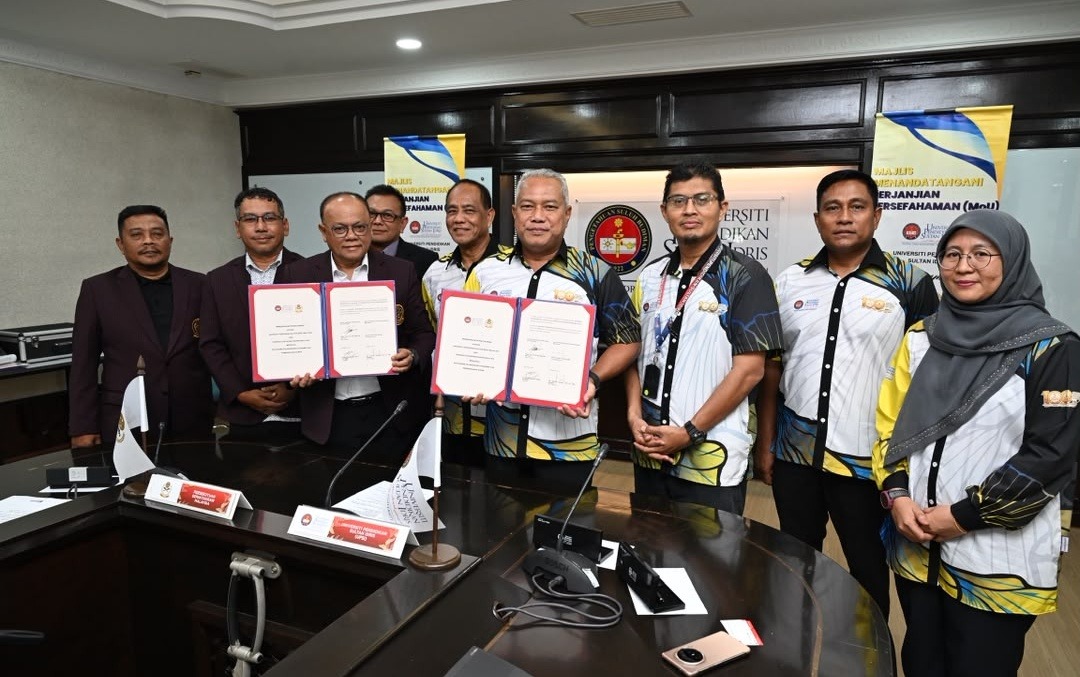
Universiti Pendidikan Sultan Idris (UPSI) has formalized a strategic alliance with the Malaysian Sepaktakraw Federation (PSM) aimed at transforming how the nation develops elite athletes whilst maintaining their academic progress. The Memorandum of Understanding, signed at UPSI's Sultan Abdul Jalil Shah Campus in Tanjong Malim, represents a significant step in integrating professional sports development with higher education in Malaysia, a model increasingly vital as countries across Southeast Asia compete for athletic excellence.
The three-year agreement, with provisions for renewal by mutual consent, establishes a framework through which UPSI will provide flexible educational programmes tailored to accommodate the demanding schedules of national and state-level sepak takraw competitors. Vice-Chancellor Prof Datuk Dr Md Amin Md Taff emphasized that this collaboration transcends ceremonial gesture, positioning itself as a blueprint for concrete initiatives that serve both institutional objectives and broader national sporting ambitions. The partnership acknowledges a critical tension in sports development: talented athletes often face binaries between pursuing education and competitive excellence, a challenge that Southeast Asian sports programmes have historically struggled to resolve.
Under the MoU's parameters, UPSI commits to enrolling PSM-affiliated athletes across all study levels, provided applicants meet established academic standards. This conditional approach maintains institutional integrity whilst demonstrating practical commitment to athlete welfare. The university will furthermore extend its technical infrastructure, encompassing sports science expertise, coaching development, officiating training, and sports technology resources. Such comprehensive support reflects recognition that contemporary sepak takraw—a sport historically rooted in Malaysian and Southeast Asian culture—now demands scientific rigour alongside traditional technique to remain competitive internationally.
The partnership specifically targets talent identification and nurturing pathways for competitors drawn from Malaysian Sports Schools and State Sports Schools. By creating formal mechanisms for these young athletes to transition into university education without abandoning their sporting trajectories, UPSI and PSM address a persistent gap in national sports infrastructure. This has implications beyond sepak takraw; should the collaboration prove successful, it could catalyse similar partnerships across other Malaysian sports, from badminton to table tennis, where educational discontinuity has occasionally disrupted athlete development pipelines.
Central to the initiative is establishment of a national training centre dedicated exclusively to sepak takraw. Such a facility would consolidate coaching expertise, sports science support, and athlete welfare services into one coordinated ecosystem. The centre's creation symbolizes Malaysia's renewed commitment to sepak takraw at a time when the sport faces growing competition from other Southeast Asian nations in regional championships and Asian Games competitions. Infrastructure investments of this nature are essential for maintaining Malaysia's traditional dominance in a sport where the country has historically fielded world-class competitors.
PSM Vice-President Tengku Zaihan Che Ku Abdul Rahman characterized the collaboration as providing athletes with unprecedented security in their educational pursuits. Rather than forcing choices between scholarship competitions and sports careers, the MoU enables dual progression. This perspective carries weight for Malaysian athlete retention; brain drain in sports talent—where gifted competitors relocate abroad for combined athletic and educational opportunities—has subtly eroded domestic competitive depth in recent years. By offering competitive conditions domestically, UPSI and PSM directly counter this trend.
The knowledge-sharing dimension of the partnership proves equally significant. UPSI brings institutional expertise in sports science, physiology, nutrition, and performance analysis—fields requiring advanced research infrastructure and academic rigour. PSM contributes technical knowledge accumulated through decades of competition management and athlete development. This complementary exchange creates conditions for genuine innovation; for instance, sports science researchers could analyse sepak takraw movements with biomechanical precision, potentially identifying training optimizations unavailable through experiential coaching alone. Such synergy between academic research and practical sporting knowledge remains underdeveloped in many Southeast Asian sports contexts.
The anticipated Memorandum of Agreement (MoA) signals ambitions extending beyond the current framework. Such a detailed successor document would likely operationalize specific targets: athlete graduation rates, training centre performance metrics, coaching certification benchmarks, and research output measures. This progression from principles-based MoU to performance-based MoA reflects mature institutional thinking and accountability consciousness. Malaysian sports bodies have occasionally signed frameworks lacking measurable outcomes; this partnership's structured approach to evolution suggests organizational seriousness.
Tengku Zaihan's hope that the collaboration serve as a reference model for other national sports bodies carries strategic significance. Malaysia hosts multiple federation-university relationships, but few have achieved the clarity and comprehensiveness evident here. Should UPSI and PSM successfully demonstrate how higher education institutions and sports federations can co-develop athlete talent, competitive legitimacy, and institutional credibility simultaneously, other partnerships will inevitably follow. Badminton, diving, and weightlifting federations may model subsequent arrangements on this framework.
For Malaysian athletes, the partnership offers tangible benefits: financial support through university enrolment, structured coaching progression, access to sports medicine and injury management, and qualification-backed pathways into coaching and officiating careers post-retirement. These provisions address a critical gap: athletes in developing sports systems frequently face retirement without career alternatives, creating financial precarity. By anchoring athletic careers within university education, UPSI and PSM provide economic scaffolding that extends athlete livelihoods beyond competition years.
The timing of this MoU proves strategically astute. Regional sporting competitions in the coming years—particularly Asian Games and Southeast Asian Games cycles—will showcase sepak takraw prominently. A revitalized national development system, combining university infrastructure with federation expertise, positions Malaysian athletes to defend traditional dominance whilst competing against increasingly sophisticated programmes from Indonesia, Thailand, and Vietnam. These nations have invested substantially in sports science integration and athlete welfare systems; Malaysia's partnership represents competitive response rather than isolationist choice.
Beyond immediate competitive implications, the UPSI-PSM collaboration reflects evolving Malaysian thinking about sports' role in national development. Contemporary policy increasingly recognizes that elite athletic achievement and mass participation, research advancement and athlete welfare, educational achievement and sporting excellence need not exist in tension. This partnership operationalizes that recognition, creating institutional mechanisms through which seemingly competing objectives strengthen rather than undermine each other. Success here could inform how Malaysia approaches sports development more broadly.

