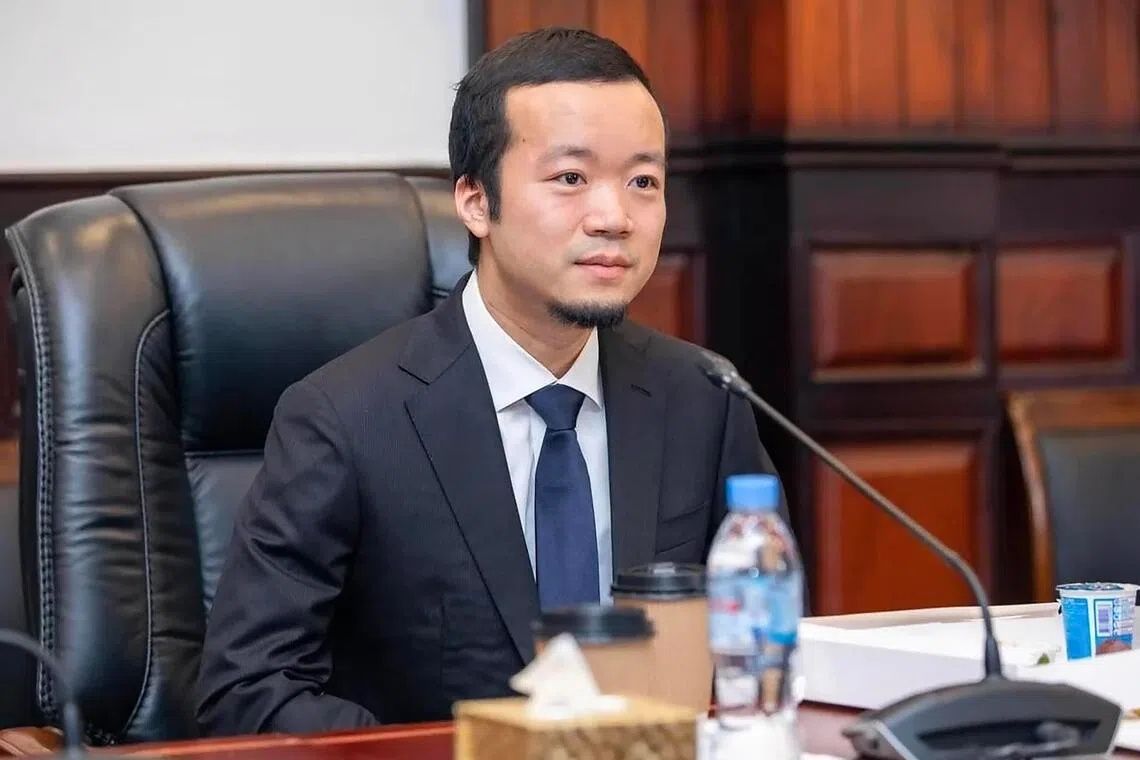
The identity of the second co-conspirator in one of the world's largest financial fraud operations has been revealed following an international investigation that pieced together corporate records across multiple countries. Chen Sokly, born Chen Xing in Shanghai in 1986, served as a critical operative in the multi-billion dollar Prince Holding Group syndicate led by scam kingpin Chen Zhi, according to a criminal indictment filed in New York on October 8, 2025. Working over six months, The Straits Times and the Organised Crime and Corruption Reporting Project (OCCRP) combed through hundreds of official documents to unmask the Shanghai-born conspirator who obtained Cambodian citizenship around late 2017 and later acquired a second nationality in Cyprus.
Sokly's role within the Prince Holding Group was deceptively straightforward on paper yet extraordinarily consequential in practice. As the syndicate's risk control officer, he was responsible for monitoring law enforcement investigations targeting the group's operations and facilitating corrupt negotiations with government officials worldwide. The indictment alleges that in May 2023, Sokly communicated with a Chinese government official who promised to shield Prince Group members from legal consequences. In return, Sokly offered to provide financial support for the official's son. His confidence in these relationships proved remarkable; internal documents reveal that Sokly and Chen Zhi regularly discussed the number of officials within the organization's sphere of influence. A ledger of bribes allegedly maintained by Chen Zhi showed that in 2019 alone, Sokly purchased a yacht valued at more than US$3 million as a gift for a foreign government official.
The sophistication of Sokly's operations extended beyond bribery into direct extortion and violence. Prosecutors allege that Sokly directed a Chinese official to instruct local police officers to extort businesses on behalf of the Prince Group, demonstrating the depth of corruption the syndicate had cultivated. When the syndicate faced challenges from authorities cracking down on scam compounds in Cambodia, Sokly's confidence in his network was so absolute that he dismissed concerns, insisting nothing would happen to the organization. Later, in July 2024, Chen Zhi explicitly tasked Sokly with enforcing discipline within the group by handling a member who had stolen funds. Sokly's position as the syndicate's enforcer became increasingly apparent through his actions and the deference shown to him by other operatives.
The financial footprint Sokly left across multiple jurisdictions reveals the extraordinary wealth generated by the Prince Group's illicit activities. He purchased a residential property in California in 2019 for approximately US$4.5 million, acquiring it from Fang Zhizhen, a member of the Knight Attack Group, a cybercriminal organization predating the Prince Group. Between 2019 and 2024, Sokly maintained ownership of multiple high-value properties, eventually selling the California home for around US$4.5 million. In a move that appeared timed to circumvent anticipated sanctions, Sokly transferred a separate US$4 million property to his wife on November 4, 2025, just weeks after sweeping financial sanctions were imposed. The property was subsequently placed in a trust controlled by his wife in December 2025, a common strategy to shield assets from government seizure.
Sokly's entry into Singapore's upper-class residential market occurred in 2017 with the purchase of a luxury apartment at 10 Leedon Heights for S$11 million (approximately US$8.61 million), occupying 5,694 square feet. The acquisition signaled his arrival as an ostensibly legitimate businessman, establishing what investigators later recognized as a base for operations in Southeast Asia's financial hub. Shortly after securing the Leedon Heights residence, Sokly incorporated his first Singapore company, M Capital Global Holdings, partnering with his wife in a joint investment of just over S$5 million. The couple remained registered shareholders throughout the investigation period, maintaining formal ownership despite Sokly's increasing operational focus in other jurisdictions.
During the subsequent two years, Sokly systematically established himself as a director across at least 16 Singapore-registered firms, creating an intricate web of corporate entities. Between 2020 and 2023, his name was gradually removed from most of these companies, a pattern consistent with efforts to obscure his direct involvement as authorities began scrutinizing the Prince Group's global operations. Multiple firms listing Sokly as director shared a registered address at Shenton Way, though when investigators visited the location, an electronic directory showed two unrelated companies occupying a single office on the 12th floor with no apparent connection to Sokly or his business interests. The discrepancy suggests the address was maintained as a convenience or administrative cover rather than as an actual operational hub.
Former employees who worked alongside Sokly painted a picture of a privileged operative who maintained a compartmentalized existence between jurisdictions. These individuals, speaking on condition of anonymity, described how Sokly typically spent between two and three months annually in Singapore, using his evenings to socialize with associates including Chen Zhi himself. His material lifestyle reflected his access to syndicate resources, with a fleet of vehicles including a Bentley and a seven-seater luxury automobile stored at his Leedon Heights residence. This residential base provided the necessary infrastructure for entertainment, meetings, and the display of wealth that signaled success and trustworthiness within the criminal network.
The indictment alleges that throughout his tenure in the Prince Group, Sokly boasted about the syndicate's extraordinary revenue generation, claiming the global operation was generating approximately US$30 million daily through illicit activities. This figure underscores the massive scale of the operation that relied on forced labor in Cambodian scam compounds where victims were coerced into perpetrating investment fraud schemes against international targets. The Prince Holding Group's business model fundamentally depended on enslaving workers in compounds where they conducted fraudulent cryptocurrency and investment schemes, with Sokly's role ensuring that authorities could not penetrate or disrupt the operation through his network of corrupted officials.
The US government's response to the investigation was decisive and historically significant. The indictment led to the forfeiture of 127,271 bitcoins valued at approximately US$15 billion at the time of seizure, representing one of the largest financial recoveries in a single case. The US dropped sanctions against Chen Zhi, the Prince Holding Group, and affiliated entities six days after the indictment was filed, indicating that the legal proceedings constituted the primary enforcement mechanism once financial assets had been identified and seized. The sanctions removal did not signify innocence but rather reflected the completion of the formal legal process and asset recovery from entities that prosecutors could no longer operate.
Sokly's exposure through this investigation carries significant implications for regional financial oversight, particularly in Singapore where the city-state's reputation as a banking and corporate headquarters hub faces persistent challenges from sophisticated money laundering schemes. The revelation that a high-profile property owner and shell company operator conducted illicit activities while maintaining a substantial legitimate profile raises questions about verification gaps in corporate registration and property acquisition processes. Sokly's ability to establish 16 corporate entities across Singapore while simultaneously managing international criminal operations demonstrates how jurisdictions can be exploited when due diligence processes rely primarily on submitted documentation rather than cross-border intelligence sharing.
The investigation reveals how criminal syndicates structure assets across multiple jurisdictions to maximize legal ambiguity and minimize seizure risk. Sokly's pattern of establishing companies, deploying them for short operational periods, and then removing his name created barriers to attribution while allowing him to maintain beneficial interest through trust structures and family relationships. For Malaysia and other Southeast Asian nations, the case underscores the vulnerability of the region's financial systems to infiltration by international criminal networks that exploit regulatory differences between jurisdictions. The Prince Group's establishment of scam compounds in Cambodia while maintaining financial operations across Singapore, the US, and China demonstrates how regional crime increasingly transcends traditional geographical boundaries.
The broader significance of Sokly's unmasking extends beyond the Prince Group itself to illuminate the network structures that international criminal organizations employ. By identifying his dual nationalities, multiple aliases, and tiered financial holdings, investigators have developed a template for understanding how transnational crime works in practice. Sokly's brazen confidence in his protection network, exemplified by his dismissal of Cambodian police actions as inconsequential, reflects a calculation that corruption at multiple levels of government could insulate the operation indefinitely. The ultimate failure of that strategy demonstrates that international cooperation, coordinated asset tracking, and persistent investigative work can overcome even deeply embedded criminal networks supported by corrupted officials.

