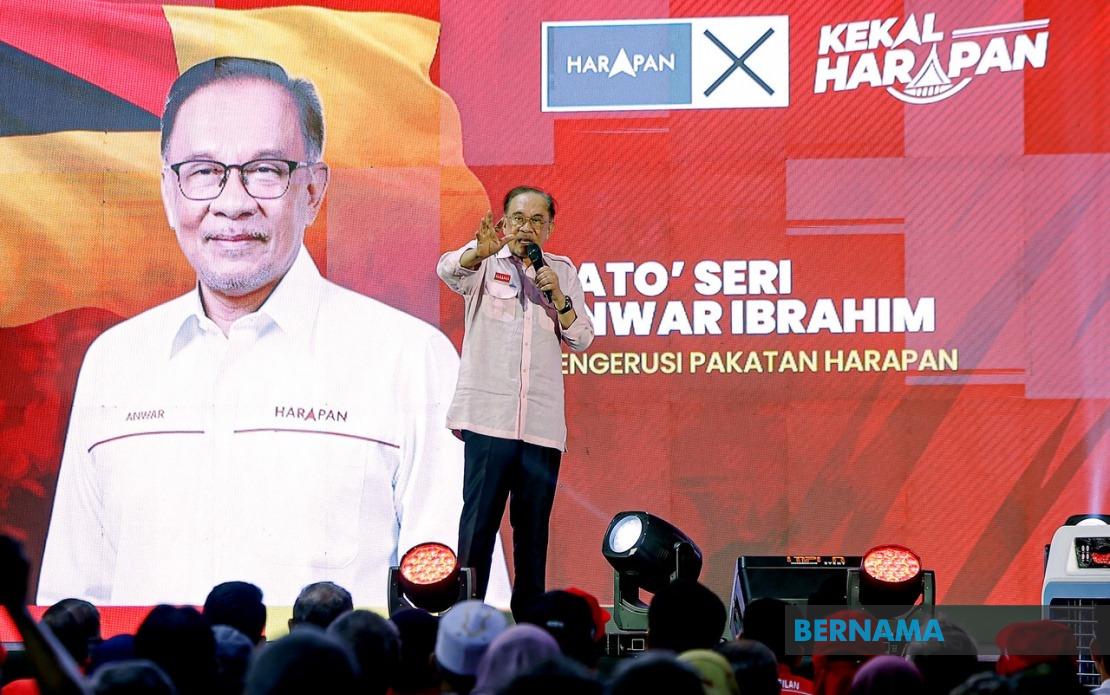
Prime Minister Datuk Seri Anwar Ibrahim has reiterated his commitment to preserving the stability of the Unity Government at the federal level, emphasising that the coalition's cohesion is essential for sustaining economic momentum and attracting foreign investment. Speaking in Seremban on July 22, the premier sought to reassure stakeholders that despite political tensions that may emerge across different states, the federal administration remains on solid footing with no immediate threats to its structural integrity.
The Prime Minister underscored that the various constituent parties within the Unity Government maintain effective working relationships at the national level, a harmony that translates into efficient governance and policy execution. He pointed to the consistent convening of Cabinet meetings as concrete evidence of this operational stability, noting that these sessions proceed smoothly and regularly notwithstanding the inevitable competition that these same parties engage in when pursuing their respective interests at the state level.
Anwar drew a deliberate distinction between the political dynamics operating at different territorial levels, acknowledging that state elections naturally introduce competitive pressures among coalition partners. However, he framed this as a manageable phenomenon that does not fundamentally undermine the federal arrangement. The implicit suggestion is that healthy competition within individual states need not destabilise the broader national architecture, provided that political leaders maintain strategic discipline and compartmentalise their respective territorial ambitions.
Recent Cabinet proceedings serve as the centrepiece of the Prime Minister's argument regarding governmental stability. He referenced his direct engagement with key ministerial figures including Minister of Agriculture and Food Security Datuk Seri Mohamad Sabu, Transport Minister Anthony Loke, and Deputy Prime Minister Datuk Seri Dr Ahmad Zahid Hamidi. The deliberate mention of these specific leaders and the normalcy with which they conduct collective business suggests an administration functioning according to established protocols and demonstrating no signs of factional breakdown.
The emphasis on investor confidence represents a critical strategic concern for the Malaysian administration. Foreign and domestic capital flows depend significantly on perceptions of political stability and governmental continuity. Any suggestion of fracturing within the ruling coalition could trigger capital flight, currency volatility, and reduced appetite for new foreign direct investment. By projecting an image of federal solidity, Anwar seeks to inoculate Malaysia's investment environment against external doubts about political durability.
The Prime Minister's comments reflect an understanding that governance effectiveness in a multi-ethnic, multi-party democracy requires the maintenance of institutional separation between partisan competition and collective policy-making. The Unity Government's formation following the 2022 elections represented a pragmatic acknowledgement that no single coalition could command parliamentary majorities without incorporating diverse political forces. This structural reality means that electoral competition among coalition partners at the state level becomes an inevitable feature rather than an aberration.
For Malaysian voters and observers, the distinction Anwar articulates carries significant implications. It suggests that the federal government intends to proceed with its economic agenda—including pursuing targeted investment initiatives, infrastructure projects, and monetary policy adjustments—without the internal disruptions that have occasionally affected previous administrations. The maintenance of cabinet-level coordination signals that departmental coordination on complex policy matters requiring cross-ministerial input should proceed without obstruction.
The broader Southeast Asian context adds weight to Anwar's reassurances. Regional investors and international financial institutions monitor the stability of ASEAN's largest economies closely, given the importance of Malaysia within regional supply chains and investment networks. Any perception of federal-level political instability could influence regional economic flows and alter assessments of Malaysia's competitive positioning relative to neighbouring economies such as Thailand, Indonesia, and Vietnam. The Prime Minister's public affirmation of stability serves therefore as a signal directed not only at domestic constituencies but also at regional and global economic actors.
Looking ahead, the sustainability of this stability will likely depend on how effectively coalition partners manage their competing interests as elections cycle through various state contests. Historical patterns suggest that such arrangements prove most durable when leadership maintains clear boundaries between partisan competition and joint governance obligations. The explicit framing offered by the Prime Minister appears designed to establish exactly such boundaries, creating space for electoral competition while insulating core governmental functions from factionalism.
The timing of Anwar's remarks also warrants consideration, as they come amid ongoing electoral schedules across Malaysian states. By making explicit statements about federal stability now, the Prime Minister pre-emptively addresses concerns that might otherwise build during campaign periods when coalition members necessarily emphasise their distinct party identities and policy platforms. This proactive communication strategy represents an attempt to shape narratives about governmental cohesion before alternative interpretations can take hold among investors, international observers, and the domestic electorate.

