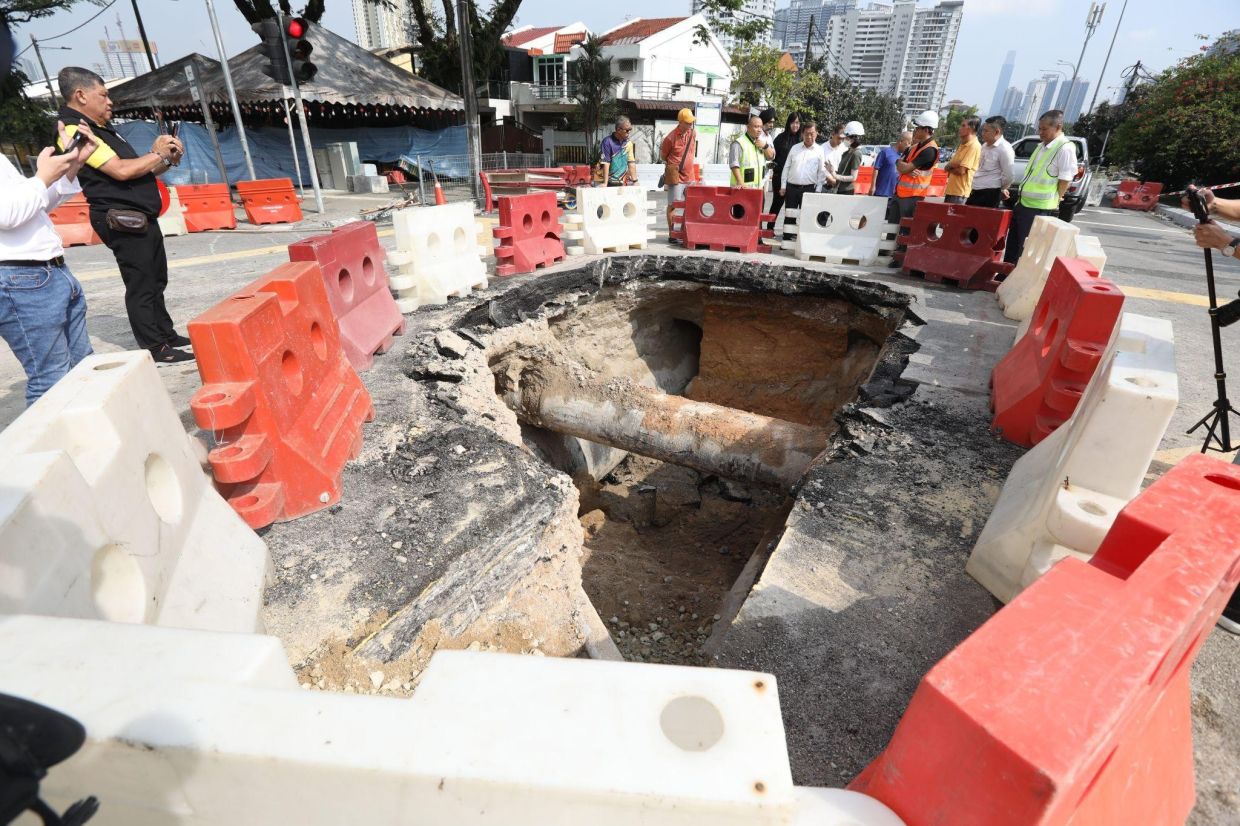
Malaysia's urban landscape faces a growing menace lurking beneath the surface. As the country experiences increasingly severe and unpredictable rainfall patterns, the risk of sinkholes has become a pressing concern for infrastructure managers nationwide. The challenge extends beyond simple maintenance—it reflects a fundamental shift in how authorities must adapt critical underground systems to withstand climate volatility that traditional designs were never intended to handle.
Sinkholes emerge from a complex interplay of geological and man-made factors working in concert to destabilise ground beneath cities and towns. Natural soil composition, movement of groundwater, construction disturbances, and the deteriorating condition of buried infrastructure all contribute to their formation, though each incident develops through a unique combination of these elements. Pinpointing the precise cause demands comprehensive technical analysis, as surface collapse rarely results from a single point of failure. This complexity underscores why Malaysian authorities cannot rely on one-dimensional solutions but must instead deploy multifaceted defensive strategies.
Indah Water Konsortium, the statutory body responsible for managing Malaysia's public sewerage infrastructure, has adopted a sophisticated risk-based approach to prevent sewer-related subsidence. The organisation oversees approximately 22,500 kilometres of public sewer pipelines distributed across the country, making it custodian of one of Southeast Asia's most extensive networked systems. Within this massive grid, large-diameter reinforced concrete trunk sewers—those measuring 600 millimetres and above—receive heightened scrutiny because they operate under the most punishing conditions. These arteries of the sewerage system often function at or near maximum design capacity, channelling wastewater at high velocities while simultaneously accumulating hydrogen sulphide gas, a corrosive compound that degrades concrete integrity and accelerates structural failure.
To combat deterioration before catastrophic failure occurs, IWK deploys an arsenal of modern diagnostic technologies that would have seemed futuristic only a decade ago. Ground Penetrating Radar allows inspectors to visualise subsurface anomalies without excavation, while Closed-Circuit Television crawler systems navigate through pipes to document internal conditions in real time. Push rod and pole cameras provide alternative access methods suited to different pipe configurations and site constraints. These inspection regimens feed data into rehabilitation programmes where trenchless sewer lining or complete pipe replacement restore structural soundness and forestall the progression toward sinkhole formation.
The relationship between extreme weather and underground infrastructure vulnerability represents IWK's central preoccupation as climate patterns shift across the region. According to IWK chief executive officer Narendran Maniam, intense rainfall destabilises soil by increasing water saturation, causing ground displacement that misaligns sewer pipes and triggers blockages or fractures. The additional water burden intensifies pressure within sewer lines to levels that existing infrastructure—particularly ageing pipes installed decades ago—was never engineered to withstand. Pipes that were adequate for historical rainfall now face hydraulic stresses that exceed their material limits, leading to cracking, bursting, and catastrophic leaks requiring complete replacement rather than remedial repairs.
The physics of sinkhole formation reveals a cascading failure mechanism that transforms underground pipe damage into surface collapse. When saturated ground loses structural strength and compromised pipes fail under accumulated pressure, surrounding soil is progressively washed away into the newly created void. As this underground cavity expands undetected, the overburden—the weight of soil, pavement, and structures above—eventually exceeds the remaining soil's bearing capacity, causing sudden subsidence. The process creates not merely an inconvenience but a genuine public safety hazard, with sinkholes capable of swallowing vehicles, damaging property, and endangering lives. Older sewer infrastructure proves particularly susceptible because material degradation and shifting alignment have already compromised structural integrity before extreme weather events impose additional stresses.
Heavy precipitation introduces another dimension to sewer system strain that distinguishes modern climate impacts from historical design assumptions. Rainwater enters aged networks through cracks, fractured joints, and deteriorated manhole covers, adding extraneous flow volumes to sewage streams already at maximum capacity. This inflow overwhelms treatment capacity downstream and places lateral pressure on pipe walls that surface-level inspections may not detect. The cumulative effect on already vulnerable infrastructure can prove catastrophic, particularly in older urban areas where sewer systems predate contemporary engineering standards and where decades of temperature fluctuations and ground movement have already initiated material degradation processes.
Recognising that reactive crisis management proves inadequate for infrastructure protection at this scale, IWK conducted a comprehensive Crisis Simulation Exercise at its Asian Sewerage Training, Research & Innovation Centre of Excellence facility. The scenario modelled a major sinkhole incident involving casualties and suspected large-scale sewer pipeline damage, creating conditions that tested the organisation's entire emergency response apparatus. The simulation mobilised operational response teams, activated crisis management protocols, and orchestrated coordination between IWK personnel, the Fire and Rescue Department, Royal Malaysia Police, and other agencies, thereby identifying communication gaps, jurisdictional ambiguities, and procedural inefficiencies before a genuine emergency tests these systems under real pressure with actual public safety consequences.
The exercise generated practical intelligence that extended far beyond theoretical value. By operating within a controlled environment where mistakes carry no real cost, IWK personnel discovered exactly which procedural steps require revision, which team members need additional training, and where inter-agency coordination breaks down. The findings enabled the organisation to strengthen and formally document crisis management standard operating procedures, ensuring that all employees understand their specific roles and responsibilities when emergencies demand rapid, decisive action. This documented clarity proves essential because genuine sinkhole incidents unfold with minimal warning, leaving no opportunity for confusion about authority, responsibility, or execution.
Maniam emphasised that protecting public safety and maintaining continuous sewerage service delivery represent IWK's paramount institutional obligations. As climate patterns become demonstrably more extreme and increasingly difficult to predict, preparedness transcends optional enhancement to become fundamental operational imperative. Through continuous planning cycles, regular employee training, collaborative relationships with emergency response agencies, and systematic infrastructure assessment programmes, IWK endeavours to sustain a sewerage network that remains structurally sound beneath Malaysia's increasingly volatile weather. The challenge reflects a broader Southeast Asian reality—that infrastructure designed for historical climate conditions must now accommodate a fundamentally different environmental regime, requiring vigilance, investment, and coordination that will define urban resilience for decades to come.

