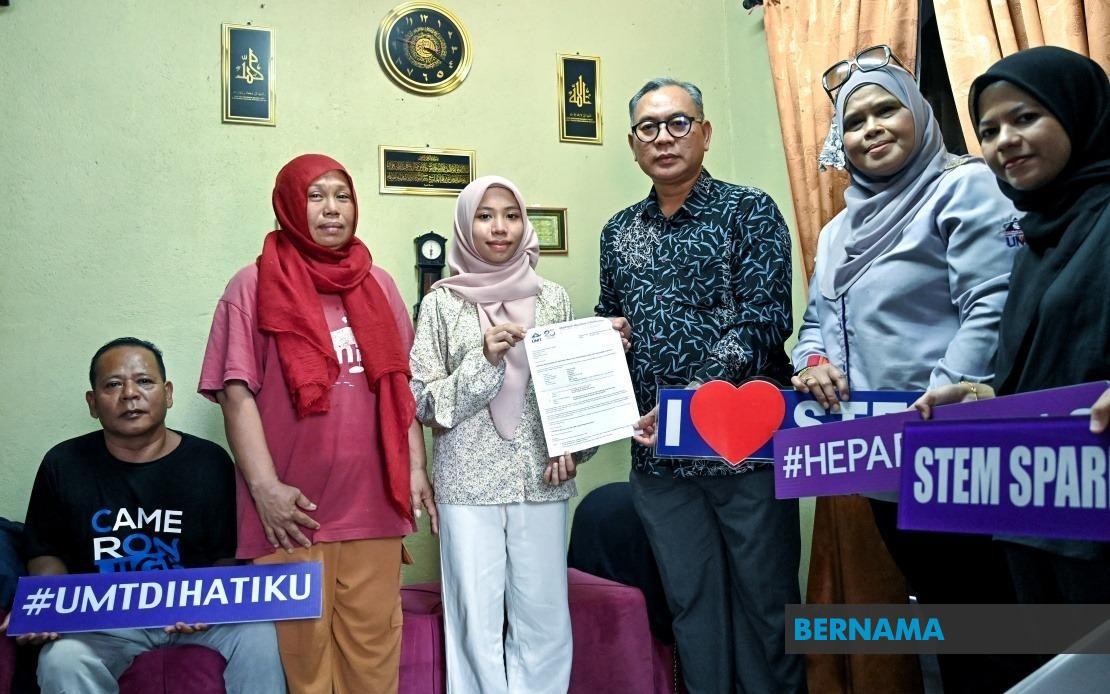
Nurul Amira Abdul Hamid's path to higher education nearly ended before it began. The 18-year-old had received a conditional offer to enrol at Universiti Malaysia Terengganu (UMT) to pursue a Bachelor's degree in Science specialising in Nautical Science and Maritime Transportation, an increasingly relevant field as Malaysia strengthens its maritime and logistics sectors. Yet the prospect of paying registration and tuition fees loomed as an insurmountable barrier for her family, prompting her to seriously consider declining the opportunity altogether. Her situation reflects a broader challenge facing Malaysian society: the persistent gap between educational aspiration and financial capacity that leaves countless capable students unable to realise their potential.
The financial strain on Nurul Amira's household stemmed from multiple pressures common to many Malaysian families. Her father, Abdul Hamid Othman, 58, grappled with ongoing health issues that likely constrained his earning capacity, while her mother, Asmah Che Ros, 53, remained a homemaker without independent income. As the youngest of three siblings, Nurul Amira felt a familial responsibility to contribute economically. After completing her SPM examination with three As—a respectable achievement—she took employment at a goods store for a monthly salary of RM1,300, prioritising household finances over immediate tertiary education. This decision demonstrates the difficult trade-offs facing lower-income youth in Malaysia, where many postpone or abandon education to provide immediate family support.
Rather than accept defeat, Nurul Amira proactively reached out to UMT to explain her predicament. This initiative proved transformative when the university responded positively to her appeal. UMT arranged the Al-Ikhlas Scholarship worth RM500 and coordinated additional financial assistance packages specifically designed to address her registration and tuition obligations. The scholarship portion alone reduced her financial burden substantially, while supplementary aid covered approximately RM400 of her initial fees. More significantly, UMT extended living allowances throughout her intended study period, recognising that many low-income students fail not because they cannot pay tuition but because they lack resources for accommodation, meals, and daily expenses during their academic journey.
The university's approach reflects an institutional philosophy increasingly necessary across Malaysian higher education. Universiti Malaysia Terengganu's vice-chancellor, Prof Dr Mohd Zamri Ibrahim, articulated a commitment to proactive engagement with financially disadvantaged students and their families. Rather than maintaining a transactional relationship where students navigate bureaucratic processes independently, UMT adopted a facilitative stance, dispatching officials to meet with struggling students at home and conduct personalised financial assessments. This hands-on methodology contrasts with passive systems where assistance applications languish in administrative queues. The vice-chancellor's explicit invitation—"If any student cannot afford to pay the fees, come to the university first and we will help via various forms of assistance"—signals an institutional culture prioritising access and completion over selective exclusion.
During the current academic year, more than ten students from underprivileged backgrounds have received comparable assistance from UMT, suggesting the university's support structures serve as meaningful safety nets rather than exceptional interventions. The scale of this assistance programme underscores how financial constraints remain a significant obstacle to tertiary education among Malaysian youth despite the expansion of public universities and government loan schemes. These figures also hint at the limitations of existing national financing mechanisms—loan programmes like PTPTN, while crucial, require credit assessments and impose repayment obligations that deter poorer families from accessing higher education. UMT's scholarship and living allowance approach provides non-repayable support that fundamentally differs from debt-based financing, addressing the root problem of inaccessibility rather than merely deferring costs.
Nurul Amira's case illuminates the broader significance of maritime and nautical education within Malaysia's economic framework. As the nation increasingly emphasises blue economy development, skills in maritime transportation, shipping logistics, and naval operations face growing demand. Yet these specialised fields often experience recruitment challenges precisely because students from disadvantaged backgrounds cannot afford extended study periods in relevant programmes. By enabling Nurul Amira's participation in the one-year STEM Foundation programme followed by her bachelor's degree, UMT simultaneously expands the talent pipeline for Malaysia's maritime sector while demonstrating social mobility through education. Her journey from retail employment to university student to prospective maritime professional embodies the kind of human capital development critical for sectoral growth and inclusive prosperity.
The support extended to Nurul Amira demonstrates how Malaysian universities can implement institutional responses to systemic inequalities without awaiting comprehensive national policy reform. While federal loan schemes and merit-based scholarships remain essential, their limitations leave gaps that resourced institutions can address through targeted assistance programmes. UMT's model—combining direct financial aid with comprehensive living support and proactive outreach—provides a replicable framework for other public universities. The relatively modest amounts involved (RM500 scholarship plus fee assistance) suggest that expanded access need not require transformative budgetary commitments, but rather strategic reallocation of existing resources toward students most at risk of exclusion.
Nurul Amira's gratitude toward the university extended beyond financial metrics. She emphasised the psychological dimensions of UMT's intervention: the shift from despair about declining her offer to excitement about commencing her studies. This emotional transition captures an often-overlooked aspect of educational financing—the confidence and dignity that comes from institutional belief in a student's potential. When universities proactively remove financial barriers and demonstrate commitment to student success, they communicate a powerful message about belonging and possibility. For a young woman from a modest background whose family sacrificed to support her education, UMT's intervention affirmed that her ambitions mattered and that institutional support systems existed to enable their realisation.
The implications of such institutional support extend beyond individual success stories to broader questions about Malaysia's human capital development and social cohesion. If talented young people abandon educational aspirations due to financial hardship, the nation forgoes their contributions to innovation, entrepreneurship, and professional advancement. The concentration of tertiary education among already-privileged groups perpetuates wealth inequality across generations and constrains social mobility. Conversely, when universities like UMT deliberately expand access for disadvantaged students, they unlock latent talent and create pathways for individuals to contribute more fully to economic and social development. Nurul Amira's journey from part-time retail worker to aspiring maritime professional represents precisely the kind of transition that strengthens both individual and national futures.
Looking ahead, Nurul Amira faces the rigorous academic demands of both the STEM Foundation programme and her subsequent bachelor's degree. Her previous SPM performance suggests capacity for university-level study, yet the psychological confidence generated by institutional support will prove equally important for sustained engagement. As she progresses through her maritime studies, she joins a small cohort of female students entering a traditionally male-dominated field, adding visibility to women's participation in maritime careers. Her success will demonstrate both to prospective students and to industry stakeholders that Malaysia possesses female talent capable of advancing its maritime sector. The pathway UMT created for Nurul Amira thus extends beyond one student's opportunity to signal broader possibilities for demographic diversification within specialised professional fields.

