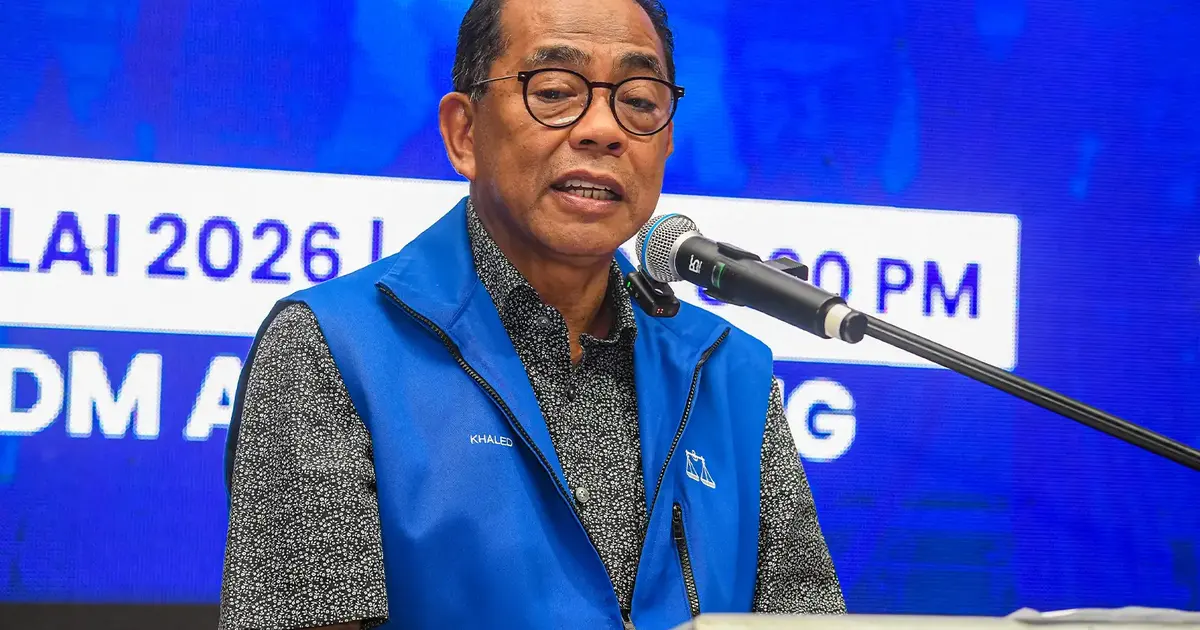
Umno Vice-President Khaled has intensified the ruling coalition's campaign assault on Bersatu, calling for voters in Negeri Sembilan to orchestrate a comprehensive electoral defeat similar to what the party experienced in Johor. His rhetoric reflects deepening tensions between the two Malay-majority parties that have previously served as coalition partners but now find themselves locked in competitive politics ahead of Malaysia's next general election.
The Umno veteran's appeal carries significant weight within Malaysia's political establishment, signalling that the Barisan Nasional leadership views Bersatu's regional electoral performance as a critical bellwether for broader national political realignment. By invoking the Johor precedent—where Bersatu failed to secure meaningful representation—Khaled is essentially mapping a strategic blueprint for systematically marginalizing the party across multiple state contests. This approach suggests that Umno strategists believe concentrating anti-Bersatu messaging in successive elections could fundamentally reshape the competitive landscape.
Khaled's intervention highlights the fractious relationship between Umno and Bersatu, two parties that initially formed the backbone of Dr Mahathir Mohamad's government following the 2018 general election but subsequently diverged over leadership and policy direction. The public call for Bersatu's complete rejection underscores how thoroughly their political partnership has deteriorated, transforming former allies into electoral adversaries competing for the same conservative Malay-Muslim voter constituency. This rupture has destabilized Malaysia's coalition politics and forced recalibration across multiple political formations.
The vice-president's statement carries particular strategic significance because it explicitly frames the Negeri Sembilan contest as preparation for the 16th general election. Rather than treating state-level politics as localized contests, Umno leadership is instrumentalizing regional polls to build momentum for a larger confrontation with Bersatu on the national stage. Such calculus suggests internal polling or organizational assessments have convinced Umno that systematically defeating Bersatu in successive elections positions them favourably for general election negotiations and coalition dynamics.
Negeri Sembilan occupies particular importance in Malaysian electoral mathematics due to its compact size and mixed demographic composition, making it a bellwether for broader voting patterns. The state's relatively concentrated voter population means that intensive campaigning and messaging can produce measurable shifts in electoral behaviour more readily than in larger, more heterogeneous states. For Umno, achieving a decisive result against Bersatu would provide both psychological momentum and concrete evidence that the party's anti-Bersatu messaging resonates with core constituencies.
Bersatu's vulnerable position stems from its organizational constraints and limited geographical presence outside its original Tun Dr Mahathir Mohamad strongholds in Kedah and other northern regions. Unlike Umno, which maintains deep institutional networks across all states through decades of electoral organization, Bersatu remains geographically concentrated with inconsistent representation. This structural disadvantage becomes magnified during state elections where local organizational capacity determines electoral competitiveness, particularly in contests without the polarizing effects present during general elections.
Khaled's rhetoric must be contextualized within broader Barisan Nasional strategy toward managing coalition composition ahead of general election campaigning. By publicly demanding Bersatu's complete rejection, Umno signals to its own grassroots supporters that the party is aggressively pursuing political dominance rather than power-sharing arrangements. This messaging serves multiple audiences simultaneously: consolidating Umno voter loyalty, demonstrating assertiveness to coalition partners like MCA and MIC, and positioning Barisan Nasional as an organization willing to expand electoral territory at Bersatu's expense.
The timing of such interventions reflects calculations about political momentum and media narrative control. By maintaining consistent pressure on Bersatu through successive electoral contests, Umno seeks to establish a narrative of irreversible political decline for the party, potentially deterring its supporters from continued engagement and complicating any attempt at future coalition rehabilitation. This strategy parallels historical instances where Malaysian political coalitions have methodically eliminated rival parties through electoral accumulation rather than formal dissolution.
For Negeri Sembilan voters specifically, Khaled's call encompasses broader implications about representation and political influence at the state level. The result will likely determine whether the state remains within Barisan Nasional control or shifts toward alternative political configurations. Since Negeri Sembilan maintains Barisan governance structures, electoral outcomes directly affect administrative capacity, development spending, and local service delivery that constitute ordinary governance concerns for residents.
The Johor precedent Khaled invokes carries particular symbolic weight because that state represents Umno's traditional heartland and contains some of the party's most loyal constituencies. The complete electoral erasure of Bersatu from Johor's legislative representation demonstrated that wholesale rejection of a political entity remains possible within Malaysia's electoral system. Replicating this outcome across multiple states would require sustained organizational effort and effective messaging penetration among target voter populations.
Looking beyond immediate electoral contests, Khaled's intervention reflects uncertainty about Bersatu's long-term political viability and role within Malaysian coalition politics. Whether the party can rebuild organizational capacity and reconstitute electoral appeal remains unresolved, though systematic defeats across successive state elections could accelerate organizational decline. The unfolding dynamic between Umno and Bersatu will substantially shape coalition composition and competitive configurations ahead of Malaysia's next general election and beyond.

