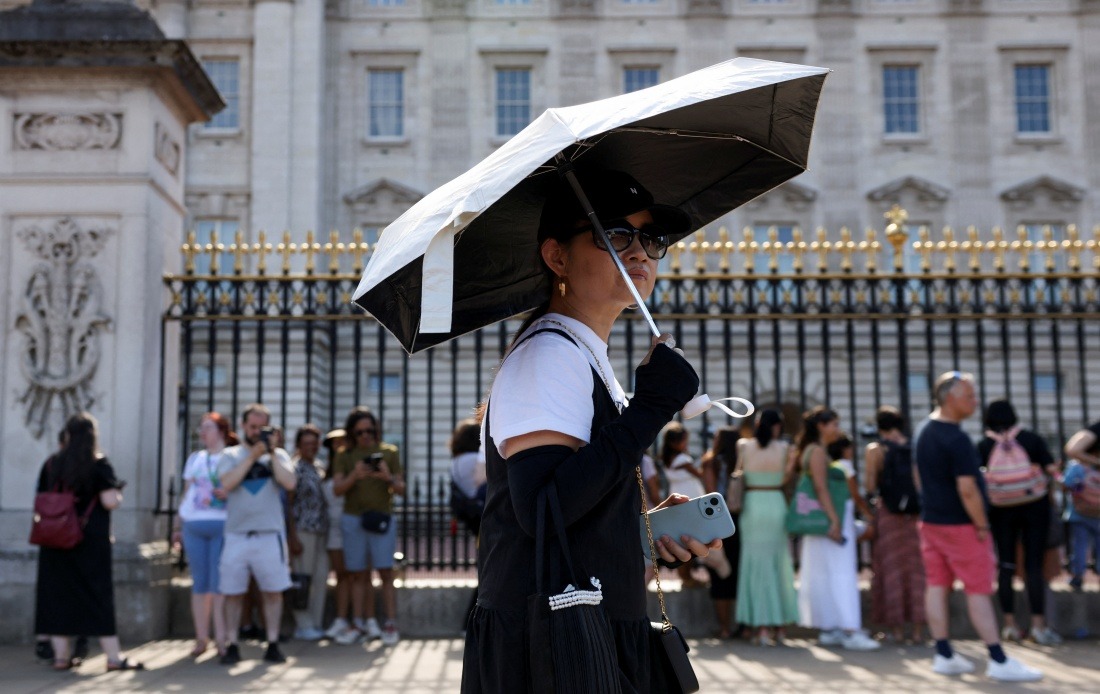
The United Kingdom's Household Division has suspended all ceremonial guard changes scheduled for Windsor and London, including the iconic Buckingham Palace ceremony, as the nation braces for an exceptionally severe heatwave. The decision, announced on Tuesday, reflects growing concern among military and government authorities about public safety during what the Met Office has flagged as a record-breaking week for summer temperatures across Britain and Wales.
The British meteorological authority issued a rare red weather warning for mid-week, the highest alert level in the UK's weather warning system. This escalation signals expectations of temperatures reaching 39 degrees Celsius on both Wednesday and Thursday, with forecasters cautioning that certain regions could experience even more extreme readings. Such conditions would represent a significant departure from typical June weather patterns and threaten to break established historical records for heat during this period.
In its official statement, the Household Division prioritised the welfare of its military personnel, the ceremonial horses integral to the pageantry, and the large crowds that typically gather to witness these events. The suspension encompasses all guard change ceremonies across both locations for Tuesday, Wednesday, and Thursday. This is a precautionary measure designed to prevent heat-related illnesses and injuries among uniformed soldiers, many of whom wear heavy traditional dress uniforms unsuitable for extreme temperatures, and among the horses, which are particularly vulnerable to overheating during physical exertion.
The Royal Horse Guards' ceremony, which would normally have proceeded on Wednesday with full ceremonial pomp, has been substantially modified rather than completely cancelled. Military authorities announced that the event will commence much earlier in the morning, before peak daytime temperatures, and will forego the usual elaborate ceremonial elements that characterise the spectacle. This compromise allows for a scaled-down presentation while minimising heat exposure. Additionally, soldiers have been instructed to position themselves in shaded locations whenever possible and will be rotated through duty assignments more frequently to prevent prolonged exposure to the sun.
The decision underscores how even venerable British institutions must adapt to environmental extremes. The Buckingham Palace guard changes have been a London fixture for generations, attracting thousands of domestic and international visitors annually. Their cancellation during peak tourist season represents an unusual disruption to one of Britain's most recognisable ceremonial traditions, signalling the seriousness with which authorities are treating this particular weather event.
The heatwave's impact extends far beyond ceremonial disruptions, affecting the broader functioning of British institutions and daily life. Educational authorities across multiple counties in southern England have mandated school closures, a measure typically reserved for exceptional circumstances such as severe winter weather or infrastructure failures. Somerset county council announced that approximately 100 schools throughout the county will remain shut during the heat peak, while Buckinghamshire reported a similar number of closures. Gloucestershire suspended classes in more than 80 schools, and London's authorities confirmed that nearly 10 major educational institutions have cancelled in-person instruction for affected days.
These closures are concentrated within the geographical area subject to the red weather warning, which encompasses not only the counties mentioned but also the capital itself. The decision to close schools reflects official recognition that standard building cooling systems in many British schools are inadequate for sustained temperatures above 35 degrees Celsius, and that exposing children to such conditions poses genuine health risks. Many British buildings, including educational facilities, are designed with climate patterns in mind and lack the air conditioning systems commonplace in hotter climates, making them potentially dangerous during extreme heat events.
For Malaysian and Southeast Asian readers, this scenario presents an instructive contrast to how tropical nations routinely manage ambient temperatures that regularly exceed 35 degrees Celsius. While heat management is an operational norm in this region, the British experience demonstrates that even wealthy, developed nations can face significant disruption when temperatures deviate markedly from historical norms. The widespread school closures and cancellation of longstanding ceremonial traditions underscore how societies organised around temperate climate assumptions become fragile when climatic patterns shift.
The episode also illuminates broader questions about climate adaptation and resilience in regions not historically accustomed to extreme heat. As climate change drives increased frequency of such events globally, the British response—combining cancellations of non-essential activities, modification of mandatory ceremonies, and protective measures for vulnerable populations—represents one template for crisis management. However, the reactive nature of these decisions, implemented with relatively short notice, suggests that proactive infrastructure and institutional redesign may be necessary for regions facing increasingly frequent temperature extremes.
From a regional perspective, this incident carries implications for international tourism and business continuity planning. The suspension of Buckingham Palace ceremonies during summer weeks when international visitors peak highlights how climate events can disrupt not merely leisure activities but the symbolic and commercial anchors of major tourism destinations. Southeast Asian nations, which have built substantial tourism industries partly on the appeal of reliable weather conditions, may find this cautionary tale relevant as climate variability increases.