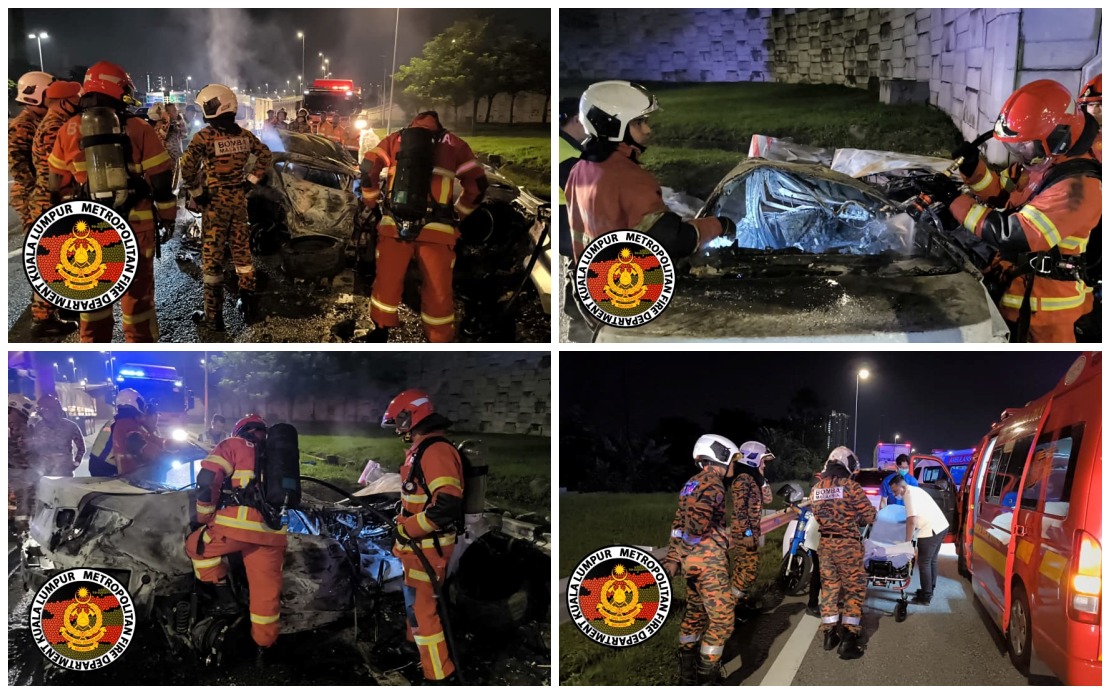
A tragic accident on the Duta-Ulu Kelang Expressway has claimed the lives of two young Malaysian university students in what authorities describe as a high-speed crash. The incident occurred early on June 27 near the Jalan Kuching exit ramp, leaving investigators probing the exact circumstances that led to the BMW 328i Sport colliding with a road divider and subsequently catching fire. The vehicle's rapid combustion trapped both occupants inside, with emergency responders arriving to find the car engulfed in flames.
According to ACP Mohd Zamzuri Mohd Isa, the chief of Kuala Lumpur's Traffic Investigation and Enforcement Department, preliminary findings suggest that the driver was operating the vehicle at an unsafe speed while travelling from Jalan Duta in the direction of Selayang. The driver appeared to lose command of the vehicle, causing it to skid across the expressway before striking the left-side barrier. This collision, combined with the vehicle's speed and trajectory, resulted in the immediate ignition of the fuel system, transforming the accident scene into a rapidly developing inferno.
The two deceased passengers have been identified as a 22-year-old Malaysian male studying at Queensland University of Technology in Australia and a 21-year-old Malaysian male enrolled at Sunway University. Both individuals were pronounced dead at the scene, their remains recovered from the charred wreckage after emergency services extinguished the blaze. The intensity of the fire and the subsequent damage to the vehicle's structure have complicated identification efforts, necessitating DNA analysis to formally confirm the identities of both victims. This forensic approach, while thorough, underscores the severity of the trauma sustained by the occupants.
A third passenger, a 20-year-old male student from Singapore, managed to escape the vehicle despite the catastrophic nature of the collision. The survivor sustained only minor injuries and was transported to Kuala Lumpur Hospital for medical evaluation and treatment. The fact that this passenger escaped relatively unharmed, while the other two occupants perished, suggests considerable variation in seating position and the circumstances of the impact—factors that traffic safety investigators will likely scrutinise in their ongoing analysis.
The investigative response to the incident has been comprehensive, with authorities undertaking multiple parallel inquiries to establish a complete picture of events. Police have initiated formal reviews of available closed-circuit television footage from the expressway corridor, which may provide critical visual documentation of the vehicle's behaviour in the moments preceding the crash. Investigators have also obtained a formal statement from the surviving passenger, whose account represents the only eyewitness testimony available regarding the driver's actions and any potential contributing factors preceding the collision.
The legal framework governing the investigation falls under Section 41(1) of the Road Transport Act 1987, which addresses traffic-related fatalities. This provision allows authorities to examine whether criminal negligence, reckless driving, or regulatory violations contributed to the outcome. The preliminary findings regarding excessive speed may form a central element of the case as it progresses through the investigative and potential prosecutorial stages. However, authorities have indicated that their examination remains ongoing, with additional evidence still being gathered and analysed.
The accident highlights persistent road safety concerns on Kuala Lumpur's expressway network, where high traffic volumes and elevated speed limits create conditions conducive to serious collisions. The DUKE expressway, connecting northern routes to central Kuala Lumpur, experiences substantial vehicle movement throughout the day and night. Incidents involving speed-related loss of control, particularly among younger drivers, have constituted a recurring safety challenge on Malaysian highways. The combination of modern vehicle performance capabilities and driver inexperience represents a documented risk factor in fatal accident statistics across the region.
Police have made a public appeal for assistance from individuals who may possess relevant information or dashcam recordings of the incident. Witnesses or those with footage documenting the vehicle's movements before the collision are encouraged to contact the Traffic Police Station located on Jalan Tun H.S. Lee or any nearby police facility. Dashcam evidence, increasingly common among Malaysian motorists, can provide investigators with additional visual perspectives on the sequence of events and may clarify aspects of the driver's conduct in the period immediately preceding the crash.
For Malaysian families with university-age children studying abroad or domestically, this tragedy serves as a sobering reminder of road safety's paramount importance. The deceased students represented families' investments in education and future aspirations—lives cut short in a moment of apparent driver error or misjudgement. The incident also underscores broader questions regarding driver education, speed awareness among young motorists, and the effectiveness of road safety campaigns in modifying high-risk behaviours among university-age demographics, a group statistically overrepresented in serious road accidents across Southeast Asia.
The investigation's progression will likely include technical examination of the vehicle's mechanical systems to determine whether any pre-existing defects contributed to the loss of control. Authorities will assess brake functionality, steering responsiveness, and tyre conditions—factors that could either support or contradict the preliminary speed-related theory. Additionally, toxicology results from the surviving passenger may provide insights into whether substance impairment played a role, though such factors would typically not be the primary determinant given the apparent speed-related nature of the initial loss of control.
As investigations continue, the incident serves as a stark illustration of expressway dangers and the catastrophic consequences of high-speed driving errors. For the families affected and the broader university community, the loss represents a tragic reminder of mortality's unpredictability and the consequences of momentary lapses in road discipline. The surviving passenger will likely face significant psychological recovery challenges in addition to physical healing, having witnessed the fatal outcome experienced by his companions in a vehicle he shared moments before the collision.

