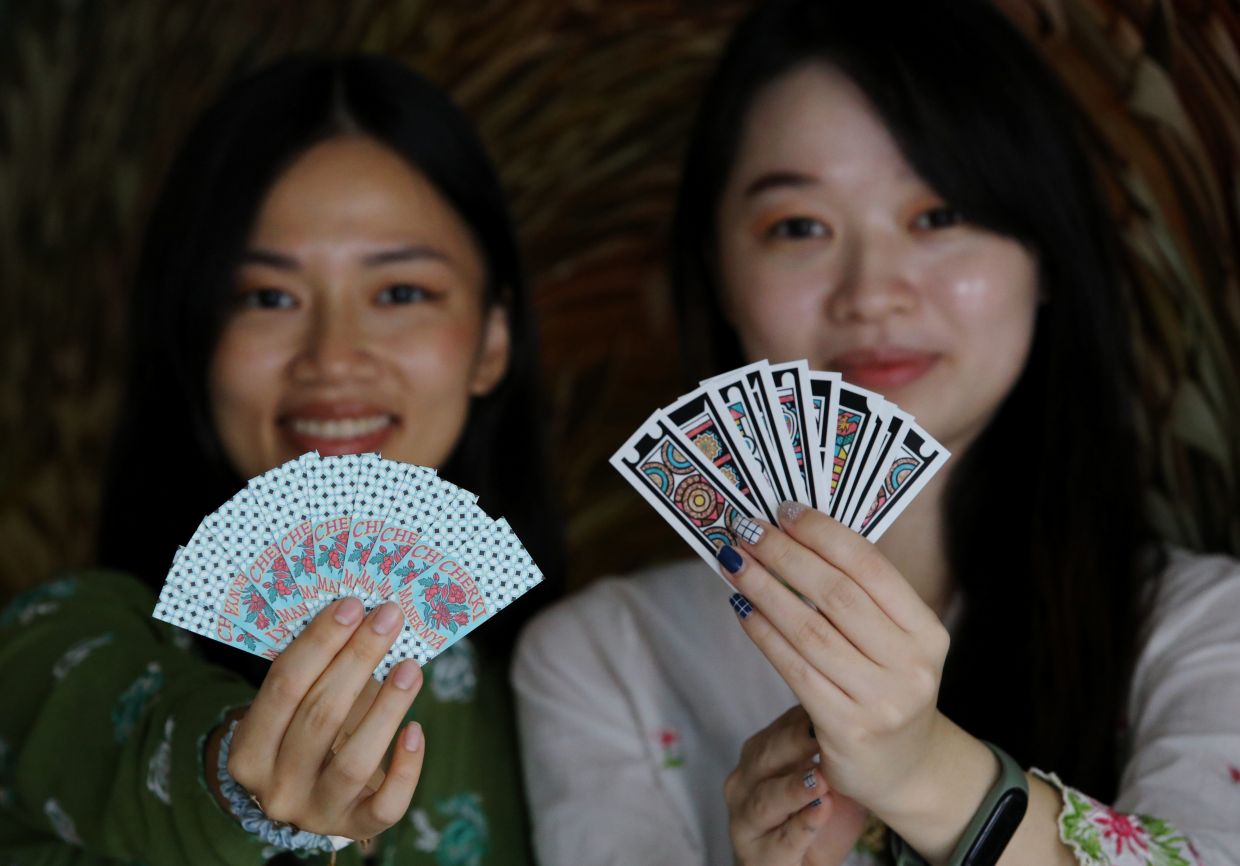
In the push to preserve Peranakan identity across Malaysia, two sisters from Melaka have turned their attention to an overlooked cultural treasure: Cherki, a traditional card game that once graced Baba Nyonya households but has largely vanished from contemporary community life. Lee Swee Lin, 32, and her younger sister Lee Swee May, 31, have modernised the game with colourful illustrations and clearer gameplay instructions, transforming cards that were originally rendered in simple black-and-white designs into vibrant, visually engaging pieces that appeal to today's digitally native audiences while maintaining fidelity to traditional Peranakan motifs.
The sisters' venture into Cherki preservation represents a natural extension of their existing work in cultural heritage. Based in Kuala Lumpur, they operate a business centred on Peranakan beaded footwear and decorative pieces—crafts passed down through their maternal lineage and refined under the guidance of their late paternal grandmother, Deo Yeok Kim. Growing up in their grandmother's Melaka home exposed them to multiple dimensions of Peranakan culture, from language and storytelling to the daily practice of traditional rituals. That immersion proved formative; when their Popo passed away recently, the sisters recognised that much of their cultural knowledge stemmed directly from her lived example, prompting them to consider how they might preserve and transmit such wisdom to peers and younger relatives.
Cherki itself carries considerable historical weight within Southeast Asian gaming traditions. Belonging to the same family of games as mahjong, it consists of two decks totalling 60 cards with 30 distinct patterns. The traditional structure divides cards into three suits—coins, strings, and myriads—each valued from one to nine, plus three special cards. Though the game is primarily known in Singapore, Malaysia, Indonesia, and Thailand, its origins trace to China, where Tang Dynasty records from the ninth century reference a "leaf game." The Malay terminology "daun ceki"—daun meaning leaf—eventually adopted by Peranakans, reflects this historical transmission along ancient trade routes. By the 14th century, similar card games had already reached Europe, making Cherki part of a broader intercontinental cultural exchange.
Yet contemporary Peranakan communities face a growing disconnection from their heritage. A 2022 academic study examining "Comparative of Cultural Material Study Between Baba Nyonya Original Descendants and Baba Nyonya New Descendants in Malacca" documented how younger community members increasingly absorb external influences through global pop culture and digital media, undermining traditional knowledge transfer within families. Lee Swee Lin acknowledges this troubling trend directly: many in her generation and even her mother's generation no longer understand how to play Cherki, let alone its cultural significance. Without deliberate intervention, she warns, this unique game risks disappearing entirely, taking with it narrative threads and cultural identity markers woven into gameplay and card symbolism.
The barriers to cultural continuity are multifaceted and modern. Lee Yuen Thien, deputy president of Persatuan Peranakan Baba Nyonya Malaysia (PPBNM), attributes the generational drift to career pressures and competing lifestyle demands. With 3,000 current members and estimates suggesting 10,000 to 15,000 ethnic Peranakans nationwide, the association observes that younger members consistently deprioritise cultural engagement in favour of professional advancement and contemporary leisure pursuits. Geographic dispersion compounds the problem; as Peranakans migrate beyond ancestral centres in Melaka and Penang, they lose the family-embedded transmission mechanisms that historically sustained cultural practices. Mixed marriages and lifestyle evolution have further reshaped the community's composition and cultural coherence.
Infrastructural initiatives like the Baba & Nyonya Heritage Museum in Melaka attempt to counteract these trends through education and public awareness. Museum management recognises that culture must be permitted to evolve contextually while simultaneously fostering younger-generation consciousness about ancestry and heritage. This philosophy directly informed the sisters' approach to their Cherki redesign. Beginning their research and development process in 2024, Swee Lin and Swee May collaborated with a small design team employing digital tools including Procreate and Adobe Illustrator to introduce colour, pattern, and contemporary visual language. Critically, they preserved the game's traditional structural logic: three suits with values one through nine, plus three special cards—though they replaced traditional "white flower, red flower, old thousand" with "butterfly, dragon, phoenix" to align with broader Peranakan symbolism.
The aesthetic choices reflect deliberate cultural curation. Each value card incorporates distinctly Peranakan visual references: the kantan, a fragrant flower central to Nyonya cuisine; chupu, traditional porcelain serving vessels; kerongsang, ornamental brooches fastening the kebaya; and gelang, bracelets worn by Nyonya women. By embedding these quotidian cultural markers into gameplay, the sisters create multiple entry points for younger players to encounter and learn about Peranakan material culture organically. Swee May explains their design philosophy succinctly: they wanted Cherki to feel contemporary and inviting rather than museological, pulling the game from historical archives into lived present experience. This required balancing aesthetic modernisation—vibrant colours, clean illustration, accessible visual design—against the imperative to maintain traditional patterns and symbols, ensuring players encounter genuine Peranakan heritage rather than diluted approximations.
Practical accessibility improvements accompany the visual redesign. The sisters developed clearer gameplay instructions specifically targeting players unfamiliar with Cherki's rules, lowering barriers to entry for younger generations raised on digital entertainment and modern board games. By making Cherki "fun, visually appealing, and easy to jump into," they attempt to create conditions where younger Peranakans can experience the game without requiring decades of family-embedded knowledge. This democratic approach to cultural transmission—meeting contemporary audiences where they are rather than demanding they adapt to heritage materials unchanged—potentially offers a model for other threatened Peranakan practices.
The revival effort arrives at a critical juncture for Peranakan identity in Malaysia. The community's diminishing intergenerational transfer of knowledge represents not merely recreational loss but a broader cultural attrition with implications for Southeast Asian heritage preservation writ large. As Lee Swee Lin emphasises, reintroducing Cherki specifically addresses "a piece of Peranakan heritage that carries stories, traditions and cultural identity." Without strategic preservation efforts, such practices—each embedded with historical knowledge, family narrative, and community memory—risk irreversible erasure. The sisters' initiative demonstrates that cultural continuity need not mean static preservation; rather, thoughtful innovation that respects foundational elements while embracing contemporary aesthetics and accessibility standards may prove essential to ensuring that future generations inherit living traditions rather than archived relics.
The broader implications extend beyond Cherki specifically. This project exemplifies how individual creative practitioners can leverage their cultural position and commercial platforms to address heritage loss at community scale. By operating simultaneously as business entrepreneurs, cultural custodians, and family tradition-bearers, Swee Lin and Swee May model an approach wherein economic viability and cultural preservation reinforce rather than contradict one another. Their willingness to invest time and resources into reviving an obscure game reflects a commitment to counteracting the market forces and lifestyle trends that marginalise traditional practices. Should their Cherki adaptation gain traction among younger Peranakans and broader Southeast Asian audiences, it may catalyse similar projects rescuing other endangered games, crafts, and cultural practices from disappearance.

