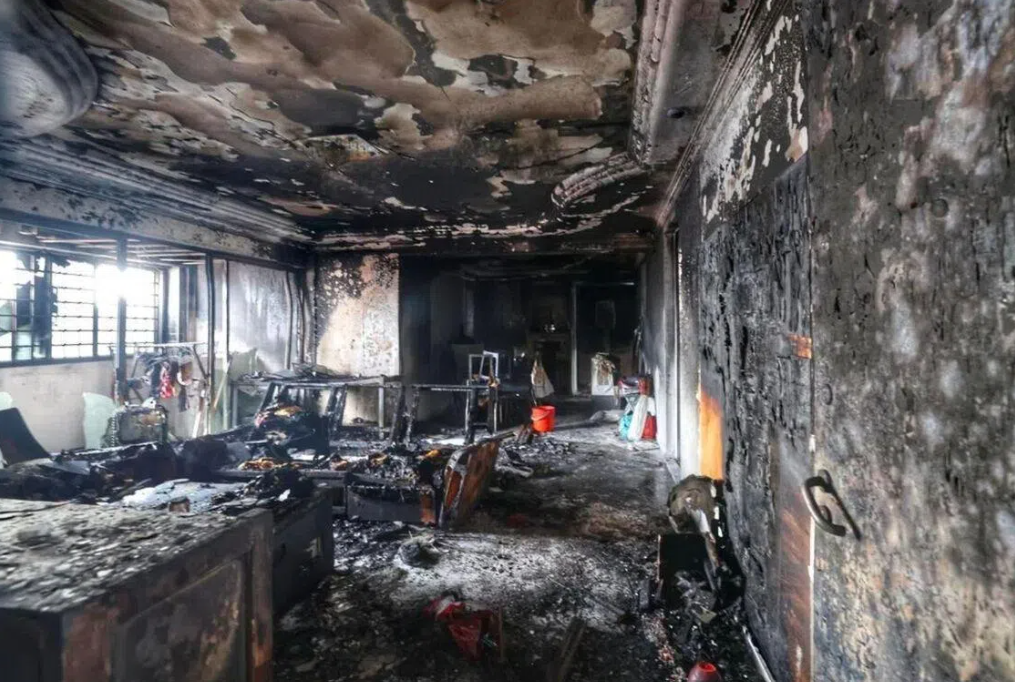
A residential fire in one of Singapore's public housing blocks claimed two casualties who required emergency hospitalisation after being pulled from a smoke-filled 13th-storey flat in the early hours of June 17. The Singapore Civil Defence Force responded to the alarm at Block 842 Jurong West Street 81 shortly after 3.35am, discovering flames actively consuming the living room of the affected unit. The intervention of firefighters, who navigated through dense smoke to extinguish the blaze using a water jet, prevented what could have been a far more catastrophic outcome.
The four-member family occupying the unit all required medical attention at Singapore General Hospital following their extraction from the burning flat, with two individuals receiving direct rescue intervention by responding personnel. As a precautionary safeguard, the SCDF evacuated approximately 40 residents from other units in the block, a standard protocol designed to protect neighbouring households from potential smoke inhalation and secondary hazards. The swift response by emergency services underscores Singapore's well-established fire safety infrastructure, though the incident highlights persistent dangers within residential buildings despite regulatory frameworks.
Initial investigations conducted by the SCDF indicated that the fire originated from electrical sources within the living room, marking a troubling pattern in residential fire causation across the city-state. The damage sustained by the flat was extensive—walls and ceilings bore severe charring, windows shattered from the heat, and furnishings reduced to charred remains when journalists from Lianhe Zaobao visited the scene approximately 12 hours after the incident. The visual devastation documented at the site illustrated the rapid intensity with which modern household fires can spread, particularly when electrical faults ignite combustible materials.
The family's survival owed considerably to the alertness of an 18-year-old student living directly above the affected unit. Unlike the household below, the young resident was awake during the early morning hours, engaged in gaming activities, when he detected smoke permeating from the floor beneath him. His swift action—touching the hot door, knocking urgently on neighbours' doors, and verbally warning residents to evacuate—created a critical window for the family below to escape. The student subsequently raced upstairs to alert his own family before his mother contacted emergency services, demonstrating how individual awareness can cascade into collective safety.
When the student ventured downstairs to investigate the smoke he had detected, he encountered members of the imperilled household emerging from their unit in evident distress. He observed a young woman whose hair had been singed and whose face was blackened by soot residue requesting towels, explaining that she needed to attend to her father's injuries. Another occupant bore visible burns across his back and arms, displaying the characteristic bright red coloration indicative of thermal trauma. These observations provided witnesses with direct evidence of the physical trauma experienced by those trapped in the intense heat moments before their escape.
The incident occurred while the family slept, rendering them initially oblivious to the developing danger—a vulnerability common in residential fires that claim lives during nocturnal hours when occupants' sensory alertness is naturally diminished. The electrical origin of the fire suggests a failure in the household's electrical infrastructure or connected devices, whether through faulty wiring, degraded insulation, or malfunctioning appliances. Such fires develop rapidly once initiated, with smoke production preceding visible flames and creating disorientation among residents attempting to locate exits in darkened environments.
Singapore's civil defence authorities have responded to such incidents by reinforcing public guidance on electrical safety practices. The SCDF recommends that households avoid plugging multiple high-draw appliances into single outlets, a practice that generates excessive heat within electrical circuits. Residents are advised to disconnect appliances when not in active use, eliminating dormant electrical consumption and associated thermal hazards. The authority specifically emphasises using only devices and plugs certified with the Safety Mark, a credential issued by Singapore's Consumer Product Safety Office to indicate compliance with established safety standards.
Particular emphasis has been placed on the dangers of unattended charging of batteries and electronic devices, especially when left overnight or for extended periods. Lithium-ion batteries, common in smartphones, laptops, and portable devices, present heightened fire risk when defective, damaged, or subjected to prolonged charging cycles. The SCDF's advisory reflects accumulated evidence from fire investigations that device charging remains a significant residential fire catalyst, particularly when conducted without monitoring during sleeping hours.
The frequency of residential fires across Singapore has demonstrated an upward trajectory that warrants concern among both residents and policymakers. According to the SCDF's annual statistical report released in February, fire incidents nationwide increased by three percent, rising from 1,990 recorded cases in 2024 to 2,050 in 2025. More alarmingly, residential buildings accounted for just over half of all fires during this period, with 1,051 incidents occurring in homes, suggesting that domestic environments remain the primary fire risk zones despite safety regulations and public awareness campaigns.
For Malaysian readers, the Jurong West incident carries particular relevance given similarities in housing typologies and electrical infrastructure across Southeast Asia. Many Malaysian residential areas, including similar high-rise public housing developments, share comparable construction methods, electrical systems, and occupancy patterns with Singapore's HDB blocks. The progression of this fire—from electrical origin through rapid smoke development to successful rescue intervention—mirrors scenarios documented in Malaysian fire safety reports, indicating that electrical faults represent a consistent regional hazard transcending specific national contexts.
The role of community vigilance demonstrated by the teenage neighbour underscores the vital importance of awareness in fire safety ecosystems that extend beyond regulatory compliance and official emergency response. Singapore's emphasis on public education regarding electrical safety practices, coupled with investment in rapid response infrastructure and inter-resident communication, represents a comprehensive approach that neighbouring countries including Malaysia continue developing. The Jurong West incident, while fortunately resolved without fatalities, reinforces that residential fire prevention requires sustained effort across multiple dimensions—from consumer product regulation through individual household behaviour to neighbourhood alertness and emergency service readiness.