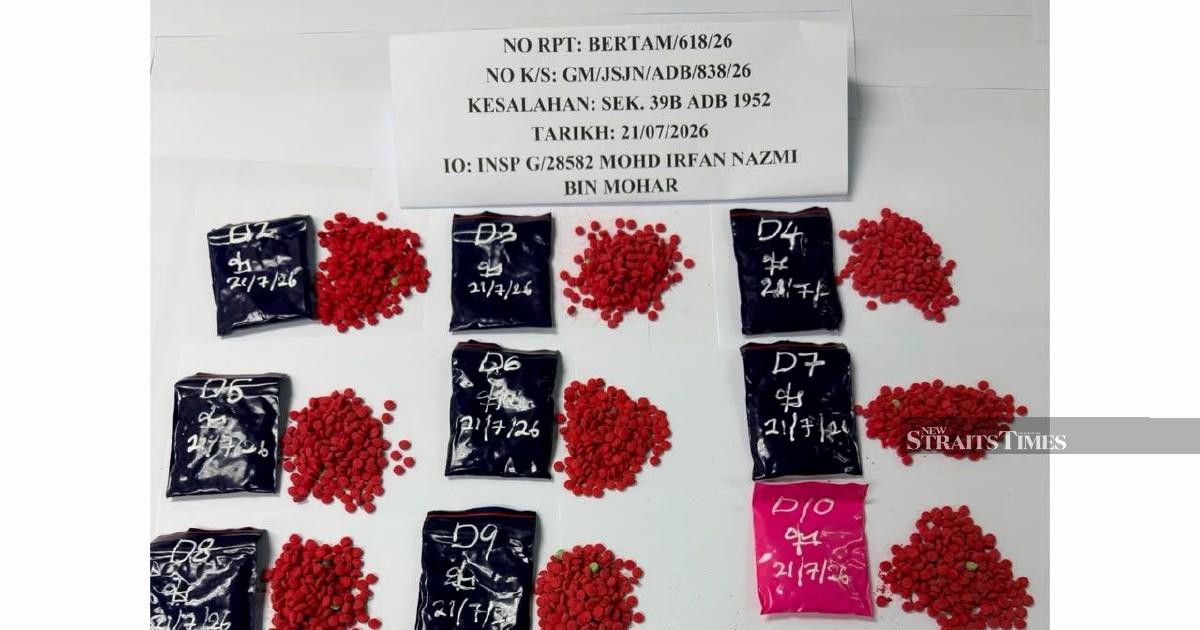
Two Myanmar men were taken into custody in Kelantan following a brief pursuit that culminated in the discovery of 6,000 yaba tablets, the street drug commonly known as methamphetamine pills. The seizure, which occurred in Gua Musang, netted contraband estimated to be worth approximately RM60,000 at street value, underscoring the scale of narcotics trafficking operations that continue to threaten Malaysia's northern borders and interior regions.
The incident unfolded yesterday when authorities initiated a chase that ended with the successful apprehension of both suspects. The rapid police response and successful conclusion of the operation demonstrates the heightened vigilance being maintained in areas known to be conduits for illicit drug smuggling. Gua Musang, situated in Kelantan's interior, has long been identified as a strategic location for trafficking operations due to its proximity to Thailand and the porous nature of border security in certain areas.
Yaba pills, compressed tablets containing methamphetamine mixed with caffeine, represent one of the primary drug threats facing Southeast Asia. Originating predominantly from clandestine laboratories in the Golden Triangle region—the mountainous area spanning Myanmar, Thailand, and Laos—these pills have become increasingly prevalent across Malaysia. The ease of transport and concealment makes yaba an attractive commodity for trafficking syndicates seeking to exploit supply chain vulnerabilities across the region.
The valuation of RM60,000 placed on the seized consignment reflects the significant profit margins inherent in drug trafficking. When converted to retail street prices, individual tablets can command premiums that make the enterprise highly lucrative for organised crime networks despite the considerable legal risks involved. For Malaysian law enforcement, each successful intercept represents not merely the removal of drugs from circulation but an disruption to criminal revenue streams that finance larger trafficking organisations.
Myanmar's position as a major source of methamphetamine production has intensified scrutiny on nationals from that country appearing in Malaysian territory with large quantities of controlled substances. While many Myanmar citizens enter Malaysia legally for employment, family visits, or business purposes, authorities remain alert to those utilising cross-border routes for contraband transport. The nationality of the suspects in this case aligns with established patterns of drug trafficking from source countries through Malaysia toward consumer markets in Southeast Asia and beyond.
Kelantan's geographic positioning makes it particularly vulnerable to trafficking flows. The state shares a substantial border with Thailand and lies in close proximity to Myanmar through Thailand's territory. This creates multiple potential entry points for contraband, and despite coordinated efforts between Malaysian, Thai, and Burmese authorities, significant quantities of narcotics continue to penetrate the region. Gua Musang, with its less densely populated hinterland, presents particular challenges for enforcement operations.
The Narcotics Division and other agencies have intensified operations in recent years following alarming statistics regarding methamphetamine consumption patterns among younger Malaysians. Yaba pills, being affordable and highly potent, have become especially problematic in secondary and tertiary education settings. Each seizure of this magnitude represents removal of between 300 and 400 individual doses from potential distribution networks serving local consumption markets.
The successful police chase and apprehension demonstrates operational effectiveness at ground level, yet officials acknowledge that preventing upstream trafficking requires coordinated regional intelligence and enforcement efforts. Myanmar's limited capacity to control clandestine manufacturing operations within its borders, compounded by political instability affecting governance structures, means that attempts to address the problem at source have yielded limited results. This places greater responsibility on transit and destination countries like Malaysia to maintain robust border interdiction capabilities.
The case contributes to a growing body of evidence documenting sophisticated trafficking operations that extend well beyond simple hand-to-hand exchanges. Larger syndicates operate structured supply chains with designated courier roles, safe houses, and distribution networks. The fact that two individuals were arrested with such a substantial quantity suggests they occupied roles within a more extensive operation rather than acting as lone operators.
For the Malaysian authorities, ongoing success in interdiction operations remains essential given the public health implications of methamphetamine proliferation. Each seizure reduces availability and theoretically elevates prices, though traffickers continuously attempt to overcome supply constraints through increased production or alternate trafficking routes. The conviction rates following drug arrests and appropriate penalties serve both as deterrents and as reminders of the serious consequences attached to involvement in narcotics trafficking.
Looking forward, analysts point to the need for sustained bilateral cooperation between Malaysia and neighbouring countries, particularly Thailand and Myanmar, to address trafficking at source and transit points. Information sharing, joint task forces, and coordinated surveillance operations have proven effective but require consistent resource commitment and political will. The seizure in Gua Musang, while significant, represents only a fraction of the methamphetamine flowing through the region, indicating that the underlying trafficking phenomenon remains substantially uncontrolled despite periodic enforcement successes.

