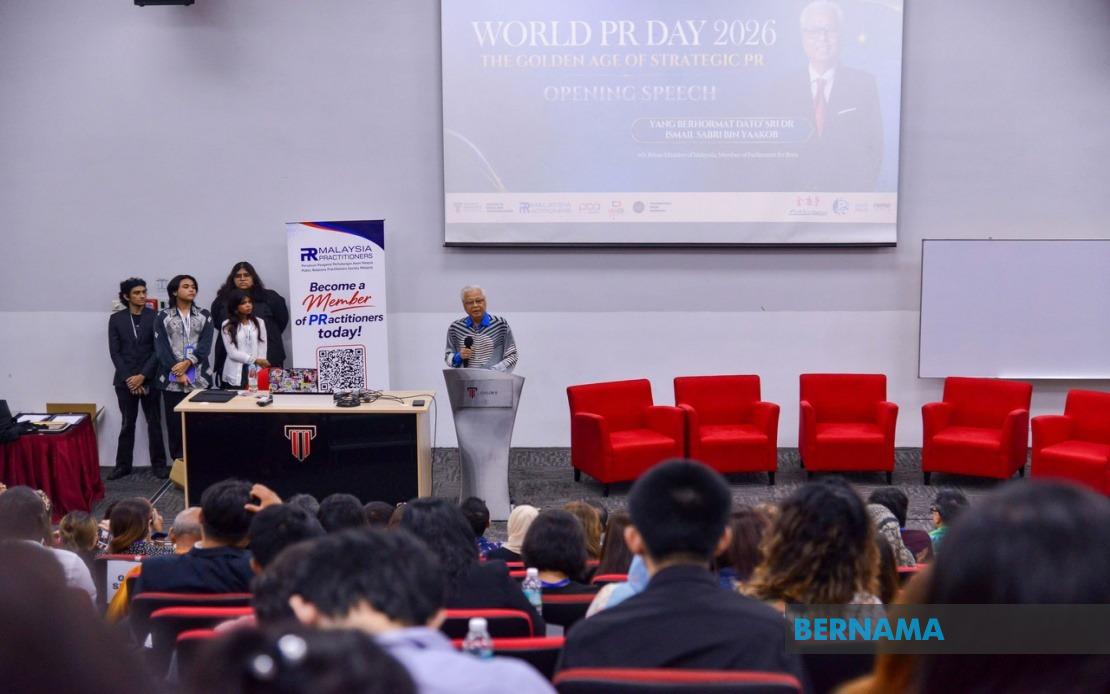
The nature of organisational competition has fundamentally shifted in the modern era, according to former Prime Minister Datuk Seri Dr Ismail Sabri Yaakob, who warned that success in today's landscape depends less on economic metrics alone and far more on an institution's capacity to establish and maintain public trust. Speaking at the World PR Day 2026 launch event held at Taylor's University in Subang Jaya on July 16, Ismail Sabri articulated a vision where communication grounded in integrity has emerged as the defining competitive advantage for any entity seeking to preserve its reputation and influence.
The distinction he drew between the 20th and 21st centuries carries significant implications for how Malaysian organisations and government agencies approach their stakeholder relations. While the previous century emphasised raw economic output and market dominance, the current era demands that entities demonstrate not merely their achievements but their transparency and moral consistency in how they engage with the public. This shift reflects a broader global recognition that in hyperconnected societies where information spreads instantaneously, the credibility of an organisation's messaging often matters more than the message itself.
Ismail Sabri underscored that organisational value is no longer determined solely by tangible performance metrics or financial outcomes. Instead, institutions are increasingly evaluated based on their demonstrated ability to communicate with clarity and candour during both prosperous and challenging periods. This dual capacity—maintaining coherent narratives through success and adversity—distinguishes organisations that retain public confidence from those that suffer reputational collapse when circumstances become difficult. The implication for Malaysian public and private sector entities is clear: communication strategies must be designed not as reactive damage control tools but as foundational expressions of institutional values.
Drawing on his tenure as Prime Minister during the COVID-19 pandemic, Ismail Sabri illustrated how communication quality directly influenced policy effectiveness and public compliance. During that period of unprecedented uncertainty, he explained, nearly daily media engagements became necessary to explain evolving standard operating procedures and health directives. The former premier characterised these interactions not as routine administrative announcements but as critical trust-building opportunities where clear, accurate information served to prevent public confusion and maintain social cohesion. This experience crystallised his conviction that communication functions as far more than a dissemination mechanism—it is fundamentally a tool for generating and sustaining public confidence in governmental or institutional decision-making.
The evolving role of public relations professionals forms another cornerstone of his remarks. Rather than remaining confined to traditional information distribution functions, PR practitioners have become strategic architects who shape organisational narratives and actively manage reputation across multiple stakeholder groups. This evolution reflects the complexity of modern communication environments where a single misstep or poorly calibrated message can generate rapid reputational damage through social media amplification. Malaysian PR professionals operating within this context must develop sophisticated capabilities in strategic messaging, stakeholder analysis, and narrative management.
Yet this expanded responsibility arrives alongside unprecedented technological challenges. Ismail Sabri identified a suite of emerging threats—including deepfake technology, manipulated content, and the sheer informational volume that overwhelms public discourse—as factors that make distinguishing fact from falsehood increasingly difficult for ordinary citizens. These challenges demand that communications professionals develop new competencies in identifying and countering false narratives while simultaneously building resilience within their organisations' messaging frameworks.
The adoption of artificial intelligence tools represents both opportunity and risk in this landscape, according to the former Prime Minister. PR practitioners must acquire proficiency in AI technologies that enable rapid analysis of public sentiment and sophisticated audience segmentation. However, Ismail Sabri warned that technological deployment must remain subordinate to human values and ethical principles. The danger of allowing AI systems to optimise messaging without ethical guardrails could result in communications that manipulate rather than inform, further eroding the trust foundations that institutions depend upon.
Ismail Sabri's advocacy for the government's proposed AI Governance Bill reflects recognition that technological advancement outpaced regulatory frameworks designed for earlier digital environments. The legislation aims to address misconduct and digital ethics concerns while specifically targeting threats from misinformation and technology misuse. For Malaysian organisations across sectors, this regulatory initiative signals the government's commitment to establishing guardrails within the digital communications space—a development that should inform corporate communication strategy and risk management planning.
The broader context of his remarks speaks to Southeast Asia's particular vulnerabilities regarding information integrity. The region has experienced significant challenges with coordinated misinformation campaigns, social media manipulation, and the weaponisation of fake content for political purposes. Malaysian companies and government agencies operating within this environment face heightened risks that make Ismail Sabri's emphasis on integrity-grounded communication more than theoretical—it represents practical necessity for maintaining operational legitimacy and public support across an increasingly fragmented and contested information landscape.

