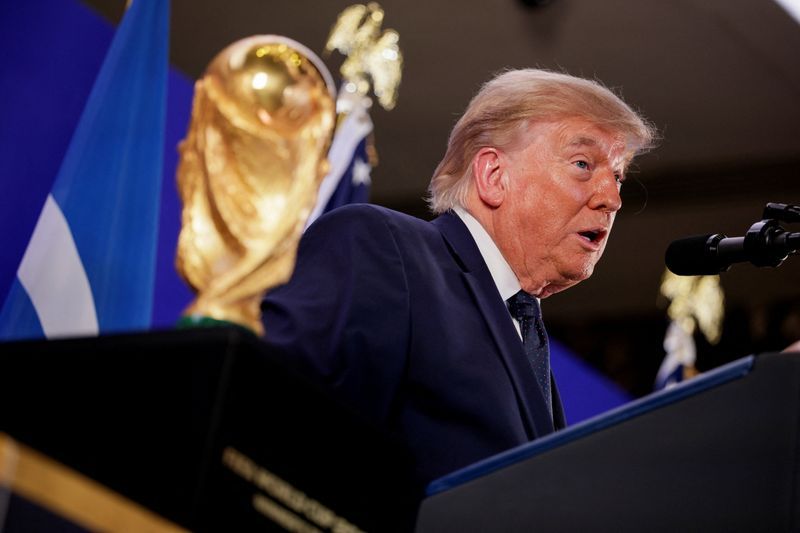
United States President Donald Trump will take centre stage at Sunday's World Cup final in New York/New Jersey Stadium, presenting the championship trophy to either Argentina or Spain. His prominent role comes after he became ensnared in the tournament's most contentious officiating dispute, when he acknowledged asking FIFA President Gianni Infantino to reconsider a red card handed to American striker Folarin Balogun. The involvement has thrust Trump into the heart of global football politics at a moment when his administration is pursuing hosting rights for a future World Cup edition in 2038.
Trump's presence at the final represents the culmination of an unusually hands-on engagement with international football governance. Infantino confirmed the arrangement at a lavish reception held inside Trump Tower in Manhattan on Friday, where the FIFA president publicly credited Trump's administration for the tournament's unprecedented commercial success. The event brought together approximately 300 attendees, including Brazilian football legend Ronaldo and numerous FIFA officials, underscoring the depth of the relationship between the American leader and world football's governing body.
The staging of the World Cup across the United States, Canada, and Mexico marks a significant diplomatic and commercial achievement for Trump, who has repeatedly invoked the tournament as evidence of his administration's global influence. At the Trump Tower reception, he declared that America had proven itself "a soccer country," a statement that reflected both pride in the tournament's record-breaking attendance figures and optimism about future hosting opportunities. His suggestion that the 2038 World Cup be held exclusively in the United States, excluding Mexico and Canada, drew laughter from supporters but also highlighted the competitive and occasionally fractious nature of major sporting event negotiations.
However, Trump's trajectory through the tournament has been marked by considerable controversy. A year before the competition began, American cities confronted serious logistical and diplomatic challenges in preparing for international visitors amid Trump's well-publicised immigration restrictions and travel bans affecting numerous countries. The concerns extended beyond mere sporting logistics, touching on fundamental questions about welcome and inclusivity at a global festival of football. As preparations advanced, Trump intensified his involvement, at one point threatening to relocate matches from cities governed by Democrats—a suggestion that prompted FIFA to clarify that such decisions remained exclusively within its purview.
The red card affair involving Folarin Balogun crystallised the tension between Trump's political role and his desire to influence sporting outcomes. Trump's request to Infantino to reconsider the disciplinary decision ignited fierce debate about the integrity of competition and the appropriate boundaries of political interference in sporting governance. FIFA formally stated that the American president played no role in Balogun's suspension eventually being lifted, yet the controversy demonstrated how Trump's involvement in World Cup affairs had transcended ceremonial participation and entered the operational realm of the sport itself.
Trump's cultivation of high-profile sporting appearances reflects broader strategic considerations within his second-term presidency. His approval ratings have faced persistent headwinds, and his engagement with major sports events appears designed to generate positive media coverage and energise his political base. Last year's Ryder Cup appearance on New York's Long Island drew enthusiastic crowds, but his reception in other sporting contexts has been decidedly more mixed. At the NBA Finals in June, he endured sustained booing, whilst presidential security protocols surrounding his attendance at last year's US Open tennis final frustrated spectators and generated negative press coverage.
The presentation of the World Cup trophy will place Trump before a genuinely global television audience watching on the world feed that Fox Sports and other international broadcasters utilise. This creates unusual broadcasting challenges for American networks, as the play-by-play commentator John Strong acknowledged. The network cannot control camera angles or cutaways to Trump's VIP position next to Infantino, meaning American viewers may encounter lengthy or repeated images of the president in a prominent position—a reality that carries distinct political implications in a deeply polarised nation. Strong's observation that "there are no neutral opinions" regarding Trump captures the fundamental reality: his attendance at the final will generate enthusiasm among some viewers whilst provoking frustration or anger among others.
The broader context reveals Trump's determined pursuit of sports diplomacy as a dimension of his presidential authority. FIFA's decision to award the 2026 World Cup to the three North American nations occurred during his first term, a fact he has frequently highlighted as a personal achievement. The prospect of hosting again in 2038 represents an extension of this ambition, suggesting that Trump views mega-events as both economic opportunities and platforms for projecting American prominence on the global stage. His exclusion of Mexico and Canada from that hypothetical 2038 scenario reflects not merely sporting preference but deeper political positions regarding bilateral relationships and American sovereignty in continental affairs.
The tournament itself has enjoyed commercial success that has validated Trump's involvement with FIFA, at least in economic terms. Record attendances and substantial television audiences have demonstrated sustained American appetite for international football, disrupting earlier assumptions that the sport remained peripheral to the national sporting consciousness. This success has provided Trump with material evidence supporting his claims that his administration has championed football's growth in the United States, a narrative he has reinforced through consistent engagement with Infantino and prominent appearances at marquee events.
As Trump prepares to take the stage at Sunday's final, the implications for Malaysian and Southeast Asian observers extend beyond mere ceremonial interest. The spectacle illustrates how political figures increasingly seek to instrumentalise major sporting events for domestic political advantage, whilst international governing bodies like FIFA navigate complex negotiations with powerful national governments. For a region that has historically viewed international sports as primarily competitive domains, the degree to which politics now permeates World Cup governance offers cautionary lessons about the blurring of boundaries between sporting integrity and political expedience. Trump's role at the final represents, in many respects, the culmination of trends that began a year ago—trends that suggest future World Cups will inevitably involve even deeper entanglement with the political priorities of host nations.

