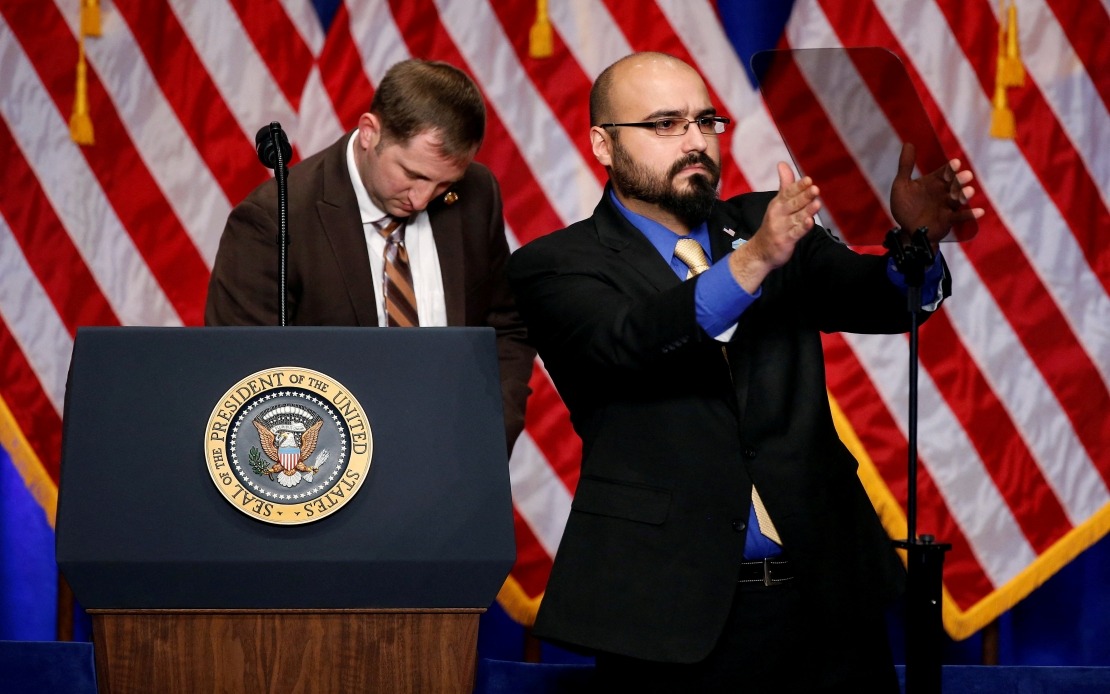
The White House has moved to place a senior teleprompter operator on unpaid leave following serious allegations of insider trading tied to President Donald Trump's speeches, marking an unusual breach of trust within the presidential administration. White House press secretary Karoline Leavitt confirmed the disciplinary action on Thursday, characterizing the situation as damaging to institutional integrity. Trump himself was briefed on the matter, with Leavitt describing it as both "deeply unfortunate and frankly a disgrace," signalling the seriousness with which senior leadership has treated the allegations.
The operator in question has held the position since 2016, meaning he has served across both Trump administrations and maintained access to advance speech materials, talking points, and policy announcements that would not be public knowledge. This long tenure suggests the individual had accumulated considerable trust within the Trump organisation, making the breach of that trust particularly striking. According to reporting by US broadcaster ABC, the operator allegedly leveraged his privileged insight into upcoming presidential remarks to generate profits exceeding $100,000, using his position to gain an unfair informational advantage.
The financial advantage was allegedly obtained through Kalshi, a prediction markets platform that has gained prominence in recent years as a venue for wagering on real-world events, political outcomes, and other developments that can be quantified and resolved. These platforms operate in a legal grey area in the United States, occupying a space between traditional financial markets and gambling operations. The ability to place bets on specific presidential statements or policy announcements creates obvious opportunities for information-based trading if someone with insider knowledge participates in such markets.
Kalshi's enforcement infrastructure appears to have functioned as intended in this instance. Robert DeNault, the platform's lawyer and head of enforcement, stated on social media platform X that the company had "promptly" identified, investigated, and reported the suspicious trading activity to the Commodity Futures Trading Commission, the federal regulator responsible for overseeing prediction markets and derivatives trading. DeNault emphasised that Kalshi had cooperated fully with regulators and provided all collected evidence, suggesting the company's compliance procedures caught the irregularities rather than the activity going undetected.
The referral to the CFTC represents an escalation beyond internal platform review, indicating that regulators now have jurisdiction to examine whether any laws were violated. The commission has authority to investigate insider trading and market manipulation across the derivatives and prediction markets it supervises. The involvement of federal regulators adds a layer of legal jeopardy for the operator, who could potentially face civil penalties, trading restrictions, or criminal charges depending on the investigation's findings and the applicable legal framework.
This incident highlights vulnerabilities that emerge when government officials operate in proximity to financial markets with access to non-public information. Unlike senior political appointees, who are typically bound by ethics rules and securities law restrictions, support staff such as teleprompter operators may not be subject to the same regulatory oversight regarding financial trading. The operator's position provided him with advance knowledge of announcements that could move markets or specific event probabilities, creating obvious profit opportunities that he allegedly exploited.
The case also raises questions about how prediction markets will be regulated going forward, particularly as their popularity has grown in recent years. These platforms have attracted significant investment and usage as alternatives to traditional polling or forecasting methods. However, their openness to insider information poses risks that resemble those in traditional securities markets, without necessarily the same compliance infrastructure or legal safeguards that developed over decades of securities regulation.
For Malaysian and Southeast Asian observers, this incident offers instructive lessons regarding political risk management and the governance challenges that emerge when new financial instruments intersect with government operations. As prediction markets and similar platforms expand globally, regulators across the region may need to develop frameworks addressing insider trading in these venues. The case demonstrates both that detection mechanisms can work—Kalshi's compliance team identified the suspicious activity—and that enforcement gaps may exist if trading restrictions are inadequate for those with government access.
The White House's swift action in placing the operator on unpaid leave signals an attempt to demonstrate accountability and institutional integrity in the face of the allegations. However, the underlying issue of who has access to advance government information and how to prevent the monetisation of that access remains unresolved. As the federal investigation proceeds, the case will likely inform discussions about stronger firewalls between government operations and financial markets, particularly given the proliferation of new trading platforms that operate with less historical regulatory precedent than traditional exchanges.

