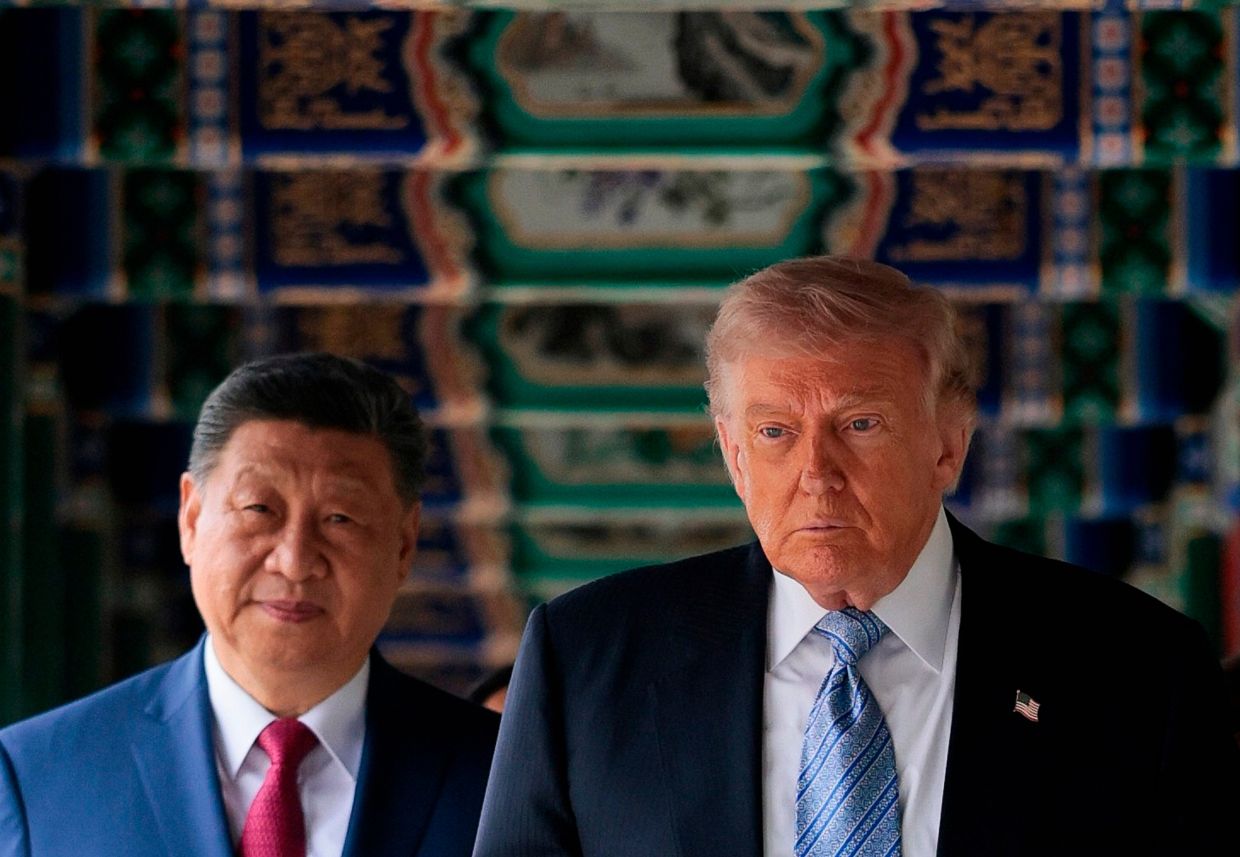
President Donald Trump has sent conflicting signals about China's alleged military support for Iran, expressing personal disappointment at the prospect while simultaneously moving forward with preparations for a high-level diplomatic visit from Xi Jinping scheduled for 24 September. The ambivalence highlights a persistent pattern in Trump's foreign policy towards Beijing: a combination of public confrontation and private accommodation that has confounded regional observers and complicated efforts to understand Washington's true strategic intent.
Reports emerged this week detailing a purported agreement for Chinese weapons to be airlifted from western China through Pakistan to Iran under a contract valued between US$60 million and US$70 million. Beijing's foreign ministry immediately dismissed these allegations as "untrue and not factual at all", reiterating China's stated commitment to facilitating de-escalation and peaceful resolution in the Middle East. This denial follows an earlier Chinese rejection of similar weapons supply claims made ahead of Trump's May visit to the Chinese capital, when Beijing denounced such accusations as "completely groundless".
When asked about the latest weapons report, Trump adopted a tone of qualified disapproval rather than outright accusation. He described the allegations as "surprising" and recalled that Xi had personally assured him during their May meeting that China would not provide any assistance to Iran under any circumstances. "He told me very strongly he wouldn't partake," Trump said, before adding the telling qualifier: "But he knows I'd be quite disappointed." The phrasing suggests Trump views potential non-compliance less as a strategic betrayal demanding sanctions than as a personal letdown from a leader he claims to have developed a relationship with.
Trump's tone contrasts sharply with his simultaneous attack on Anthony Fauci, the long-serving US health official. In a lengthy social media tirade, Trump renewed his assertion that Covid-19 originated in a Wuhan laboratory and accused Fauci of consistently attempting to "protect China" by disagreeing with the lab leak theory. "I said from the beginning that the virus came from the Wuhan Laboratory in China. Fauci strongly disagreed, always trying to protect China," Trump wrote. These comments resurrect a disputed theory that remains contentious within the global scientific community, which has increasingly leaned towards conclusions that the virus emerged through natural spillover from animals to humans.
For Malaysian and Southeast Asian observers, the revival of lab leak accusations carries particular significance. The narrative has become entangled in broader geopolitical competition, potentially influencing regional attitudes towards China and complicating efforts at constructive engagement. Additionally, reopening pandemic origin disputes may undermine scientific cooperation mechanisms that regional governments have worked to strengthen since 2020.
The contradiction between Trump's public accusations and his diplomatic calculations became even more apparent when examining the broader context of his recent China statements. Just one week before the weapons report emerged, Trump claimed that China and Russia were not "participating" in any war involving Iran. He cited his May conversation with Xi as the basis for this assessment, stating that the Chinese leader had promised non-interference "under any circumstances". Trump emphasised his willingness to accept Xi's word: "Considering our relationship, I take him at his word." Simultaneously, however, he issued a warning that if China did assist Iran, "it would be very bad for them – certainly not in their best interests".
This oscillation between expressions of trust and barely veiled threats reveals how deeply Trump's China policy is personalised around his relationship with Xi. Rather than grounding decisions in institutional frameworks or clearly articulated strategic objectives, Trump appears to rely on what he perceives as personal understandings with the Chinese leader. For policymakers in the region, this approach creates substantial uncertainty, as outcomes depend heavily on the stability and nature of bilateral personal dynamics rather than formal agreements or established protocols.
The inconsistency becomes even starker when considering Trump's earlier accusations regarding election interference. Just twelve days before expressing confidence in Xi's word, Trump delivered a prime-time address accusing Beijing of executing "the largest compromise of election data in history", alleging that China had illicitly obtained 220 million American voter records. He declassified documents purporting to support these claims and described the situation as an "unprecedented election security nightmare" representing a direct threat to American democracy.
Yet despite these grave accusations, Trump's administration has imposed no new sanctions, trade penalties, or formal diplomatic consequences targeting China in response. Planning for Xi's September visit has proceeded without apparent disruption. This stark gap between rhetorical escalation and policy action suggests that either Trump views the election interference claims as less serious than his public statements indicate, or that his desire to maintain workable relations with Beijing overrides security concerns. For regional governments attempting to calibrate their own approach to Washington and Beijing, this ambiguity is deeply problematic.
The broader pattern reflects a fundamental tension within Trump's China strategy. He combines nationalist rhetoric attacking Beijing's intentions and actions with a pragmatic willingness to negotiate and maintain channels for dialogue. Previous administrations have also balanced competition with engagement, but Trump's approach differs markedly in its intensity of personal invective combined with apparent operational accommodation.
For Malaysia and other Southeast Asian nations, understanding this dynamic is essential. Trump's unpredictability regarding China policy creates opportunities for smaller nations to play a larger role in regional diplomacy, but it also increases risks of miscalculation. The approach suggests that bilateral relationships with Washington cannot be assumed to follow consistent strategic logic, requiring careful navigation and independent assessment of long-term national interests.
As Xi's September visit approaches, observers will be watching closely to determine whether Trump uses the occasion to address concerns publicly or whether the meeting proceeds in an atmosphere of diplomatically papered-over disputes. The answer may depend less on rational policy frameworks than on the personal chemistry between the two leaders and whatever private assurances Xi may offer regarding Iran and other contested issues.

