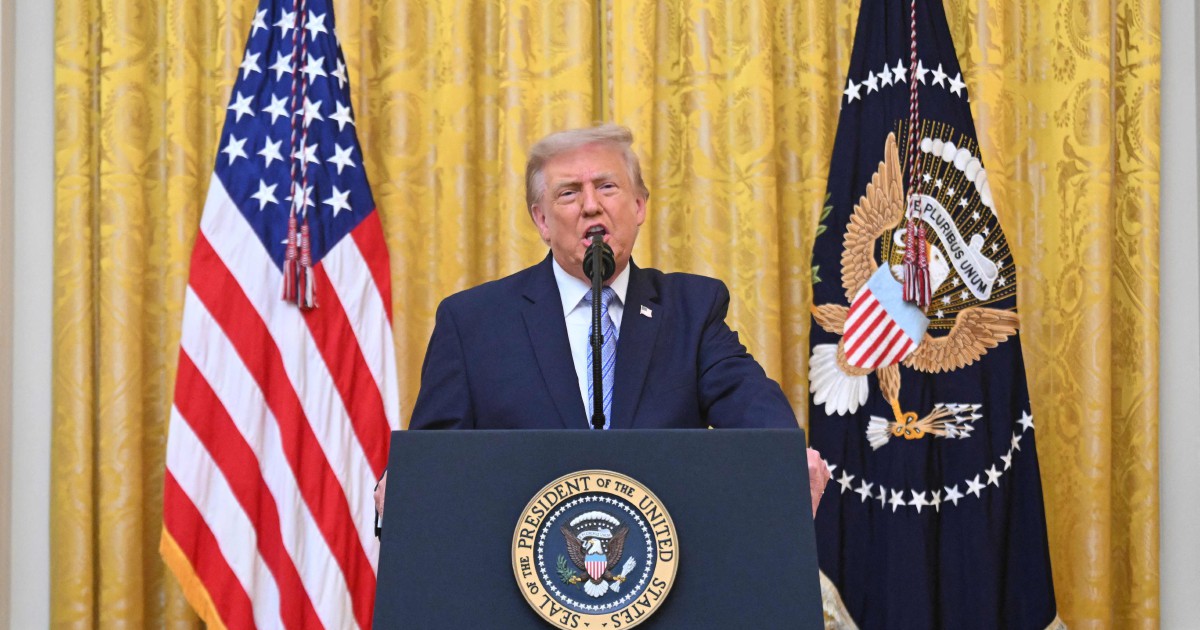
President Donald Trump has resurfaced a series of election fraud allegations that have been repeatedly examined and rejected by law enforcement agencies, election officials, and independent fact-checkers during a public address in Washington on Thursday. The remarks represent a continuation of contested narratives that have dominated political discourse in the United States since the 2020 presidential contest, even as the nation enters a new electoral cycle.
Among the claims put forward by the US President was an assertion that China illicitly obtained millions of voter registration files, a charge that has not been substantiated by federal agencies tasked with investigating election security. The allegation touches on longstanding concerns about cybersecurity and foreign interference in American democratic processes, yet independent investigations and official government bodies have found no credible evidence supporting such large-scale data theft during the 2020 election cycle. Election security experts have consistently noted that American voting infrastructure operates through decentralized systems managed by individual states and counties, making coordinated manipulation extraordinarily difficult.
Trump also suggested that Venezuela possessed the capability to alter American voting machine outcomes, another claim that lacks evidentiary support from election authorities and cybersecurity professionals. This particular assertion echoes earlier speculation that emerged in the immediate aftermath of the 2020 election, despite Venezuelan officials' denials and the absence of technical findings backing such interference. The claim persists despite multiple audits, recounts, and court proceedings across numerous states that were unable to identify evidence of machine tampering or manipulation at scale.
The persistence of these narratives underscores deeper divisions within American political discourse regarding election legitimacy and institutional trust. For observers across Southeast Asia, including Malaysian readers, these developments reflect broader tensions within mature democracies regarding how contested electoral outcomes are processed and adjudicated. The contrast between institutional responses to fraud allegations in established Western democracies and approaches elsewhere highlights the varying mechanisms through which different nations address electoral disputes and public confidence in electoral systems.
Election security officials from both political parties, along with Trump's former Attorney General William Barr and Department of Homeland Security representatives, have previously characterised the 2020 election as secure. Numerous court challenges to the results—exceeding 60 cases brought through the American judicial system—failed to establish any widespread fraud. State election officials, many appointed by Republican administrations, certified results following standardised procedures and audits. These institutional responses demonstrate how democracies typically employ checks and verification mechanisms to address electoral concerns.
The reintroduction of these allegations raises questions about the trajectory of political rhetoric in the United States and its potential implications for democratic institutions. When prominent political figures repeatedly articulate claims that have been investigated and found lacking credible evidence, it creates an environment where public confidence in electoral legitimacy becomes increasingly strained. For international observers, including those in Malaysia with interest in studying comparative political systems, this dynamic illustrates how misinformation can persist despite official investigation and public refutation.
Independent fact-checking organisations have extensively catalogued the evolution and evolution of these claims, documenting how specific allegations have been modified, repackaged, or refined when initial versions proved untenable. This pattern suggests an ongoing political strategy rather than genuine investigative discoveries. The resilience of these narratives despite contradictory evidence from election officials, cybersecurity experts, and courts indicates how deeply embedded such claims have become within certain political communities.
The implications for democratic institutions extend beyond electoral cycles. When citizens encounter persistent claims of fundamental institutional corruption unsubstantiated by investigation, it erodes the shared foundation of factual understanding necessary for functional democratic discourse. This challenge—common to multiple democracies globally—requires sustained effort from institutions, media, and civic organisations to establish and maintain common standards for evidence and credibility.
For Malaysian observers monitoring American political developments, these events reflect tensions increasingly visible across numerous democracies regarding misinformation, institutional legitimacy, and the handling of electoral disputes. The American experience demonstrates both the resilience of institutional checks—through court systems, electoral authorities, and auditing mechanisms—and the limitations of institutional responses when political figures continue advancing unsubstantiated claims despite official investigation.
Trump's Thursday address represents the latest instance in a pattern of statements that election authorities, law enforcement, and courts across the United States have found unsupported by evidence. The continued assertion of these claims despite comprehensive investigation underscores the complex challenge democracies face when prominent political figures maintain narratives disconnected from factual findings, particularly regarding fundamental democratic processes like elections.

