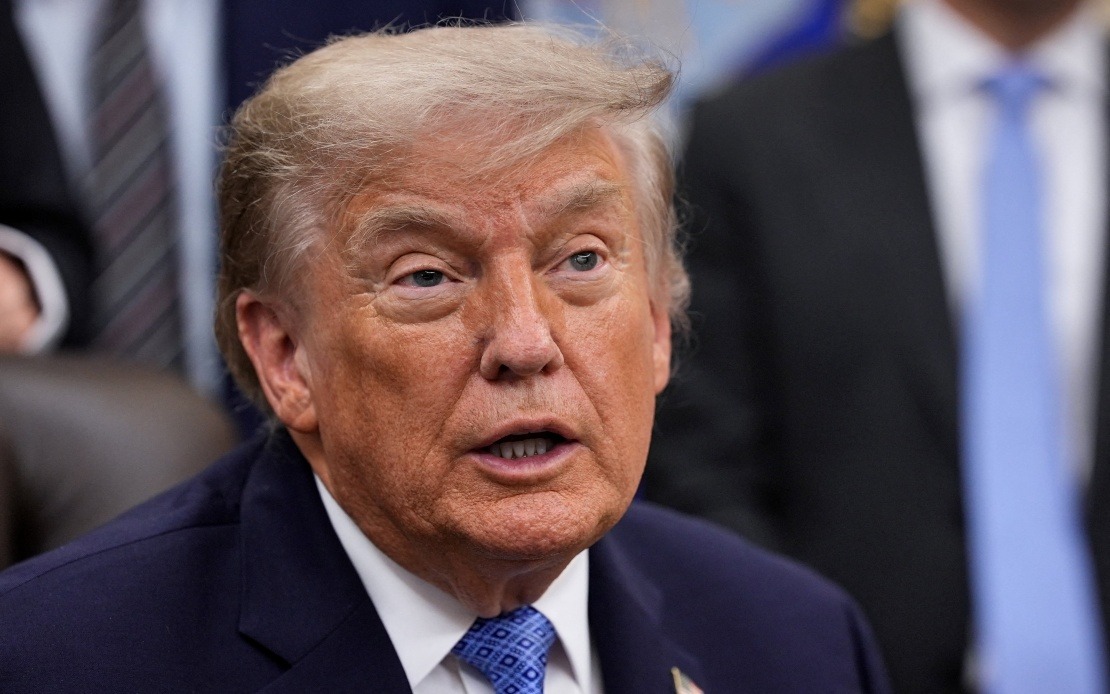
US President Donald Trump has escalated tensions with Canada over cross-border wildfire smoke, using the environmental issue to justify potential trade penalties against his northern neighbour. On Friday, Trump took to his Truth Social platform to declare that the cost of air pollution drifting into American territory should be absorbed into tariffs already imposed on Canadian goods, signalling a willingness to weaponise environmental concerns in pursuit of trade leverage. The remarks represent another instance of the Trump administration linking environmental incidents to commercial negotiations, a pattern that underscores the intertwining of climate, trade, and diplomacy in contemporary North American relations.
The immediate trigger for Trump's complaint stems from dozens of active wildfires burning across Ontario and Minnesota, which have together produced vast quantities of smoke affecting air quality across much of the northeastern United States and Canada alike. Major population centres including Toronto, Chicago, Detroit, and Washington have experienced notably degraded air quality, whilst New York witnessed particularly severe visibility reductions and persistent smoke odour in urban areas. The scale and geographic reach of the smoke plumes demonstrate how environmental phenomena respect no border and inevitably create cross-jurisdictional complications for political leaders on both sides of the Canada-US boundary.
Trump's characterisation of the situation blamed Canadian authorities for inadequate forest management practices, specifically citing what he described as a failure to properly maintain forests and remove accumulated brush and debris. This negligence, in his assessment, directly enabled the conditions necessary for wildfires to ignite and spread with such vigour. The president's language grew increasingly heated as he described American territory as being "unnecessarily invaded by filthy, polluted, and unhealthy air, the quality of which is dangerous, and totally unacceptable," deploying inflammatory rhetoric that framed an environmental problem as an act of negligence or even transgression by a neighbouring state.
However, the scientific consensus on North American wildfire causation diverges substantially from Trump's characterisation. Peer-reviewed research and environmental studies consistently identify climate change as the primary driver accelerating wildfire frequency, intensity, and duration across the continent. Rising temperatures create drier conditions that fuel larger conflagrations, whilst altered precipitation patterns reduce moisture availability in vegetation. This scientific reality complicates Trump's narrative of Canadian forest mismanagement as the root cause, suggesting instead that both nations face a shared climatic challenge that transcends the boundaries of political blame-shifting.
The tariff threat represents Trump's preferred mechanism for translating environmental grievances into economic pressure. By explicitly linking the smoke pollution to existing or forthcoming tariff schedules, the American president positions environmental damage as another cost that should be compensated through trade concessions. This approach mirrors previous instances where the Trump administration has invoked environmental or health concerns to justify protectionist measures, treating international environmental spillovers as tradeable commodities rather than collective problems demanding coordinated solutions.
Meanwhile, Ontario Premier Doug Ford responded to the tariff threat with a starkly different rhetorical approach, urging American politicians to focus on mutual assistance rather than recrimination. Ford reminded Trump that Ontario and Canadian provinces have repeatedly provided support and resources to American jurisdictions facing natural disasters, framing cross-border environmental crises as opportunities for solidarity rather than confrontation. The premier's statement implicitly critiques the transactional mindset underlying Trump's tariff proposal, suggesting that geographically proximate nations with porous boundaries should cultivate cooperative relationships during environmental emergencies.
The dispute carries particular relevance for Malaysian and Southeast Asian observers given the region's experience with transnational smoke and haze pollution. Indonesia's recurring forest fires and the resulting transboundary smoke affecting Malaysia, Singapore, and Thailand provide a regional parallel to the Canada-US situation, albeit with different political dynamics and economic consequences. Just as Trump frames smoke crossing into America as an external imposition warranting tariff responses, some Southeast Asian nations have historically expressed frustration with Indonesian forest management whilst struggling to formulate collective responses beyond diplomatic protests.
The incident also illustrates how Trump's approach to Canada differs markedly from conventional diplomatic norms surrounding transnational environmental issues. Rather than invoking the framework of environmental cooperation or shared responsibility that characterises most international environmental negotiations, Trump immediately converted the smoke problem into a trade leverage opportunity. This suggests that the Trump administration views virtually all bilateral interactions through a mercantile lens, where environmental externalities become merely another category of costs to be offsetted through tariff adjustments rather than genuine collaborative management.
For Canadian policymakers and businesses, the tariff threat introduces new uncertainty into an already strained bilateral relationship. Canadian exports to the United States comprise a substantial portion of national economic output, making tariff increases a genuine economic concern regardless of their connection to wildfire smoke. The precedent of using environmental incidents as tariff justification could enable future American administrations to levy additional trade penalties on environmental grounds, creating a perverse incentive structure where cross-border environmental issues become occasions for economic punishment rather than cooperative problem-solving.
Looking forward, the question of how Canada and the United States will respond to transnational wildfire smoke in coming years remains unresolved. Trump's threat to increase tariffs suggests he may resist initiatives requiring genuine joint investment in forest management or climate adaptation. Ontario's rebuttal indicating willingness to assist American communities could establish a pattern where provincial and state governments work around federal-level acrimony, though this informal cooperation remains fragile and dependent on political goodwill.

