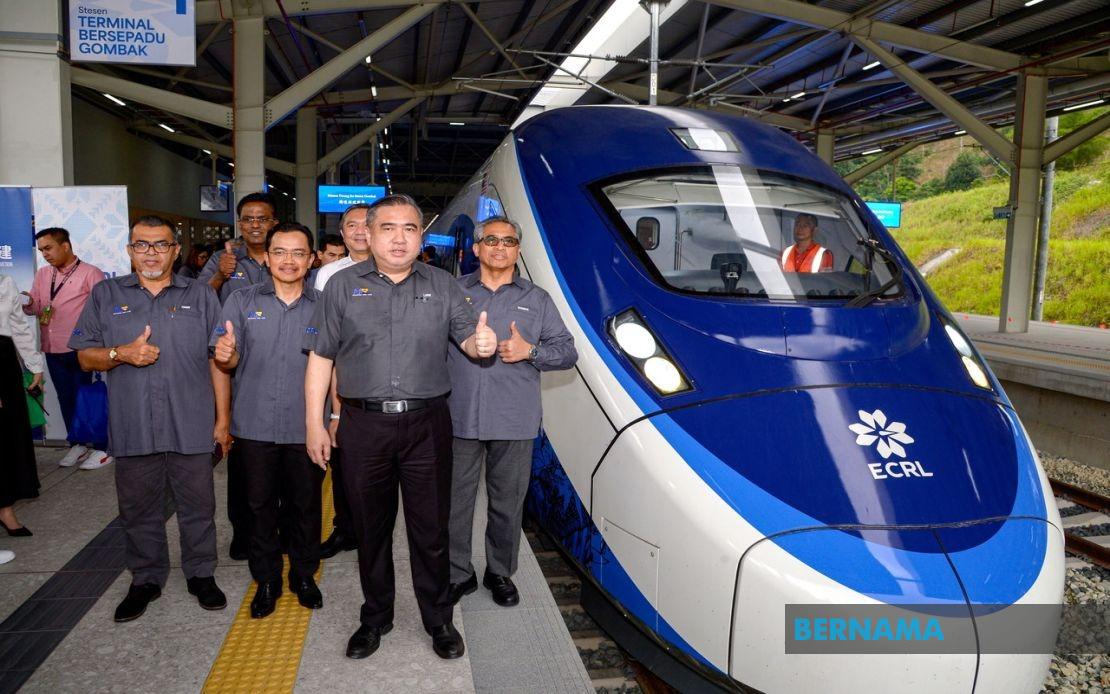
Transport Minister Anthony Loke Siew Fook has announced a significantly accelerated timeline for the East Coast Rail Link (ECRL) Phase 1, targeting operations between Kota Bharu and Gombak to commence by December this year rather than the previously scheduled January 2027. The ambitious four-month advancement reflects confidence in project progression, though Loke emphasised that the expedited schedule hinges entirely on successful completion of rigorous testing protocols and remains contingent on maintaining uncompromised safety standards throughout the commissioning process.
The acceleration strategy represents a coordinated effort involving Malaysia Rail Link Sdn Bhd, the primary contractor China Communications Construction Company Ltd, and the Land Public Transport Agency, which Loke indicated will seek efficiencies in certification and testing approval workflows. Loke acknowledged that standard regulatory processes typically consume two to three months, and his administration is investigating how to streamline these procedures without circumventing essential safeguards. The announcement came during the launch of the Comprehensive Inspection Train and the introduction of ECRL's main station design concept at Gombak Integrated Terminal Station.
The push for acceleration relies partly on groundwork already completed before the train arrived in Malaysia. Extensive factory testing in China, including multiple systems validations, has substantially reduced the validation workload remaining domestically. This foreign pre-commissioning, Loke suggested, provides a foundation for compressed timelines that might otherwise be impossible. The minister framed the strategy not as cutting corners but as leveraging efficiencies gained from earlier development phases.
Two critical testing stages now occupy the project schedule. System Integration Testing commencing this month will validate the interconnection between electrical, signalling, and other critical systems across the entire railway network. Following SIT completion, Fault-Free Run testing will commence in September, requiring the first train set and electric locomotive to traverse 8,000 kilometres under real operational conditions but without passenger loads. This extended mileage verification, conducted under Land Public Transport Agency supervision, ensures operational reliability meets established Malaysian standards and international requirements.
Loke stressed that FFR represents a non-negotiable prerequisite for commercial service because it replicates genuine operating conditions while preserving the controlled environment necessary for safety certification. All preceding tests must receive formal approval before FFR implementation commences, meaning the pursuit of accelerated timelines cannot compromise the sequential, cumulative nature of safety validation. The minister's repetition that safety cannot be sacrificed underscored government awareness of public concerns regarding ambitious project schedules.
As of July, Phase 1 construction has achieved 95.08 per cent completion, indicating the infrastructure itself is substantially ready for operational activation pending successful testing outcomes. This near-completion status differentiated ECRL from many infrastructure projects globally, where testing timelines often extend due to construction delays. Consequently, the December target becomes plausible rather than purely aspirational, provided testing proceeds without significant technical obstacles.
Phase 2, extending service from Gombak to Port Klang, operates on a separate completion timeline, with infrastructure anticipated by December 2027 and operational launch scheduled for January 2028. This phased approach allows revenue-generating service on the high-density Kota Bharu-Gombak corridor to commence while Port Klang connectivity development continues. For Malaysian commerce and passenger traffic patterns, Phase 1 activation creates immediate benefits by connecting Kelantan's economic centres to Selangor's industrial and commercial hub, potentially reshaping logistics networks across peninsular Malaysia.
The ECRL project holds profound significance for Southeast Asian connectivity and Malaysia's position within regional trade frameworks. By linking East Coast resources and manufacturing to Klang Port—one of Asia's busiest container terminals—the railway strengthens Malaysia's competitive positioning in regional supply chains. Faster, more reliable cargo movement reduces logistics costs for Malaysian exporters and positions the country advantageously against regional competitors in Thailand, Vietnam, and Indonesia, all developing comparable infrastructure projects.
For Malaysian commuters and businesses in participating regions, December activation would mean early access to high-speed rail capacity that transforms travel economics between peninsula regions currently dependent on highways and domestic flights. Journey times between Kota Bharu and Gombak would compress substantially, facilitating labour mobility, business expansion across regions, and tourism development. The rail link also addresses perennial highway congestion between the east and central regions, potentially reducing accident rates and improving freight efficiency.
Loke's acknowledgment that acceleration involves working with the Land Public Transport Agency on regulatory processes highlights institutional coordination as crucial to infrastructure timelines. In Malaysian governance, regulatory bodies sometimes operate independently of development agencies, creating procedural bottlenecks. Actively involving APAD in streamlining certification demonstrates government commitment to resolving systemic implementation obstacles that delay project activation beyond technical readiness.
The involvement of Chinese stakeholders, including Ambassador Ouyang Yujing's presence at the launch ceremony and CCCC president Zhang Bingnan's participation, underscores the ECRL's significance as a flagship Malaysia-China infrastructure project under the Belt and Road Initiative framework. Chinese contractors' performance and Malaysian government's commitment to meeting accelerated timelines carry implications for future bilateral infrastructure cooperation and Malaysian credibility in attracting Chinese investment into comparable projects.
For Malaysia's broader transport ambitions, ECRL Phase 1's December activation sets precedent for infrastructure delivery timelines. Successful acceleration would demonstrate that ambitious project schedules are achievable through coordinated effort, potentially influencing government expectations for other major transport initiatives. Conversely, delays extending into 2025 or beyond would raise questions about whether optimistic timelines adequately account for real-world contingencies, affecting public confidence in future infrastructure commitments.
The December target remains conditional on testing outcomes and regulatory approval progression, meaning stakeholders should anticipate potential adjustments as commissioning phases complete. Nevertheless, Loke's public announcement signals government determination to prioritise ECRL activation and willingness to allocate administrative resources toward removing bureaucratic obstacles, suggesting serious commitment to the accelerated timeline beyond political rhetoric.

