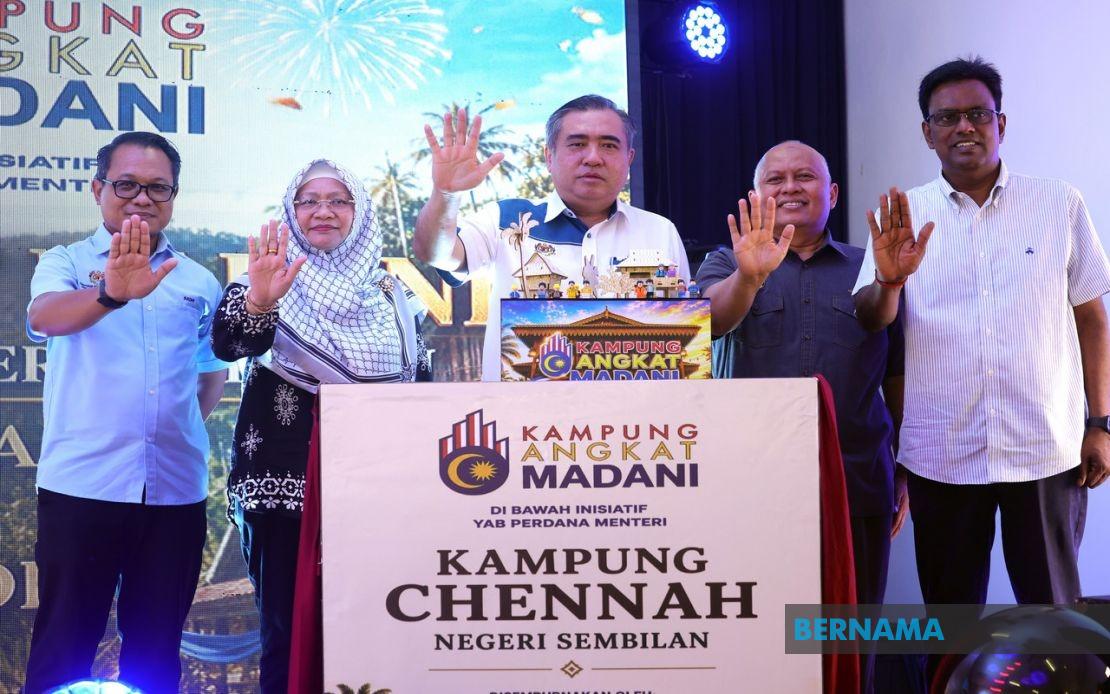
Transport Minister Anthony Loke Siew Fook moved quickly to deflect criticism of the Kampung Angkat MADANI programme, insisting that the village development initiative bears no connection to the concurrent state election campaign. Speaking in Jelebu after launching the Land Public Transport Agency's contribution to the scheme at Kampung Chennah, Loke positioned the effort as a continuation of government work initiated two years prior, implemented through a phased approach designed to systematically reach communities most distant from urban centres.
The minister's statement carries significance for Malaysian observers accustomed to scrutiny over the timing of government initiatives during electoral periods. Loke acknowledged that such sensitivities exist and outlined the rigorous constraints the government has imposed on itself. He explained that the administration has established a clear protocol: all official government programmes and ceremonial events must conclude before the nomination day that formally kicks off the election campaign period. This self-imposed discipline reflects what Loke characterised as a Prime Minister-initiated shift toward a new administrative culture—one designed to insulate the electoral process from the machinery of government patronage.
What distinguishes Loke's position is his transparency about the mechanics of this scheduling challenge. Rather than claiming innocence through ignorance, he acknowledged that government ministers continue performing their substantive duties during campaigns but must refrain from attending official government events in affected constituencies once the formal campaign window opens. This nuance matters because it demonstrates an attempt to balance the government's ongoing responsibility to deliver services with the democratic principle that elections should not be dominated by displays of state resources. For Loke personally, it means stepping back from public-facing ministerial activities in constituencies actively campaigning, even as his ministry's ordinary work continues behind the scenes.
The Kampung Chennah initiative itself exemplifies the programme's stated purpose. Local officials selected this remote village based on objective criteria: geographic isolation and documented infrastructure deficiencies. Rather than selecting a site for maximum political advantage, the selection process appears to have prioritised communities with the greatest needs. The government has committed RM500,000 to five distinct projects: library renovation, futsal court refurbishment, and drainage improvements at the mosque. These tangible improvements address basic service gaps that development economists recognise as critical for rural quality of life and represent the kind of foundational work that typically generates cross-party support at the local level.
Loke's framing of his ministry's role reflects a broader evolving understanding of what transport governance entails in Malaysia. Conventionally, the Transport Ministry focuses on port operations, airport management, railway development, and public transport systems—the technical infrastructure that moves goods and people. Yet Loke articulated a vision encompassing social responsibility and community engagement as core functions rather than peripheral activities. This rhetorical shift, whether substantive or merely presentational, acknowledges that infrastructure development cannot be divorced from the human ecosystems it serves. Rural communities that lack basic amenities experience infrastructure projects as disconnected from their daily realities if those projects only serve inter-city logistics.
The phased rollout strategy merits attention as well. Rather than a single grand announcement, the government is spreading implementation across multiple phases and multiple agencies. Loke confirmed his personal involvement in launching similar initiatives previously, including in an Orang Asli village in Lenggeng the previous year. This pattern suggests a considered approach to managing expectations and ensuring implementation quality rather than pursuing headline-grabbing mass announcements. The two to three month completion timeline for Kampung Chennah projects appears realistic given their scope, though execution timelines for government contracts in Malaysia have historically proven optimistic.
For Malaysian readers in rural constituencies, the minister's remarks carry practical implications. The existence of objective criteria for village selection—remoteness and infrastructure needs—provides a framework for understanding how their own communities might qualify for similar support. At the same time, the emphasis on phased implementation suggests that not every village will receive assistance simultaneously, and residents should expect timelines measured in years rather than months for comprehensive coverage. The allocation of resources, while substantial for a single village, also illustrates the incremental pace at which rural development occurs when handled through formal government channels rather than concentrated investment.
The programme's relationship to broader development policy in Southeast Asia also warrants consideration. Countries across the region struggle with rural-urban disparities that fuel migration to overcrowded metropolitan areas. Malaysia's emphasis on directed village development represents one policy response, though evaluations of similar programmes in Thailand, Indonesia, and the Philippines suggest that infrastructure provision alone, without complementary initiatives addressing employment and educational opportunity, often fails to stem rural exodus. The Kampung Angkat MADANI programme's success will partly depend on whether improvements in physical infrastructure create conditions for local economic activity or simply make villages more comfortable places to live before residents eventually depart for urban opportunities.
Loke's insistence that the programme predates the current election campaign and follows government protocols reflects a government conscious of the need to maintain democratic norms while leveraging the state's legitimate role in providing public goods. The Transport Minister's willingness to preempt criticism by explaining the scheduling constraints demonstrates awareness that citizens and opposition politicians scrutinise the relationship between government spending and electoral timing. Whether this constitutes genuine institutional restraint or sophisticated public relations remains a question individual voters must assess based on patterns of behaviour across multiple election cycles rather than isolated statements.

