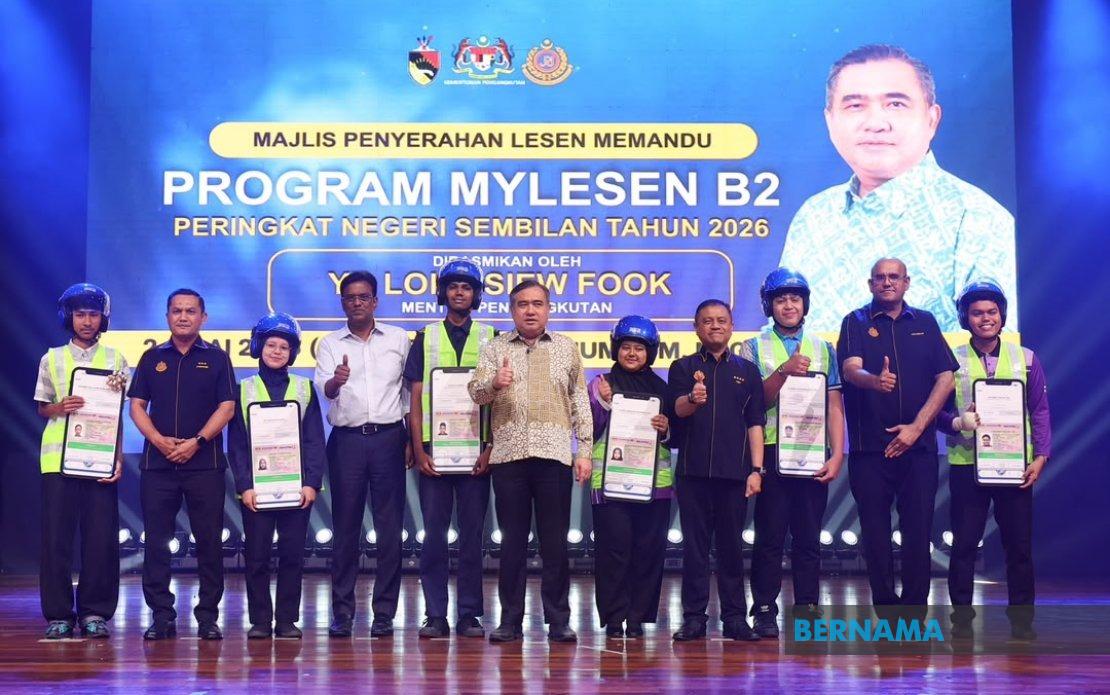
Transport Minister Anthony Loke has delivered a stern message to Malaysia's youth motorcyclists, particularly those newly enrolled in the MyLesen B2 Programme, emphasising that a motorcycle licence represents a legal privilege and moral obligation rather than a licence for reckless riding. Speaking during a licence presentation ceremony in Seremban on July 2, Loke stressed the importance of responsible road use and strict adherence to traffic laws, signalling the government's intensified focus on curbing dangerous riding behaviours that have claimed countless lives across the country.
The minister's remarks come against a sobering backdrop of road safety statistics. Motorcyclists and pillion riders account for approximately 60 per cent of all annual road fatalities in Malaysia, with the overwhelming majority of victims below age 30. This demographic pattern reveals a troubling vulnerability among young road users whose inexperience and risk-taking tendencies combine to create a public health crisis. By directly addressing licence recipients at the point of receiving their credentials, the government is attempting to instil safety consciousness from the outset of riders' legal journeys on Malaysian roads.
Loke characterised the free motorcycle licence as an opportunity for young Malaysians to commute safely to educational institutions and employment, not as a gateway to antisocial behaviour. His explicit warning against treating weekends as opportunities for illegal racing signals mounting government concern about organised motorcycle racing groups that have proliferated in urban and suburban areas. The minister's reference to illegal activities underscores a broader pattern of enforcement challenges authorities face in combating street racing and unregulated vehicle testing, which pose dangers to both participants and innocent road users.
The MyLesen B2 Programme has emerged as a cornerstone of government mobility and socioeconomic policy. Since its inception in 2023, the initiative has benefited more than 100,000 recipients nationwide, providing free access to motorcycle licensing that previously represented a financial barrier for lower-income youth. By removing cost obstacles to legal riding credentials, the programme theoretically reduces incentives for unlicensed operation while simultaneously expanding employment and educational opportunities for participants who gain independent transportation access.
Negeri Sembilan has witnessed substantial programme expansion this year, with the quota increasing to 2,300 participants from just 1,000 in the previous cycle. Current figures reveal that 1,979 candidates have obtained their Learner's Driving Licence, whilst 1,879 have progressed to complete practical training and competency assessments, securing their Probationary Driving Licence. This progression pipeline demonstrates systematic implementation, though the minister's emphasis on behavioural compliance suggests concerns that acquiring legal credentials does not automatically translate to responsible riding practices.
The government has simultaneously strengthened legal frameworks to deter reckless riding. The Road Transport (Amendment) Bill 2026, recently passed by the Dewan Rakyat, introduces enhanced penalties specifically targeting illegal racing and speed testing activities. Loke emphasised that enforcement under this legislation now includes not merely fines but potential imprisonment, elevating illegal racing from a traffic violation to a serious criminal offence category. This legislative escalation reflects recognition that previous regulatory approaches have proven insufficient in deterring widespread organised racing culture among youth populations.
For Malaysian and Southeast Asian observers, the MyLesen B2 initiative represents an instructive model of combining financial accessibility with safety advocacy. Rather than implementing restrictive licensing policies that exclude lower-income youth from legal motorcycling, the programme embraces inclusion whilst pairing it with intensive safety messaging and regulatory enforcement. However, the minister's need to publicly caution licence recipients suggests persistent cultural attitudes amongst some young riders that treat motorcycles primarily as vehicles for thrilling rather than transportation.
The emphasis on SIRIM-certified helmet usage reflects recognition that protective equipment remains underutilised among Malaysian motorcyclists. Loke's reiteration of helmet standards indicates that behavioural compliance extends beyond traffic law adherence to encompassing basic safety practices often neglected by riders, particularly those aged under 30 who may perceive accident risk as abstract rather than imminent. The requirement for certified equipment establishes a minimum protective threshold that authorities can enforce independently of rider compliance with speed or licensing regulations.
Transport Ministry and Road Transport Department (JPJ) officials present at the ceremony, including Secretary-General Datuk Seri Jana Santhiran Muniyan and JPJ Director-General Datuk Aedy Fadly Ramli, signal coordinated institutional commitment to programme implementation and road safety enhancement. This administrative alignment suggests that MyLesen B2 represents not merely a licensing initiative but a comprehensive mobility ecosystem prioritising accessibility, safety standardisation, and enforcement integration. The involvement of Negeri Sembilan's state-level JPJ director emphasises federalised implementation that tailors national policy to local contexts and conditions.
Looking forward, the apparent tension between expanding motorcycle access and preventing dangerous riding suggests government recognition that road safety improvements cannot rely solely on licensing restrictions or penalty escalation. Instead, success appears to depend on cultivating safety consciousness amongst young riders whilst simultaneously strengthening enforcement mechanisms and legal consequences. The MyLesen B2 Programme's combination of financial accessibility with behavioural expectations presents a dual-track approach that acknowledges youth mobility needs whilst establishing non-negotiable safety and legal compliance standards that transcend demographic boundaries.

