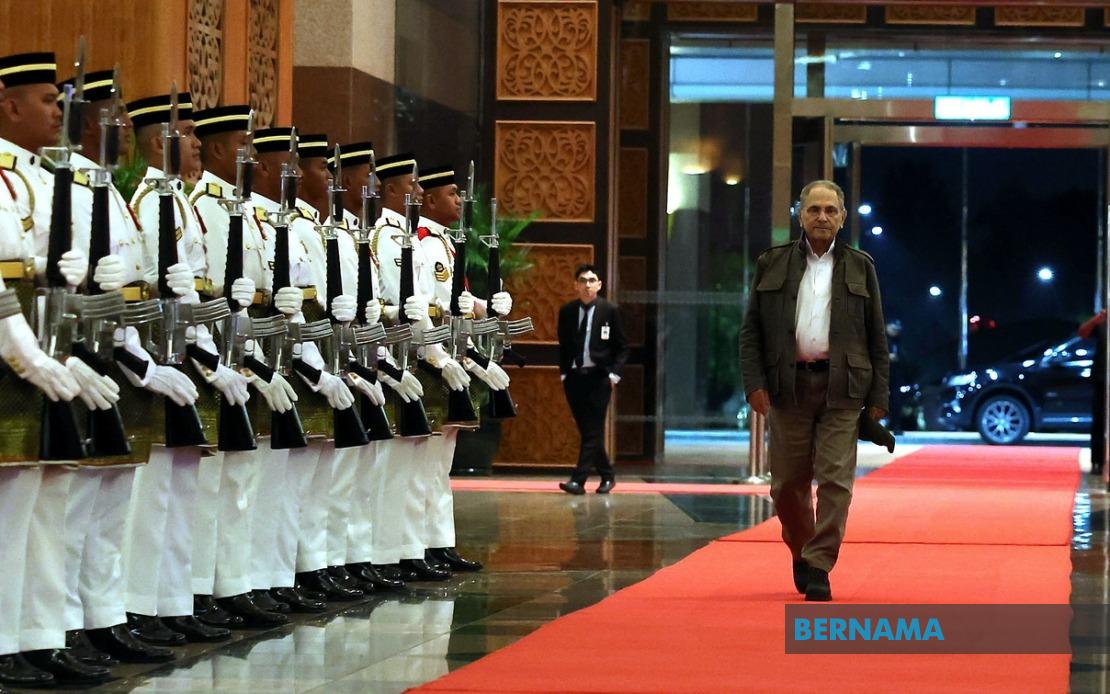
Timor-Leste President Jose Ramos-Horta concluded a five-day special visit to Malaysia early today, departing from Kuala Lumpur International Airport on a Batik Air flight bound for Dili. The departure, which took place in the early hours of the morning, marked the end of a diplomatic engagement that sought to deepen cooperation between the two Southeast Asian nations and affirm Malaysia's support for Timor-Leste's evolving role within the regional bloc.
The Nobel Peace Prize laureate was accorded full ceremonial honours befitting a visiting head of state, with a formal Guard of Honour comprising officers and personnel from the First Battalion Royal Ranger Regiment assembled to bid farewell to the presidential delegation at the airport terminal. The meticulous protocol surrounding his departure underscored the diplomatic significance that Malaysia places on its relationship with Timor-Leste, a nation that has increasingly assumed prominence in regional affairs following its integration into ASEAN.
Ramos-Horta's visit encompassed a series of high-level engagements that revealed the breadth of Malaysia's commitment to its eastern neighbour. During a dialogue session held on June 15 titled "A Changing World, Enduring Values," the Timorese leader publicly characterised bilateral relations as "exceptionally good," providing rare high-level validation of the diplomatic partnership. His remarks reflected satisfaction with Malaysia's trajectory in maintaining robust security arrangements, nurturing democratic institutions, and achieving meaningful economic growth—matters of particular relevance to Southeast Asian nations navigating complex geopolitical and developmental challenges.
A significant dimension of the visit involved acknowledging Malaysia's historical role in Timor-Leste's emergence as an independent nation. Ramos-Horta expressed gratitude for Malaysia's steadfast backing since well before the country's independence in 2002, particularly emphasising the Malaysian contribution to United Nations peacekeeping operations conducted in 1999. These observations carry weight within Timor-Leste's national consciousness, as the independence struggle remains central to its identity, and international solidarity during that period continues to shape diplomatic relationships today.
The timing of this visit held particular significance given Timor-Leste's recent ascension to ASEAN membership. Ramos-Horta specifically acknowledged Malaysia's instrumental support for Timor-Leste's accession bid during Malaysia's chairmanship of the regional organisation, with Timor-Leste formally becoming ASEAN's eleventh member on October 26, 2025. This backing represented a tangible demonstration of Malaysia's commitment to expanding the association's footprint and inclusive governance, positioning Kuala Lumpur as a constructive force in regional integration.
Looking ahead, Ramos-Horta expressed confidence in Timor-Leste's preparedness to assume the ASEAN presidency in 2029, a responsibility that typically carries substantial logistical and diplomatic demands. He revealed that his government is expediting infrastructure development and facility upgrades to meet the standards expected for hosting the regional bloc's complex institutional machinery. This ambitious timeline reflects the confidence that ASEAN member states have placed in Timor-Leste's institutional capacity, though the undertaking will require sustained investment and international cooperation.
Economic engagement featured prominently in the presidential visit, with Ramos-Horta actively cultivating Malaysian business interest in Timor-Leste's infrastructure sector. He highlighted the country's favourable investment climate, characterised by manageable debt levels and a robust sovereign wealth fund providing financial resilience. The appeal to Malaysian investors stressed that Timor-Leste benefits from backing by multilateral financing institutions, offering investors the additional security of institutional support. This pitch reflects a strategic shift toward leveraging ASEAN membership to attract foreign direct investment from regional partners.
Prime Minister Datuk Seri Anwar Ibrahim's hosting of a formal luncheon reception at the Seri Perdana Complex further demonstrated Malaysia's diplomatic priority accorded to the Timorese leader. The bilateral discussions between the two premiers explored an expansive agenda encompassing trade promotion, investment facilitation, human capital development, and collaborative educational and technical training initiatives. Such comprehensive engagement signals that both governments view the relationship as multifaceted rather than narrowly focused on security or political matters.
The current trade relationship between Malaysia and Timor-Leste remains modest but reflects the early stage of post-ASEAN membership integration. Bilateral trade in 2024 reached USD18.72 million, equivalent to RM85.68 million, with Malaysian exports dominating the exchange at USD18.37 million while imports from Timor-Leste totalled merely USD0.35 million. This asymmetrical pattern suggests substantial untapped potential for growth as supply chain networks develop and trade facilitation mechanisms mature within the ASEAN framework. The modest import volume particularly indicates opportunities for Malaysian companies to identify and develop commercial sourcing relationships in sectors where Timor-Leste possesses comparative advantages.
For Malaysia, cultivating robust relations with Timor-Leste carries strategic implications beyond bilateral commerce. As ASEAN expands geographically to encompass the eastern reaches of Southeast Asia, Malaysia's engagement with emerging members helps shape the organisation's trajectory and reinforces Kuala Lumpur's positioning as a responsible regional stakeholder. The support extended to Timor-Leste's ASEAN accession and presidential aspirations reflects Malaysia's broader commitment to institutional deepening and inclusive regional architecture.
The visit concludes a period of intensive diplomatic attention that positions both nations to capitalise on their shared institutional membership. As Timor-Leste embarks on its ASEAN journey, Malaysia's demonstrated backing provides a foundational relationship upon which expanded cooperation can develop. The emphasis on infrastructure investment, human capital, and technical expertise suggests that both countries envision a partnership transcending ceremonial engagement, instead grounded in practical collaboration addressing development imperatives facing Southeast Asia.