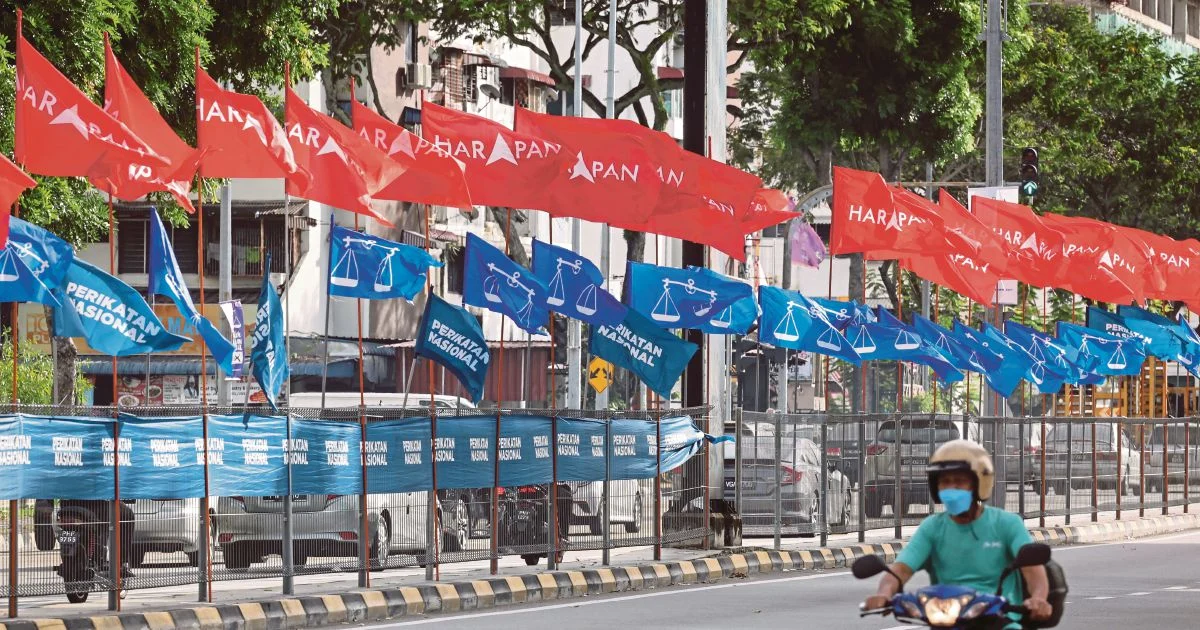
Three of Malaysia's major political coalitions are bracing for direct confrontation across roughly 60 per cent of seats in the upcoming Johor state election, signalling a fragmentation of the voter base that could reshape outcomes across the southern peninsula. Barisan Nasional, Pakatan Harapan and Perikatan Nasional face each other simultaneously in 33 of the 56 state constituencies, a configuration that reflects the current volatility and realignment sweeping Malaysian politics.
The prevalence of three-cornered contests in Johor carries broader implications for how power may shift in the state. When three major coalitions compete for the same seat, the mathematical dynamics of victory change fundamentally. A party securing around 35 per cent of the vote in a traditional two-way contest might lose; in a three-way race, that same vote share could prove decisive. This dynamic has historically benefited the incumbent or best-organised ground force, creating uncertainty about whether machinery or messaging will determine outcomes.
Barisan Nasional, which has governed Johor continuously except for a brief interregnum, enters this contest as the establishment force with existing state administrative machinery. The coalition's performance in Johor traditionally anchors its broader national standing, making the outcome of profound importance to overall Malaysian politics. A significant BN reversal in Johor would reverberate across the country, while consolidation there would strengthen the coalition's position going into any future general election.
Pakatan Harapan's strategy must navigate the reality of contesting in three corners across a third of seats. The opposition coalition achieved government nationally in 2018 but has struggled to translate that into consistent state-level dominance outside strongholds. Johor represents a test of whether PH can expand beyond its core support base, particularly given the coalition's internal tensions between its constituent parties. The scale of three-cornered contests works against opposition coalitions that depend on tactical voting, where supporters must precisely coordinate across multiple parties.
Perikatan Nasional's participation across 33 seats demonstrates the coalition's determination to become a serious force in peninsular politics, building on its control of Kedah and recent gains elsewhere. The relative newness of PN as a competitive entity at state level means the coalition will be testing its ground organisation and voter appeal in Johor. The concentration of three-way contests gives PN opportunities to position itself as an alternative to both the incumbent BN and the opposition PH, though such positioning requires both clarity of message and effective voter communication.
The geographic distribution of these three-cornered contests carries tactical significance. If they cluster in certain regions, they may create corridors where one coalition dominates, or conversely, areas of extreme fragmentation that boost the strongest organised force. The nature of Johor's demographics—with urban, suburban and rural constituencies possessing different political compositions—means these contests will play out differently across the state. Johor Bahru itself and other major urban centres may behave distinctly from interior and rural seats.
Tactical considerations will heavily influence outcomes given the three-way nature of most contests. Voters must decide not merely which coalition they prefer but also whether their preferred choice can win in their specific seat. In constituencies where one coalition appears significantly ahead, voters may consolidate; in more uncertain seats, the temptation to hedge votes across parties increases, potentially fragmenting support and producing unexpected winners. Media coverage and polling will shape perceptions of viability, creating feedback effects that influence voting behaviour.
The remaining 23 seats feature different contest configurations, ranging from straight fights between two parties to circumstances where one or more coalitions declined to field candidates. These seats offer opportunities for parties to construct narratives of strength in certain regions and retreat in others. BN's performance in uncontested or two-way seats relative to the three-cornered ones will reveal whether the coalition maintains organisational coherence or whether fragmenting contests genuinely pose problems.
For Malaysian observers, the Johor election operates as a barometer of broader national sentiment. The state's size, geographic importance and historical role as a BN bastion make shifts there indicative of wider realignments. The prevalence of three-cornered contests in this particular election distinguishes it from previous Johor polls and reflects Malaysia's evolving political structure, where post-2018 disruptions have not yet settled into stable patterns. Whether the three coalitions can each establish distinctive positions with sufficient voter clarity to overcome the fragmenting effect of three-way contests remains to be seen.
The coming Johor election will test whether Malaysia's political system can function effectively with three major competitive forces simultaneously contesting large numbers of seats. The results may clarify whether Perikatan Nasional has genuinely become a tier-one political force, whether Pakatan Harapan can expand beyond core support areas, and whether Barisan Nasional retains sufficient strength in its traditional bastions. For voters and analysts alike, the three-way battles across 33 seats will generate the most scrutiny and the most significant implications for the peninsula's political trajectory.

