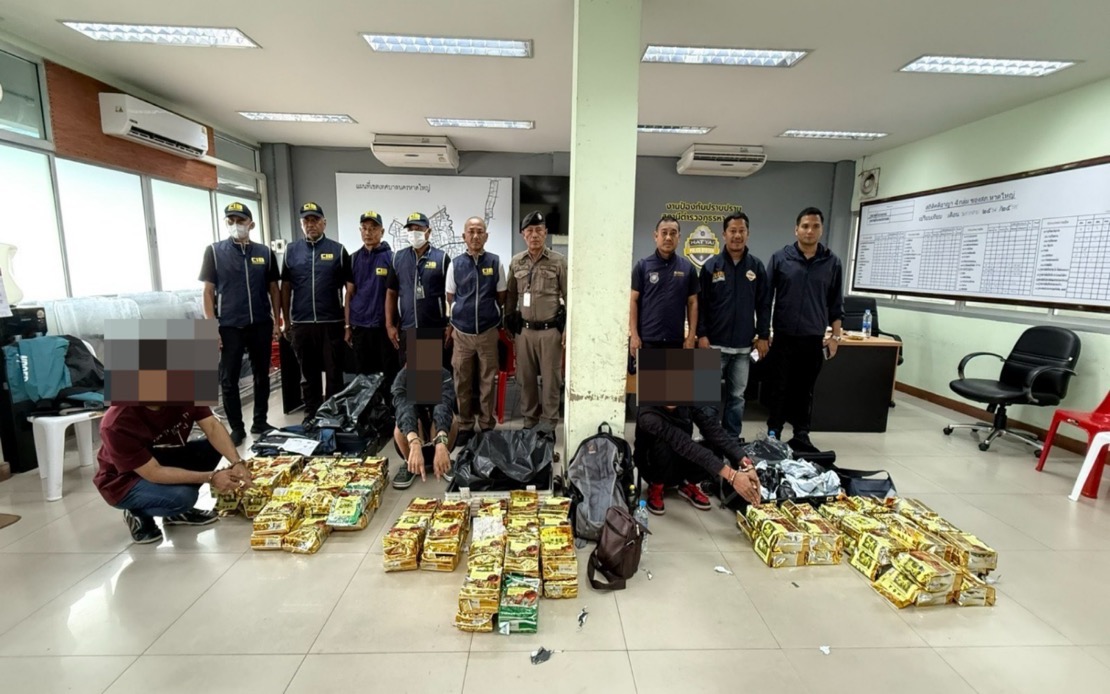
Three Malaysian nationals were detained at Hat Yai Railway Station in Thailand's Songkhla province on July 31 following an attempt to transport 87 kilograms of crystal methamphetamine into Malaysia hidden within luggage. The coordinated operation represents another significant interdiction along Southeast Asia's busy drug trafficking corridors, where synthetic narcotics continue to flow across porous borders despite intensified enforcement efforts.
The contraband was concealed within three wheeled suitcases and three backpacks when officers from Thailand's narcotics and law enforcement agencies intercepted the suspects upon their arrival from Bangkok. The operation involved extensive inter-agency coordination between the Tawan Hat Yai unit, railway police, Crime Suppression Division, Anti-Trafficking in Persons Division, tourist police, Narcotics Suppression Bureau, and the Region 9 Office of the Narcotics Control Board. Such multi-institutional responses underscore Thai authorities' commitment to disrupting trafficking networks operating across their territory.
According to Ratchapon Palakul, director of the ONCB's Region 9 Office, preliminary investigations revealed the suspects had boarded a train in Bangkok specifically bound for Hat Yai, where they would likely transfer the shipment across the border into Malaysia. This route through Southern Thailand has long served as a major conduit for synthetic drugs heading toward Malaysian distribution networks, making Hat Yai a critical chokepoint for enforcement operations.
The financial incentive structure illuminates how trafficking syndicates operate at ground level. One suspect disclosed that he and his associates had each been offered RM8,000 to transport the methamphetamine into Malaysia, suggesting a relatively modest payment for participants in a sophisticated smuggling operation. This compensation level indicates the pyramid structure typical of such networks, where low-level couriers assume disproportionate legal risk for minimal financial reward while upper-echelon operators retain substantial profits.
The scale of this single seizure underscores the massive volumes of synthetic narcotics circulating through regional markets. Eighty-seven kilograms represents a substantial shipment with significant street value, yet such quantities are regularly interdicted across the Thailand-Malaysia border, indicating the enormous scale of the overall trafficking problem. Crystal methamphetamine, locally known as ice or syabu, commands premium prices in Malaysian markets and has become increasingly prevalent across the nation's drug landscape.
Facing prosecution under Thailand's narcotics statutes, the three men have been charged with joint offences including possession and trafficking of Category 1 narcotics with intent to distribute. Conviction carries penalties of up to 15 years imprisonment and fines not exceeding 1.5 million baht, equivalent to approximately RM183,000. These substantial penalties reflect Thai authorities' determination to impose serious consequences on trafficking participants, though enforcement alone has proven insufficient to stem the flow of narcotics through the region.
Law enforcement agencies have prioritized identifying higher-level operatives within the trafficking network, recognizing that apprehending couriers, while important, addresses only the most visible layer of organized drug operations. The investigation seeks to establish connections to syndicate leadership and identify other members complicit in the cross-border operation. Such intelligence gathering often proves more valuable than immediate prosecutions, as it maps criminal infrastructure and enables targeting of more sophisticated actors controlling distribution systems.
The arrest illustrates broader regional challenges surrounding synthetic drug production and trafficking. Thailand itself remains both a transit point and consumption market for methamphetamine manufactured in clandestine labs across Myanmar and other locations throughout Southeast Asia. Malaysia's role as both a transit nation and significant market creates particular vulnerability, as trafficking organizations exploit geographic position and porous land borders to move products toward lucrative Malaysian and Singaporean markets.
For Malaysian readers and policymakers, this incident reinforces the persistent threat of cross-border drug trafficking despite cooperative enforcement initiatives. The coordination demonstrated by Thai authorities provides a model for regional cooperation, yet gaps remain in detection capabilities and information sharing. Malaysian authorities work alongside Thai counterparts at multiple border points, but resource constraints and jurisdictional complexities continue to impede comprehensive interdiction efforts.
The involvement of railway transport highlights how trafficking organizations adapt to exploit different smuggling vectors. While maritime routes have received substantial enforcement attention, land and rail corridors remain relatively undermonitored compared to other modes, making them attractive alternatives. As enforcement pressure increases on traditional routes, syndicates demonstrate flexibility in adopting alternative methods and pathways, perpetually challenging border management authorities.
The case also reflects the human cost of narcotics trafficking, both within production regions experiencing violence associated with drug manufacturing and distribution, and consuming nations confronting addiction and related social harms. The three detained men represent thousands of economically vulnerable individuals recruited annually into trafficking networks through modest financial inducements, lives subsequently derailed by criminal convictions and imprisonment.
Moving forward, sustained pressure on trafficking operations requires continued investment in intelligence sharing, enforcement capacity building, and financial investigations targeting the profits motivating such networks. While individual seizures provide tactical victories, disrupting the economic viability of trafficking requires attacking the criminal enterprises directing operations and capturing the substantial proceeds that fuel continued expansion. This incident, significant as it stands alone, represents merely one element within a much larger regional struggle against entrenched narcotics trafficking.

