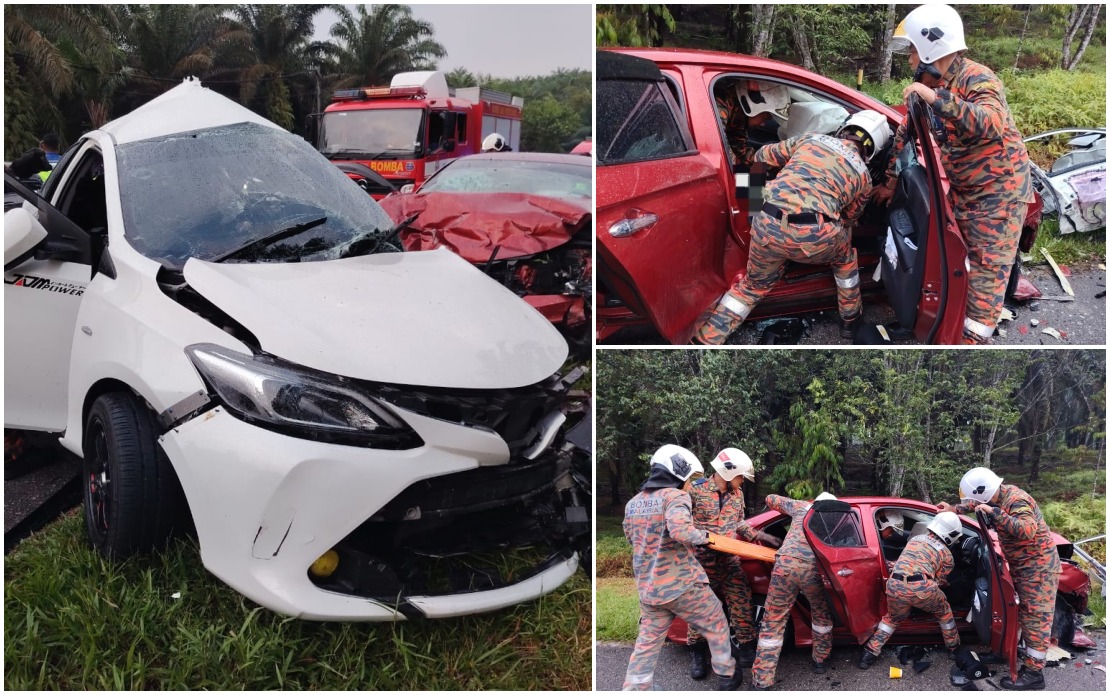
A fatal collision claimed three lives in Kota Tinggi on the afternoon of August 25, when a Honda City and Toyota Vios struck each other near a petrol station in the Tanjung Leman district along Jalan Jemaluang. The victims—two young occupants of the Honda City aged 21 and 20, and a 31-year-old driver of the Toyota Vios—were pronounced dead at the scene by Health Ministry medical personnel, marking another tragic reminder of road safety hazards on Malaysian highways.
Emergency responders received notification of the crash at 5.05 pm and mobilized quickly to the location, which lay approximately 45 kilometres from their station. Senior Fire Officer II Azlan Hamzah, the operations commander overseeing the incident, coordinated a team of eight firefighters dispatched to the collision site. The firefighting personnel arrived to discover the two vehicles severely damaged from the impact, requiring specialised equipment and techniques to safely recover the deceased from the wreckage.
Extrication of the three victims proved labour-intensive, necessitating the deployment of hydraulic rescue cutters to prise open the mangled metal and create safe access paths. Once freed from the vehicles, the bodies were carefully placed on stretchers and removed from the scene with appropriate dignity. The entire emergency operation concluded at 6.59 pm, consuming just under two hours from initial alert to completion of rescue and recovery efforts.
Kota Tinggi district police chief Superintendent Othman acknowledged the ongoing investigation into the collision's circumstances but deferred detailed comment pending completion of preliminary inquiries. The authorities have not yet released specifics regarding vehicle speeds, weather conditions, driver behaviour, or mechanical factors that may have contributed to the crash. Such details typically emerge as investigators reconstruct the sequence of events leading to impact and interview any witnesses present in the vicinity.
Road accidents in Johor, Malaysia's southern industrial and transportation hub, have presented persistent public safety challenges. The state's dense network of highways connecting port facilities, manufacturing zones, and residential areas experiences substantial vehicle traffic daily. Collisions involving private vehicles, commercial trucks, and public transport remain distressingly common, with fatality rates exceeding national averages in several districts. Tanjung Leman and surrounding Kota Tinggi regions, while less urbanised than Johor Bahru, nonetheless witness regular incidents as motorists transit between coastal settlements and inland commercial centres.
The involvement of two compact sedans—the Honda City and Toyota Vios—reflects the prevalence of these affordable, fuel-efficient models among Malaysian drivers navigating daily commutes and longer intercity journeys. Both vehicles occupy similar market segments, offering practical transportation without premium price tags. However, their relatively lighter construction compared to larger sports utility vehicles or commercial trucks means occupants experience heightened vulnerability in high-impact collisions, a factor that likely contributed to the fatalities recorded in this incident.
The presence of a petrol station near the crash location suggests the collision occurred in a semi-commercial area with mixed vehicular traffic patterns. Such zones often experience variable speed compliance and driver attentiveness issues, as motorists transition between highway speeds and lower-velocity local driving. Fatigue, distraction, or mechanical failure affecting braking systems represent common precursors to serious collisions at such locations, though definitive determination awaits investigative outcomes.
For the families and associates of the three deceased, this incident represents sudden, devastating loss during what appeared to be an ordinary afternoon journey. The ages of the two younger victims—a 20-year-old and 21-year-old—underscore how road trauma affects individuals in their prime years with particular tragedy. Community responses in Kota Tinggi and surrounding areas typically include heightened awareness regarding accident prevention and supportive gestures toward bereaved families navigating unexpected grief.
Firefighting and emergency medical services across Malaysia routinely confront the human consequences of vehicle collisions, balancing rapid response protocols with compassionate handling of deceased and injured persons. The professionalism demonstrated by the eight-member firefighting team and medical personnel reflects institutional commitment to minimising suffering despite circumstances beyond recovery. Their work exemplifies the dedication of frontline responders who regularly face the intersection of mechanical destruction and human tragedy.
Police investigations into the Kota Tinggi collision will likely examine forensic evidence collected from both vehicles, analyse skid marks and debris patterns at the impact zone, and interview any bystanders who witnessed the sequence of events. Determining whether excessive speed, mechanical failure, driver error, or external factors such as weather conditions contributed to the crash remains essential for understanding how similar tragedies might be prevented. Authorities are expected to release detailed findings once preliminary inquiries conclude and formal statements become available to the public and bereaved families seeking understanding of circumstances surrounding their loss.

