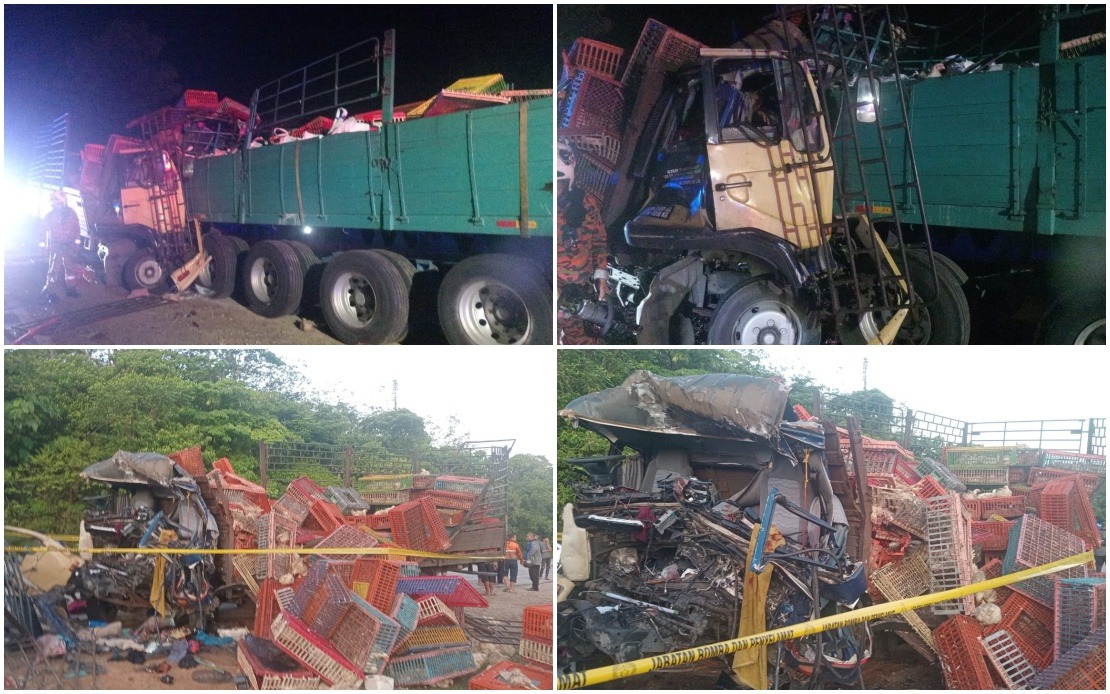
A fatal collision on the East-West Highway claimed three lives in the early hours of Monday when a five-tonne lorry laden with chicken struck a trailer parked along the roadside in Tanah Merah, Kelantan. The deceased have been identified as Norazeman Abdul Aziz, 42, the lorry driver, alongside passengers Mohammad Zakwan Mohd Nor, 16, and Mohd Haikal Hanifah, 29. The incident underscores the continuing hazards faced by commercial road users on Malaysia's major arterial routes, particularly during the low-visibility hours of early morning when fatigue and reduced awareness can prove fatal.
Emergency responders received notification of the accident through the NG999 emergency line at 4.26 am, prompting the Kelantan Fire and Rescue Department (JBPM) to dispatch personnel from both the Kemahang and Tanah Merah fire and rescue stations. The rapid mobilisation reflects established protocols for major traffic incidents, though the challenging conditions of night-time rescue operations inevitably affected response capabilities. Firefighters reached the scene just fifteen minutes after the alert was raised, arriving to discover the lorry's occupants pinned within the heavily damaged vehicle following impact with the parked trailer.
The rescue operation proved complex due to the degree of entrapment suffered by all three occupants. A team of twelve firefighters deployed two engines from the respective stations to conduct extrication procedures, carefully removing each victim from the twisted metal of the lorry's cabin. Once freed, all three individuals were examined by Health Ministry personnel on the scene, though tragically none survived the severity of injuries sustained in the collision. The bodies were subsequently transferred to police custody for formal investigation and further procedures.
The East-West Highway, which traverses Kelantan and connects major population centres across the peninsula's northern regions, has long been identified as a corridor experiencing elevated accident rates. Heavy commercial traffic, including produce and livestock transport vehicles, operates continuously along this route, particularly during night hours when cooler temperatures preserve perishable cargo. The presence of parked vehicles on the roadside—a common sight given limited rest facilities and informal stopping practices—introduces significant hazards for drivers navigating darkness and managing fatigue during extended journeys.
The age of one passenger, a sixteen-year-old, raises questions about occupational practices within Malaysia's haulage industry and the informal employment structures characterising small-scale transport operations. Young workers in commercial vehicles often lack formal training in safety protocols and emergency procedures, and their presence alongside experienced drivers does not necessarily ensure protective oversight. This incident highlights gaps in workplace safety regulation and enforcement within sectors relying on small independent operators rather than large corporate logistics firms with standardised safety frameworks.
Night-time commercial driving across Malaysia presents compounding risks that extend beyond mechanical or infrastructural factors. Driver fatigue remains inadequately addressed through enforcement of mandatory rest periods, with economic pressures incentivising continuous operation to maximise delivery schedules and profitability. The collision occurring in pre-dawn hours suggests the driver may have been navigating extended shifts common in perishable goods transport, where time sensitivity drives relentless scheduling that compromises alertness and reaction capacity.
The incident will likely prompt renewed scrutiny of roadside parking practices and the absence of designated rest facilities along major highways. Informal stopping arrangements, while economically convenient for small operators avoiding commercial rest area charges, create unpredictable hazards for other road users, particularly during limited visibility conditions. Regulatory bodies and highway authorities face ongoing tension between facilitating commercial operations and enforcing safety standards that might increase operational costs for already margin-constrained transport businesses.
Kelantan's road safety record reflects broader national patterns of rising accident fatalities despite improvements in vehicle technology and infrastructure development. The state experiences disproportionate casualty rates relative to traffic volume, suggesting that local factors—including road conditions, driver demographics, and enforcement intensity—contribute to elevated risk profiles. This fatality adds to accumulating evidence that technological solutions alone cannot address road safety without accompanying behavioural, regulatory, and infrastructural interventions.
The police investigation will examine whether contributing factors included excessive speed, driver impairment, mechanical failure, or the visibility conditions created by the parked trailer's positioning. Establishing causation carries implications beyond determining fault, as findings inform recommendations for highway safety enhancement, regulatory modification, and industry practice standards. For the transport sector and regulatory authorities, this incident represents another data point in ongoing efforts to reduce commercial vehicle collision fatalities that persistently exceed targets established in Malaysia's Road Safety Blueprint initiatives.

