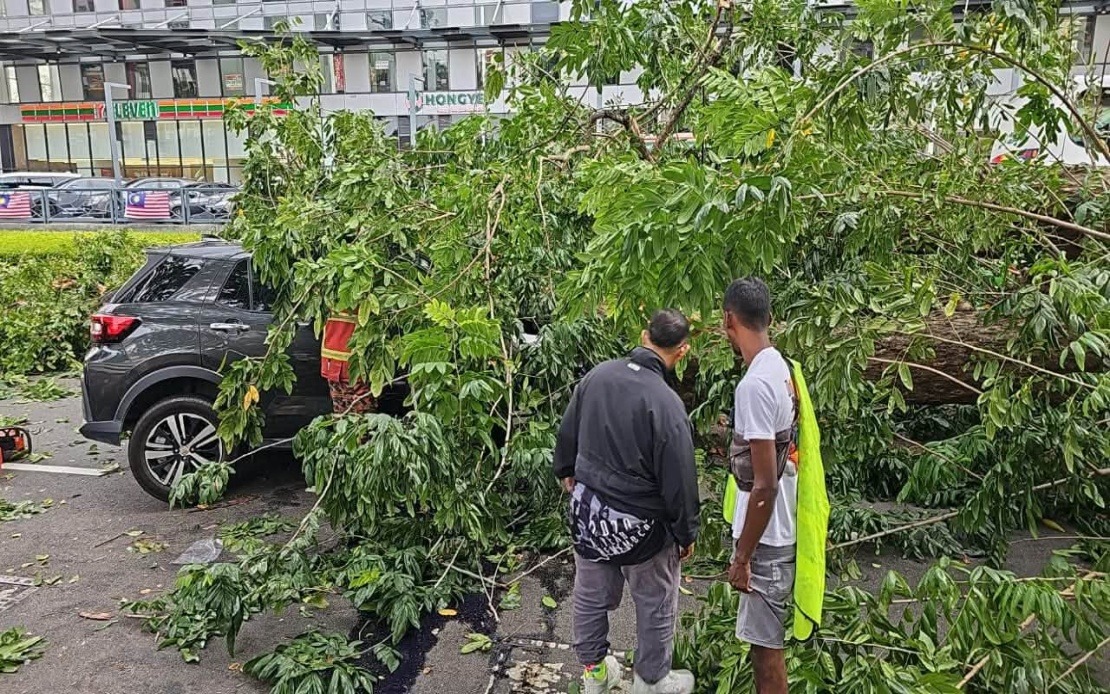
An elderly couple and their young granddaughter narrowly escaped death on Friday morning when a massive tree came crashing down onto their vehicle in the heart of George Town, Penang. The three occupants of the Perodua Ativa sustained injuries in the incident that unfolded on Jalan Macalister at approximately 9:12 am, prompting a swift emergency response from authorities and an outpouring of assistance from nearby residents who happened to witness the accident.
The Malaysian Fire and Rescue Department received its distress call just after 9 am, and a specialist team of eight firefighters from the Jalan Perak Fire and Rescue Station was promptly dispatched to the location. However, by the time the uniformed personnel arrived at the scene, the immediate crisis had been averted through the courageous intervention of members of the public who were present in the area. These quick-thinking individuals managed to extract all three victims from the crushed vehicle before professional rescue crews could reach them, a development that may well have prevented the situation from deteriorating further.
According to Assistant Director John Sagun Francis of the Operations and Firefighting Division at the Malaysian Fire and Rescue Department's Penang office, the rescue operation proceeded smoothly given the circumstances. While the fire department's primary role shifted from extraction to scene management, their personnel nonetheless remained actively engaged at the location throughout the morning and into the early afternoon. By noon, firefighters were working in coordination with local authorities to methodically dismantle the remaining portions of the fallen tree and remove debris from the roadway, a process essential not only for preventing additional hazards but also for restoring normal traffic flow to one of the city's important thoroughfares.
The incident drew immediate attention from elected officials concerned about the welfare of those affected. Tanjong Member of Parliament Lim Hui Ying, who also serves as Deputy Minister of Women, Family and Community Development, made a public statement through social media indicating that her team was actively monitoring the situation and preparing to visit the scene. In her Facebook post, she acknowledged that three individuals had sustained injuries requiring hospital treatment and urged both the injured persons and the general public to take every precaution while the area remained in a state of disruption.
The cascade of falling debris on Jalan Macalister created a traffic nightmare for commuters travelling through George Town that morning. Road authorities were forced to close the affected section to permit the cleanup operation to proceed safely and without obstruction. The combination of vehicular congestion, emergency vehicles, and heavy machinery working to clear the massive tree created considerable disruption to the normal rhythm of traffic in this busy part of the city.
Roads leading to and from the incident site experienced severe congestion as traffic was redirected and diverted around the blocked area. Motorists who typically relied on Jalan Macalister for their daily commute found themselves caught in unexpected delays, and the disruption underscored the broader vulnerability of urban infrastructure to weather-related hazards. For a city with Penang's density and traffic volume, even a relatively brief closure can trigger hours of congestion that ripple through surrounding neighbourhoods.
The incident raises important questions about municipal tree maintenance and urban forestry management in Malaysian cities. While the immediate cause of the tree's collapse remains unreported, such incidents often stem from inadequate inspection protocols, insufficient pruning, soil degradation, or structural weakness that might have been identified and addressed through systematic review. For residents and commuters in Penang and other urban centres across the region, this accident serves as a stark reminder of the necessity for proactive preventive measures rather than reactive crisis management.
Authorities typically conduct post-incident investigations following such accidents to determine what factors contributed to the tree's failure and what improvements might prevent similar occurrences. The findings of such investigations often inform updated maintenance schedules, equipment upgrades, and revised inspection procedures. In Penang's case, municipal officials will likely be examining whether their current arboricultural practices align with best standards for tropical urban environments, where monsoon seasons and high humidity create particular stresses on tree health.
The fortunate presence of bystanders at the moment of crisis highlights both the element of chance involved in such situations and the importance of community awareness and willingness to assist in emergencies. The residents who freed the trapped family members demonstrated the kind of civic responsibility that can mean the difference between tragic outcomes and survivable injuries. Their actions, combined with the subsequent professionalism of firefighters and hospital staff, contributed to what could have been a far more devastating event concluding instead with the three victims receiving medical attention and, presumably, embarking on recovery journeys.
For Malaysian road users and residents, this incident in Penang serves as a timely reminder to remain vigilant about environmental hazards, particularly during seasons prone to severe weather. Drivers are advised to be especially cautious near large trees displaying signs of damage or stress, and to maintain awareness of their surroundings even on familiar routes. The broader lesson extends to municipal administrations across Southeast Asia regarding the critical importance of comprehensive urban forestry programmes that balance the environmental and aesthetic benefits of trees against the imperative to maintain public safety.

