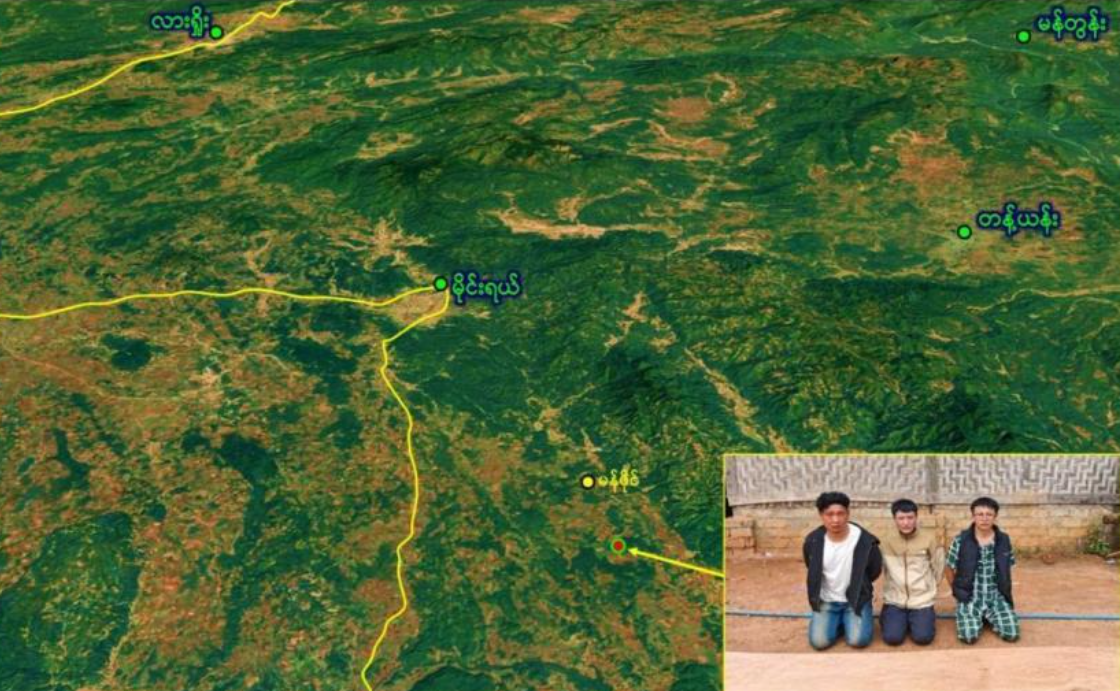
Myanmar's military has intensified its war on cross-border cybercrime with the arrest of three Chinese nationals accused of orchestrating an online gambling scam operation in Mongyai Township, Shan State. The operation represents the latest casualty in what authorities describe as a national-level campaign against digital fraud networks that have increasingly exploited Myanmar's porous northern borders and remote terrain to establish hidden bases.
The significance of this bust extends beyond the arrest of three individuals. It underscores a growing regional concern about criminal syndicates leveraging Myanmar's ungoverned spaces and relatively weak enforcement capabilities to conduct large-scale online fraud targeting victims across Asia. The arrest highlights how border regions in Southeast Asia have become contested terrain where organised crime groups operate with relative impunity, requiring coordinated military and law enforcement responses that strain already-stretched resources.
According to local intelligence that triggered the operation, the suspects had constructed a temporary operational base deep in Mongyai Township to facilitate their scam gambling activities. This setup—combining rudimentary infrastructure with sophisticated telecommunications equipment—reflects a pattern increasingly observed in cross-border criminal networks. By situating themselves in remote, mountainous terrain far from urban centres, the gang minimised detection risks while maintaining digital connectivity to reach victims across multiple countries and jurisdictions.
On August 26, military security columns discovered and apprehended the three Chinese nationals approximately 26 kilometres southeast of Mongyai town and roughly 5 kilometres south of Manphai Village. The precise geographic coordinates suggest authorities had narrowed their search area substantially before moving in, indicating either informant intelligence or signal-tracking capabilities. The remoteness of the location—accessible only through difficult terrain—explains why such operations can flourish: legitimate state presence in these areas remains minimal, and communication infrastructure is sparse enough to escape casual notice.
The equipment seized during the raid reveals the technical sophistication of the operation. Investigators recovered 25 mobile phones, five all-in-one computers, two power stations, and one Starlink satellite internet device, alongside ten communication radios. The presence of Starlink equipment is particularly noteworthy for Southeast Asian observers. It demonstrates how criminal networks have adapted to exploit modern satellite internet services that bypass traditional telecom infrastructure and regulation, creating new enforcement challenges for governments attempting to monitor and intercept illicit online activities.
Beyond electronic equipment, authorities dismantled the physical infrastructure underpinning the scheme. The operation occupied one large corrugated iron structure measuring 50 by 20 feet alongside five temporary tarpaulin shelters, fashioned from bamboo and basic materials. This combination of semi-permanent and temporary structures reflects operational security practices: the main building provided a working hub, while the surrounding shelters housed personnel and additional equipment. The primitive construction method enabled rapid deployment and swift abandonment if authorities approached, making such setups ideal for criminal enterprises expecting eventual discovery.
The suspected illegal border crossing through which the three Chinese nationals entered Myanmar points to another pressing regional issue: the porous nature of Southeast Asian borders and the inadequacy of monitoring systems at remote crossing points. Despite Myanmar's security concerns, controlling thousands of kilometres of mountainous frontier with China remains virtually impossible given available resources. Criminal networks exploit this reality systematically, moving personnel and equipment across borders with minimal risk of interdiction.
Myanmar's government has positioned this crackdown within a broader anti-fraud initiative that acknowledges online scam gambling as a national security and public order problem. Authorities recognise that such operations don't merely defraud individual victims—they generate substantial money-laundering opportunities, attract organised crime networks, and destabilise border communities. The campaign reflects growing coordination between Myanmar's military junta and security apparatus to identify and eliminate criminal infrastructure, particularly in regions where state control remains contested.
The investigation methodology—beginning with community tips about suspicious activity and escalating to full military operations—suggests authorities are building local intelligence networks in remote areas. This grassroots approach may prove more effective than conventional surveillance in sparsely populated regions where electronic monitoring is impractical. However, it also raises questions about enforcement consistency: similar operations likely continue in even more remote locations beyond informant networks.
For regional observers, the case illustrates how online fraud networks have evolved into mobile, transnational enterprises capable of establishing sophisticated bases in practically any jurisdiction with weak governance and difficult terrain. The Starlink device particularly signals how traditional geographic isolation no longer protects law enforcement from determined criminal actors. The equipment can sustain global-scale operations from locations authorities might previously have considered unreachable.
The arrested individuals face prosecution under Myanmar's existing legal framework following formal questioning, though specific charges remain unannounced. Authorities indicated that additional dismantling of illegal shelters across the region would proceed systematically. However, the broader question persists: without addressing the underlying factors enabling such operations—inadequate border control, limited state presence in remote zones, and gaps in telecommunications regulation—similar networks will continue establishing themselves throughout the region's ungoverned spaces.

