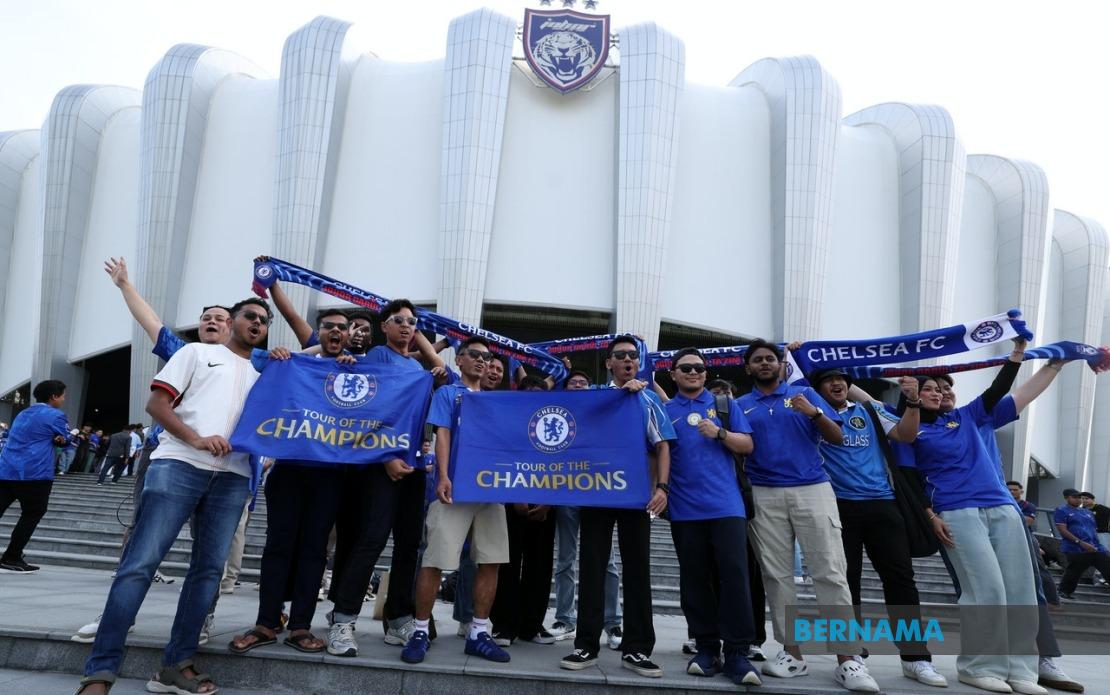
The Sultan Ibrahim Stadium in Iskandar Puteri transformed into a vibrant tapestry of red and blue on August 9 as legions of football devotees arrived to witness Chelsea FC's friendly encounter with Johor Darul Ta'zim. Beginning from mid-afternoon, throngs of supporters adorned in the colours of both clubs created an electric atmosphere at the prestigious venue, with families, seasoned enthusiasts, and youth groups all converging to experience what many regarded as a milestone occasion for Malaysian football.
The diversity of attendees reflected the broad appeal of the fixture. Multi-generational families arrived together, with parents and grandparents introducing younger relatives to the spectacle of international football at a domestic venue. Across the stadium grounds, supporters seized opportunities to capture photographs against SSI's modern architectural backdrop, with the occasion providing memorable moments for collections both digital and physical. The presence of attendees from beyond Malaysia's borders underscored the continental significance of hosting an elite English club, with the weekend timing enabling visitors from Singapore and other neighbouring territories to participate in the event.
Commercial activity flourished throughout the stadium precinct, with official merchandise outlets becoming focal points of sustained consumer interest. Merchandise stalls drew extended queues throughout the afternoon and evening, as supporters sought limited-edition items commemorating the occasion. The availability of exclusive products heightened the sense of occasion, with many attendees treating the merchandise as tangible reminders of what constituted a rare opportunity to witness top-tier English football action outside the United Kingdom.
Transportation logistics presented the primary operational challenge as crowds accumulated in the hours preceding the 8 pm kick-off. Monitoring conducted at 7 pm indicated that traffic flowing toward the stadium along principal arterial routes remained congested yet manageable, with the Royal Malaysia Police maintaining vigilant oversight to facilitate smooth vehicular progression. The coordination between venue management and law enforcement appeared effective in preventing the kind of gridlock that might have undermined the supporter experience or created security vulnerabilities.
For Ahmad Danial Muhammad, a 28-year-old Chelsea supporter from Bangsar in Kuala Lumpur, the occasion represented a pivotal moment in his two decades as a club loyalist. Having followed the club since the Didier Drogba era, the opportunity to witness Chelsea's playing personnel without undertaking the substantial expense and logistical commitment of travelling to Stamford Bridge held profound significance. The convergence of his lifelong fandom with the practical accessibility of witnessing his beloved club at Sultan Ibrahim Stadium constituted, in his assessment, a once-in-a-generational opportunity that justified his immediate ticket acquisition upon learning of the fixture.
The appeal extended across national boundaries. Tan Wei Sheng, a 34-year-old Singapore-based Chelsea enthusiast, coordinated his family's cross-border travel to coincide with early afternoon, enabling them to navigate the Johor Causeway before congestion intensified. His assessment of Sultan Ibrahim Stadium's infrastructure as world-class reflected broader recognition that Malaysian football facilities had evolved substantially in recent years. The combination of venue quality and the prospect of elite-level football competition presented compelling reasons for regional supporters to participate, transforming what might have been a domestic fixture into a transnational gathering of football cognoscenti.
Among JDT's supporter constituency, the fixture carried significance beyond competitive interest. Mohd Khairul Anuar Ismail, a 41-year-old enthusiast from Bukit Piatu in Melaka, framed Chelsea's selection of the Southern Tigers' stadium as validation of Malaysian football's ascending status in the global hierarchy. The decision by a Premier League institution to dispatch its squad for a friendly in Malaysia conveyed, in his interpretation, that domestic clubs had achieved sufficient stature to warrant recognition from elite international competitors. This perspective extended beyond mere sporting appreciation; it encompassed perceptions of national football development and global competitive standing.
Female supporters also articulated the broader implications of hosting world-class European opposition. Safiyah Rosli, a 32-year-old JDT devotee from Batu Pahat, connected the Chelsea visit directly to the strategic vision and institutional investment championed by Tunku Mahkota Ismail, the Regent of Johor. In her assessment, the presence of Chelsea represented tangible evidence that the systematic elevation of Malaysian football infrastructure and competitive standards—pursued with considerable financial commitment and administrative coordination—had achieved visibility and recognition at the continental level. The match thereby functioned as a public validation of sustained investment in football development.
The convergence of supporters and the atmosphere they generated reflected deeper transformations in Malaysian football culture. The ability to attract international clubs for competitive fixtures, the infrastructure investment necessary to host such encounters, and the popular enthusiasm demonstrated by thousands of attendees collectively indicated that domestic football had transcended its traditional parameters. What might have seemed improbable a decade earlier—crowds of thousands assembling at a Malaysian stadium specifically to watch Chelsea FC—had materialized through deliberate institutional strategies, substantial capital investment, and the cultivation of ambitious competitive structures centred on marquee domestic clubs.
The fixture also illuminated shifting regional football patterns. Southeast Asian football has historically developed within constrained parameters, with domestic club competition often overshadowed by national team football and foreign league consumption. The capacity to reverse this dynamic—to create occasions where international stars travelled to Southeast Asian venues rather than expecting local participation to occur on European soil—represented a meaningful reorientation of regional football geography. The August 9 convergence at Sultan Ibrahim Stadium demonstrated that such repositioning was operationally feasible and commercially viable, with thousands validating their commitment through attendance and merchandise expenditure.
Looking forward, the Chelsea match established precedent for future international engagements. The successful management of crowd flow, security coordination, and supporter experience suggested that Malaysia possessed both the institutional capacity and popular appetite for additional high-profile international fixtures. For Malaysian football administrators and club proprietors, the occasion provided empirical evidence that investment in elite competitive infrastructure and marquee fixture scheduling could generate substantial public engagement. Whether this enthusiasm translates into sustained support for domestic competition—beyond the spectacle of international celebrity—remains a longer-term measurement of Malaysian football's developmental trajectory.

