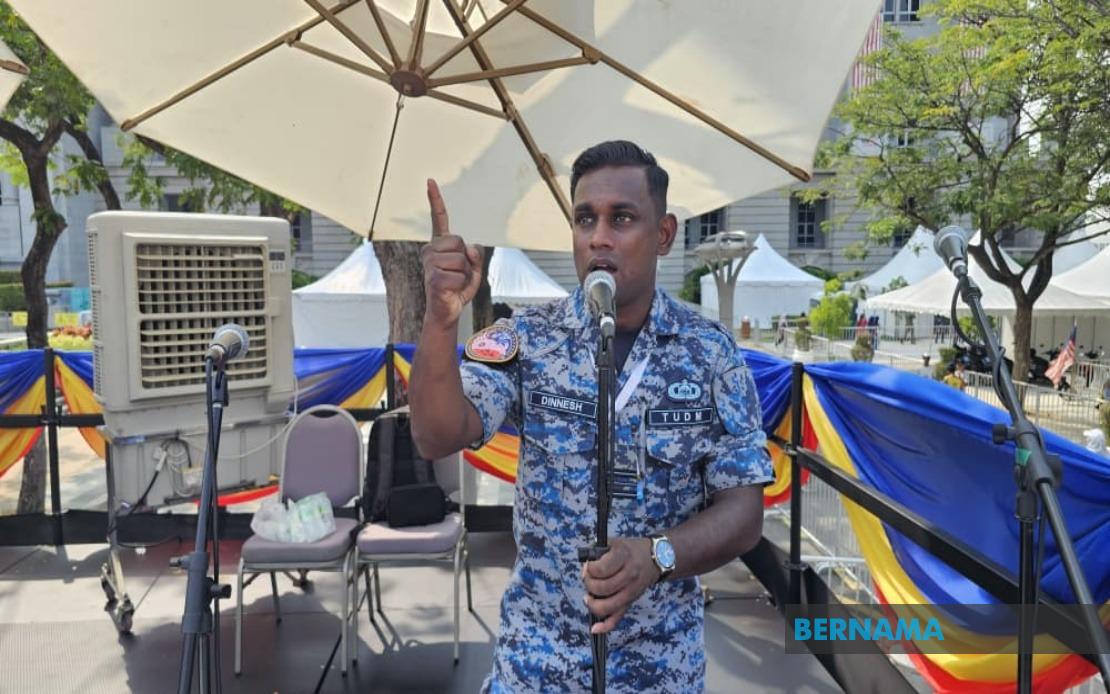
When fighter jets roared across the skies above Dataran Putrajaya on National Day, thousands of spectators looked skyward to witness their breathtaking manoeuvres. Yet what many did not fully appreciate was the crucial role played by Major Dinnesh Nicolas Rene, whose commanding voice from the commentary booth transformed the raw power of military aviation into a narrative that millions could understand and appreciate. At 34 years old, this Royal Malaysian Air Force officer demonstrated how the art of air show commentary extends far beyond simply describing what audiences can already see—it requires weaving together technical knowledge, dramatic timing, and profound institutional understanding to create a coherent experience from controlled chaos.
The commentator's craft demands expertise that extends across multiple domains of military aviation. Major Dinnesh emphasises that successful commentary requires intimate familiarity with aircraft specifications, the particular pilots performing the display, the formations being executed, and the precise sequence of each aerial manoeuvre planned for the event. This is not knowledge that can be improvised or learned minutes before an event begins. Rather, it represents the accumulated understanding developed through years of engagement with the Royal Malaysian Air Force's operational environment. For Major Dinnesh, this journey began in 2015 when he joined the RMAF, establishing the foundational knowledge that would later enable him to transition into this specialised role.
His entry into air show commentary came relatively recently, following his selection as a commentator for the Langkawi International Maritime and Aerospace Exhibition in 2019. This assignment proved transformative, establishing a new career trajectory within his military service. Subsequently, he continued developing his commentary skills during the RMAF's anniversary celebrations, steadily building the experience necessary to handle increasingly high-profile events. By the time the 2026 National Day parade approached, Major Dinnesh had established sufficient credibility to be selected as one of three air commentators alongside Major Neny Suhaida Ab Suki and Captain Muhammad Iqbal Nasrudin, reflecting the significance placed on this role by the Air Force leadership.
Working within the RMAF Air Defence Control Division, Major Dinnesh brings an operational perspective to his commentary work that proves invaluable during major displays. His background in air defence operations provides insights into the technical realities underlying each aerial manoeuvre, enabling him to explain not merely what is happening in the sky, but why specific formations and sequences matter from a military perspective. However, this operational background, while helpful, does not eliminate the substantial preparation demands that precede every major event. Instead, it provides context that must be supplemented with event-specific knowledge gathering and coordination.
The preparation process for major national celebrations involves extensive collaboration with multiple stakeholders. Major Dinnesh describes how commentators must coordinate with ground controllers and pilots to establish comprehensive understanding of every element in the display. This coordination extends to identifying which specific aircraft will participate, determining the exact number of aircraft involved in each formation, learning biographical details about the pilots themselves, and researching the historical mottos and traditions of the participating squadrons. Beyond the aviation team, commentators must also liaise with security agencies and other organisational units contributing to the overall national event, ensuring seamless integration of the aerial component within the broader celebration framework.
At the National Day level, where the King and Prime Minister are present, commentators face additional layers of complexity surrounding protocol and appropriate messaging. Major Dinnesh identifies protocol mastery as a fundamental challenge, noting that air show commentators must maintain acute awareness of what information can be shared, how it should be framed, and precisely when it should be delivered during the proceedings. Certain subjects remain sensitive in the context of state occasions, while others require specific framing to align with official narratives. This demands not only technical knowledge but also political and diplomatic awareness—a dimension of air show commentary that external observers rarely appreciate.
Preserving vocal capacity throughout the demanding schedule of rehearsals and the actual event represents perhaps the most underestimated challenge in this field. Unlike master of ceremonies who speak at normal volume, air show commentators must project powerful voices capable of reaching thousands of spectators despite the deafening roar of military aircraft overhead. This sustained projection places extraordinary strain on the vocal apparatus, creating genuine risk of voice loss or degradation precisely when performance is most critical. Managing voice preservation becomes as important as managing the commentary content itself, requiring disciplined approaches to hydration, vocal warm-up, and careful pacing throughout rehearsal cycles leading up to the main event.
Major Dinnesh emphasises that successful commentary requires the commentator to authentically embody the emotional content they wish to convey to audiences. Rather than approaching the role as mechanical script delivery, he maintains that the voice must transmit genuine enthusiasm and respect for the spectacle unfolding overhead. This demands more than professional technique—it requires maintaining authentic awe and excitement despite years of repeated exposure to military aircraft displays. Many commentators might lose this emotional connection through habituation, yet Major Dinnesh describes how his sense of wonder at fighter jet capabilities remains undiminished despite his close and frequent engagement with RMAF operations.
For Malaysian readers considering the broader significance of this role, air show commentary represents a small but meaningful component of how the nation presents itself during major celebrations. The quality of the commentary experience influences how effectively the military's capabilities resonate with the public imagination, how young people develop aspirations toward military service, and how international visitors perceive Malaysian defence capabilities. Major Dinnesh's meticulous approach to his role—the coordination efforts, the voice preservation discipline, the emotional investment—reflects broader RMAF commitments to professional excellence and national representation.
The 2026 National Day celebration featured this carefully orchestrated air display precisely because such events serve multiple purposes within Malaysian society. They celebrate national achievement, demonstrate military readiness, inspire civic pride, and create memorable experiences that bind communities together around shared symbols of sovereignty. The invisible labour of air show commentators like Major Dinnesh—the months of preparation, the coordination with dozens of officials, the vocal discipline—ultimately aims at creating seamless experiences where audiences feel rather than think about the complexity required to deliver such spectacles.

