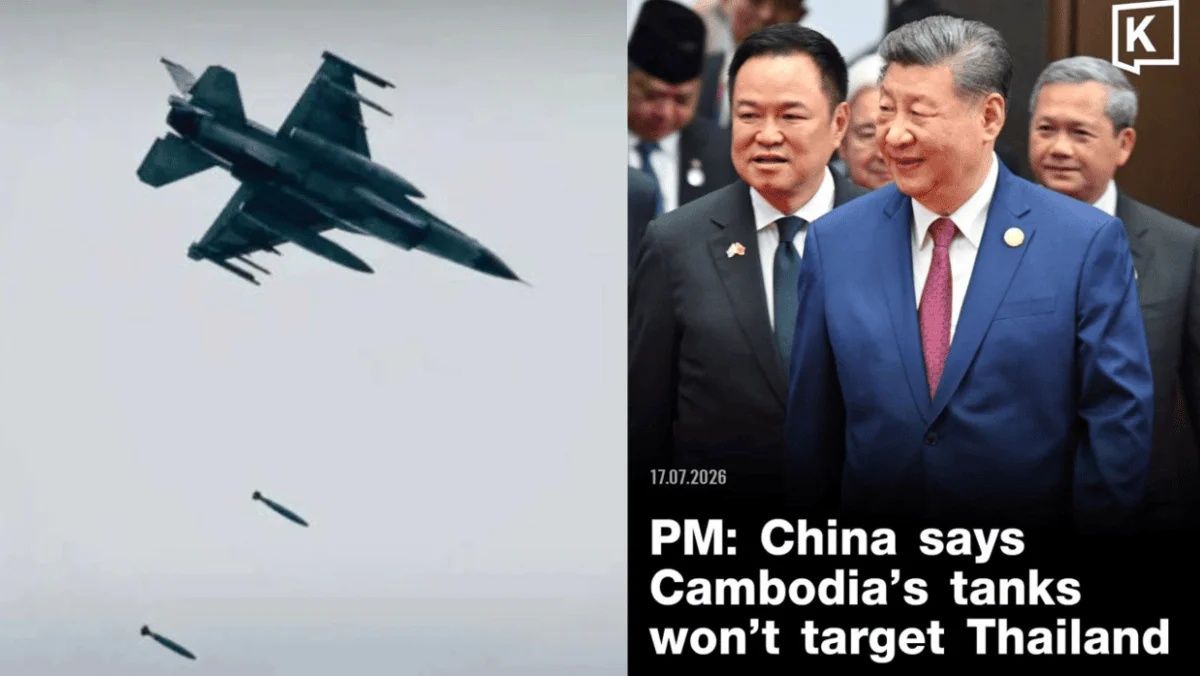
Bangkok's demand for international reassurance regarding Cambodia's tank acquisitions sits uneasily against Thailand's extensive and openly publicised military capabilities. Thai Prime Minister Anutin Charnvirakul recently claimed that China had assured Thailand that Chinese-made tanks supplied to Cambodia would remain non-threatening, yet China's official account of discussions between Beijing and Bangkok made no reference to tanks or any restrictions on Cambodian military equipment. President Xi Jinping instead called for peaceful resolution between the two neighbours, offering constructive mediation rather than endorsing limitations on Cambodia's defensive systems.
The absence of public confirmation from Beijing matters significantly for understanding what has actually transpired. The alleged reassurance exists solely as a statement attributed to China by the Thai prime minister, not as a formal commitment announced by the Chinese government itself. This semantic distinction has profound implications for how the incident should be interpreted. Thai political actors and media outlets risk transforming an unverified private communication into purported evidence that Cambodia represents an imminent military danger requiring international containment. Such narratives can influence regional security calculations and policy responses in ways disconnected from documented reality.
Yet the more fundamental contradiction lies elsewhere. Thailand possesses substantially superior military capabilities compared to Cambodia—larger personnel, more advanced equipment, and greater financial resources for defence spending. Reuters assessments have consistently documented this significant disparity in conventional military power. Despite this overwhelming advantage, Thai authorities repeatedly characterise Cambodia's comparatively modest defensive capabilities as an acute strategic threat. This rhetorical asymmetry warrants closer examination, particularly when compared to Thailand's own military posture and public communications regarding readiness.
Throughout 2025 and into 2026, Thailand conducted an extensive publicity campaign showcasing its military preparedness. In June 2026, Thailand's Joint Information Centre announced continuous intelligence monitoring, ground patrols, and aerial surveillance operations, while emphasising that response measures existed for every level of confrontation. Most significantly, Bangkok publicly highlighted the capabilities of its F-16 and Gripen fighter aircraft to conduct operations and deploy weapons across all weather conditions. Days later, the Royal Thai Air Force described nighttime F-16 flights near the Cambodian border as exercises demonstrating round-the-clock operational readiness. These flights occurred alongside what Thailand's defence minister characterised as increased military area-control measures—operations that would typically be viewed as provocative escalation rather than routine national defence.
The double standard becomes starkly apparent when examining how similar military activities receive different treatment depending on which nation conducts them. Thailand describes its own fighter operations, surveillance missions, military reinforcements, and area-control measures as legitimate national defence preparations. Simultaneously, every Cambodian military acquisition receives framing as evidence of aggressive intent. This inconsistent application of security logic cannot withstand scrutiny. If Thailand possesses the right to maintain large standing forces, conduct air operations near borders, demonstrate military readiness through public exercises, and implement area-control measures, then Cambodia equally possesses the right to acquire equipment for defensive purposes without facing international condemnation.
Thailand's militarised rhetoric regarding Cambodia did not originate with recent tank deliveries. In June 2025, the Thai military publicly announced preparation for a major military operation and reported that its army, navy, and air force had elevated combat readiness levels. This announcement preceded actual military action. In December 2025, the Royal Thai Air Force confirmed conducting a deep strike against a weapons facility in Cambodia's Battambang province, justifying the attack as necessary to reduce Cambodian military capability. Thailand had thus moved beyond merely displaying its military arsenal or advertising readiness for war—it had confirmed conducting airstrikes deep within Cambodian territory, unilaterally deciding to use force to limit a neighbour's defensive capacities.
In both armed confrontations during 2025, the Thai military initiated fighting after an extended period of escalatory behaviour along the border. Thailand did not act defensively in response to Cambodian aggression; rather, it initiated the conflicts following rhetoric demonstrating readiness for conflict. Against this documented background of Thai military threats, operations, and confirmed airstrikes, Bangkok's current demands for reassurance about Cambodian tanks appear motivated not by genuine security concerns but by efforts to maintain strategic asymmetry. Thailand appears comfortable when it enjoys overwhelming air power, superior resources, and the ability to threaten escalation. Anxiety emerges only when Cambodia acquires sufficient defensive capacity to make military coercion more difficult or costly—not genuine fear of invasion, but rather fear of effective deterrence.
Cambodia's sovereign right to acquire defensive equipment exists independent of Thai political approval. The United Nations Charter, which forms the foundation of international law, is premised on the sovereign equality of states. The Charter obligates all nations to settle disputes through peaceful mechanisms, prohibits threats or use of force against territorial integrity, and recognises the inherent right of self-defence if armed attack occurs. International law does not determine aggression through tank inventory counts. Rather, proper legal analysis focuses on whether force has been threatened or used, whether territorial integrity has been violated, whether ceasefire obligations have been respected, and whether disputes are being addressed through established peaceful mechanisms.
The distinction between defensive procurement and military aggression merits emphasis. Weapons stored in arsenals differ fundamentally from fighter aircraft conducting combat operations across borders. Tank deliveries to a nation's armed forces are not equivalent to military occupation of another state's territory. The physical presence of equipment does not alter a border or directly threaten a neighbouring population. Cambodia's acquisition of tanks represents a modernisation of its military infrastructure, not a change in territorial control or an increase in immediate military threat. Under international law, Cambodia's actions constitute legitimate national defence preparation, while Thailand's confirmed airstrikes and initiated armed confrontations constitute uses of force requiring international legal justification.
Understanding this dynamic carries implications far beyond bilateral Thai-Cambodian relations. Southeast Asian nations increasingly face pressure to accept external limitations on military modernisation, often justified through security arguments advanced by more militarily powerful neighbours. Malaysia, Vietnam, the Philippines, and other regional states should note how Thailand has weaponised concerns about Cambodian equipment acquisition to justify its own military dominance and military action. The precedent of demanding international restrictions on a weaker nation's defensive capabilities—while maintaining unrestricted military superiority—threatens to establish dangerous principles for regional security relations. If accepted, such arguments could be applied throughout Southeast Asia to justify restrictions on any nation's military modernisation that reduces strategic asymmetry.
Regional stability is better served by consistent application of international law principles rather than by rhetorical frameworks that protect military asymmetry. Thailand and Cambodia should settle disputes through dialogue and peaceful mechanisms, as China has advocated. Both nations should respect ceasefire agreements, refrain from military operations, and pursue diplomatic resolution. Yet such commitments cannot be imposed asymmetrically, limiting only Cambodia's military capabilities while permitting Thailand unlimited military buildup and operational freedom. Regional security architecture requires that all nations enjoy equal protection under international law and equal rights to pursue legitimate defence. Thailand's current position—demanding Cambodian military restraint while maintaining superior forces and demonstrated willingness to conduct airstrikes—contradicts these fundamental principles and undermines the regional peace that all Southeast Asian nations require for prosperity.

