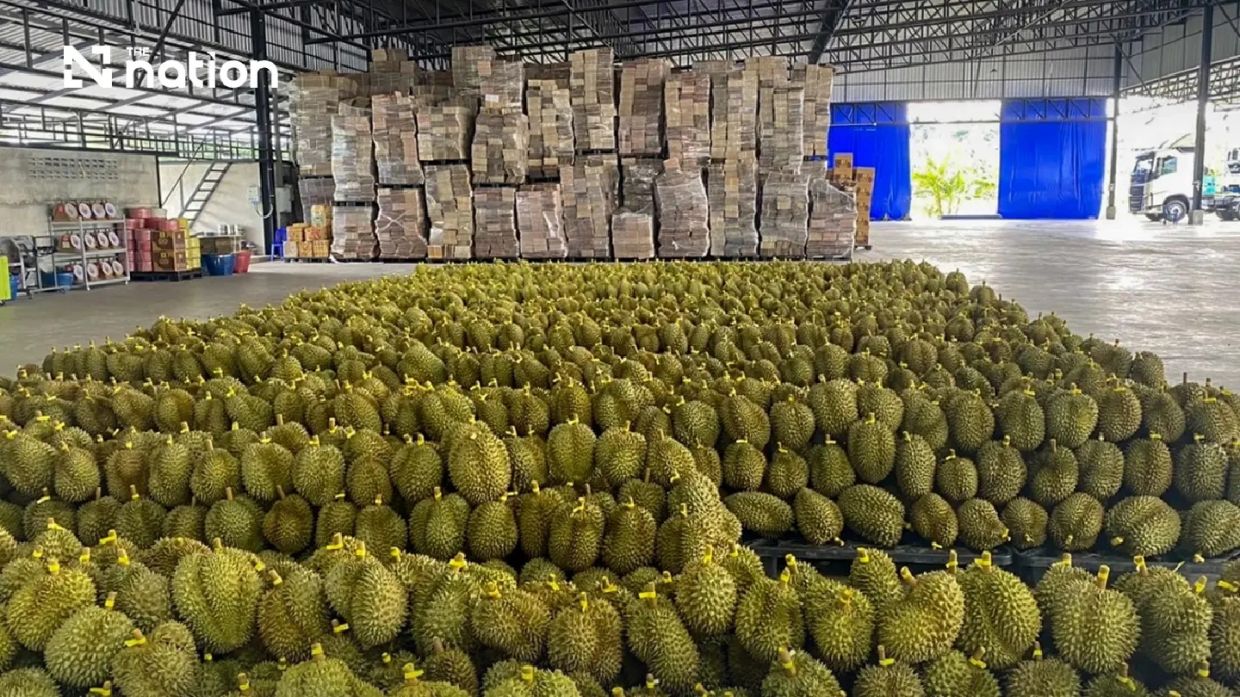
Thailand has achieved a significant breakthrough in its agricultural trade with China, with fresh durian exports reaching THB100.08 billion during the first six months of 2026—a watershed moment for an industry that generates substantial revenue for the kingdom. The milestone encompasses more than 872,000 tonnes shipped across 53,665 containers to the People's Republic of China as of June 30, 2026, signalling robust demand despite global supply chain complexities and evolving regulatory requirements that have historically complicated cross-border fruit trade in Southeast Asia.
This achievement does not arise from market conditions alone but reflects deliberate governmental restructuring of how Thailand manages its durian supply chain from farm to consumer. The Ministry of Agriculture and Cooperatives has fundamentally altered its operational philosophy, moving away from reactive problem-solving toward proactive, system-wide quality governance that extends across all production and export stages. Minister Suriya Jungrungreangkit, during his initial 90 days in office, prioritised the modernisation of quality assurance protocols, recognising that sustained competitiveness in demanding international markets depends on consistency and transparency rather than sporadic interventions.
Central to this transformation is the establishment of what officials term the "Four Nos" enforcement regime, which prohibits immature durian from entering export channels, eliminates worms and pest contamination, prevents false claims about geographical origin, and bars the presence of Basic Yellow 2—a synthetic dye that has repeatedly triggered rejections by Chinese regulators. These measures directly address the specific sanitary and phytosanitary challenges that had previously damaged Thailand's market reputation and created friction with Chinese trading partners. By targeting contamination sources systematically rather than catching problems at inspection points, Thailand has reduced bottlenecks and accelerated the release of goods to importers.
The regulatory overhaul incorporates a four-layer screening mechanism that applies risk-based evaluation at production, packing, laboratory and certification stages. This architecture leverages scientific analysis and traceability technologies—including electronic phytosanitary certificate systems—to create a transparent audit trail that satisfies Chinese food safety authorities while simultaneously reducing bureaucratic burden on farmers and exporters. For Malaysian observers, this approach offers instructive precedent: as Southeast Asian agricultural exporters compete for access to China's massive fruit market, similar institutional reforms could unlock value across the region's horticultural sectors.
The integration of multiple government agencies represents another crucial element of Thailand's strategy. The Department of Agriculture serves as the coordinating hub, working alongside the National Bureau of Agricultural Commodity and Food Standards, the Department of Agricultural Extension, the Customs Department, provincial authorities, laboratories, commercial operators and Chinese regulatory bodies. This horizontal coordination model contrasts with fragmented approaches that remain common in regional competitor nations, where agricultural exports often navigate overlapping and sometimes contradictory standards imposed by different ministries or provincial governments.
Minister Suriya framed Thailand's success not merely in financial terms but as the construction of institutional foundations for long-term agricultural competitiveness. He emphasised that robust quality management systems stabilise farmer incomes, enable operators to compete effectively on international markets and position Thailand as a reliable supplier of premium fruit products. This narrative extends beyond durian to encompass the broader agricultural export portfolio—the government explicitly intends to apply these lessons to other high-value crops competing for space in global markets already crowded with producers from India, Vietnam, the Philippines and beyond.
The full-year export target of THB150 billion represents a 50 percent increase over the first-half performance, a projection that assumes sustained Chinese demand, continued logistical efficiency and the absence of major trade disruptions or new regulatory obstacles. Such targets drive domestic priority-setting but also carry risk if unforeseen circumstances—such as shifts in Chinese consumption patterns, the emergence of competing suppliers with lower costs, or the imposition of additional food safety requirements—alter market dynamics. Nevertheless, the structural improvements implemented are durable and should support baseline performance even if growth projections prove optimistic.
For Malaysia and other ASEAN nations, Thailand's experience illuminates both opportunity and competitive pressure. The success of Thailand's durian exports demonstrates that Southeast Asian agricultural products possess genuine competitive advantages in Chinese markets when quality assurance systems match international best practices. Simultaneously, Thailand's institutional innovations raise competitive benchmarks that other regional producers must meet. Malaysian agricultural exporters, whether focused on durian, palm oil, cocoa or other commodities, face implicit pressure to adopt comparable quality management and traceability systems or risk losing market share to better-organised competitors.
The Ministry of Agriculture's evolution toward what officials characterise as a "Smart Regulator" role signals a broader shift in how Asian governments conceptualise agricultural trade facilitation. Rather than viewing regulatory agencies primarily as enforcement bodies that inspect and reject substandard goods at border crossings, Thailand has repositioned its Department of Agriculture as a system architect and enabler. Technology infrastructure—particularly electronic certification and real-time information sharing—reduces manual inspection burden while paradoxically improving oversight and compliance. This model may prove increasingly attractive to other Southeast Asian governments attempting to balance food safety obligations with the operational efficiency required to maintain export competitiveness.
The strategic importance of the China market for Thai agriculture cannot be overstated. Chinese consumers' growing appetite for premium fruit products, combined with their government's protective agricultural policies that shield domestic producers, creates intense competition among exporters from Thailand, Vietnam, the Philippines and beyond. Thailand's current success rests partly on the kingdom's geographical proximity to China, established logistics infrastructure and established trade relationships, but these advantages erode if quality or reliability falter. The institutional changes now in place represent insurance against such deterioration—they transform quality assurance from a periodic concern into a continuous, embedded process.
Looking forward, Thailand's durian success may serve as a template for upgrading management of other agricultural exports. The kingdom remains a significant exporter of rice, cassava, sugar, fish and other commodities where similar institutional innovations could unlock value. The government appears cognisant of this potential, with officials explicitly positioning the durian reforms as a prototype for sectoral improvements. For Malaysian policymakers and agricultural business leaders, this signals that the regional competitive landscape is shifting toward those nations that can credibly assure Chinese buyers of product quality, safety and supply consistency through demonstrable systems rather than reputation alone.

