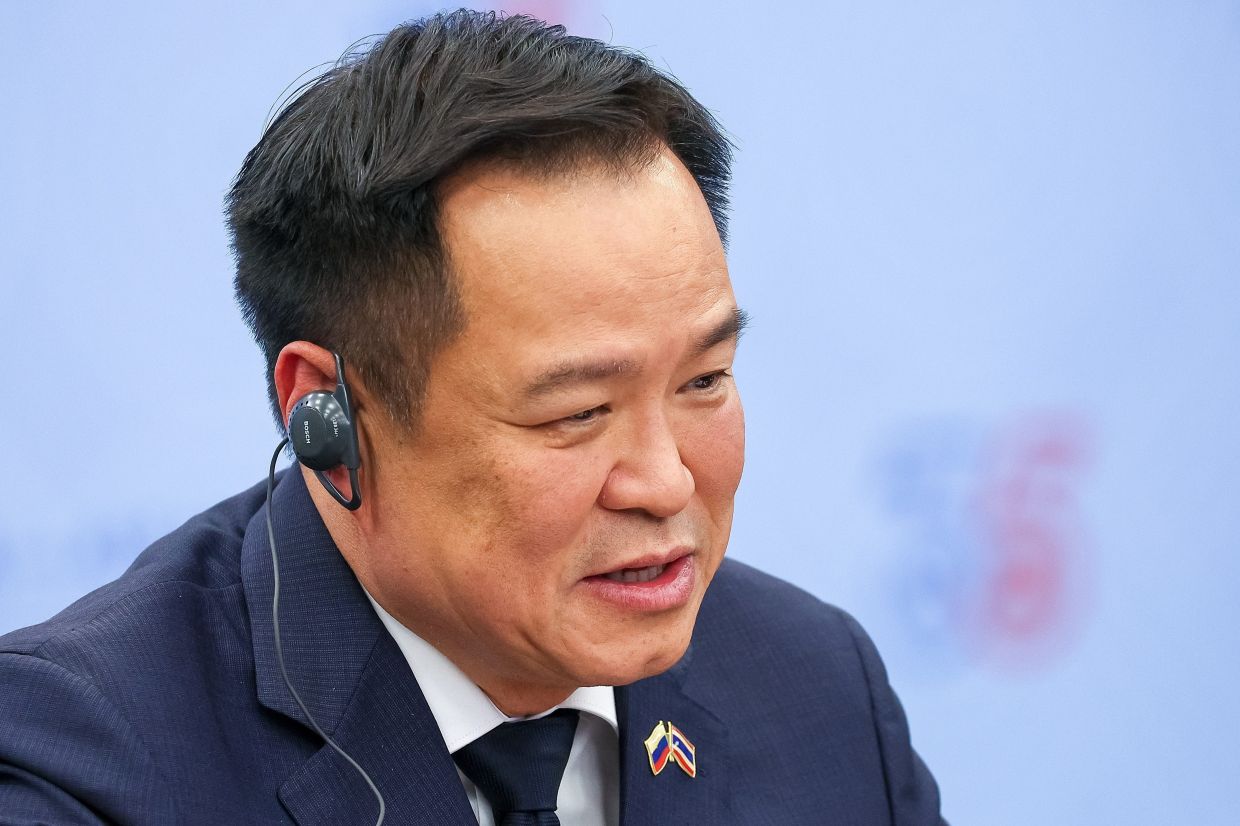
Thailand's Prime Minister Anutin Charnvirakul, sworn in on March 20 following his February 2026 election victory, has completed his first hundred days managing a nation facing both immediate crises and deeper structural challenges. The milestone, reached on June 27, comes after he previously served as prime minister from September 2025 until the Paetongtarn Shinawatra government collapsed, before securing a fresh electoral mandate just four months later. Yet the question facing observers and analysts remains whether his administration intends merely to steady the ship or to chart a transformative course for Southeast Asia's second-largest economy.
The new government faced its critical test almost immediately upon taking office. When US-Israel military operations against Iran on February 28 disrupted global oil exports and shipping through the Strait of Hormuz, Thailand—like much of the region—experienced supply shocks that threatened economic stability. Petrol stations struggled to refuel fast enough to meet panicked demand, and crude oil prices climbed above $100 per barrel for extended periods, exposing the region's dependence on energy supplies controlled by forces and circumstances far beyond its control. For a nation already grappling with tepid economic growth, such external disruptions posed a genuine threat to consumer confidence and industrial activity.
Anutin's response drew measured approval from both analysts and the public. The government tapped the national Oil Fuel Fund to subsidise fuel prices, lowered borrowing costs for farmers and manufacturers, and ordered coal-fired power plants to increase output. Officials pursued energy diversification by expanding imports from the United States, Malaysia, and Brunei, recognising that Thailand's energy security required reducing its exposure to volatile Middle Eastern markets. Political science researcher Mathis Lohatepanont of the University of Michigan observed that the government managed to weather the initial supply disruptions and price spikes without triggering the kind of sustained social unrest that often destabilises developing democracies. Although grumbling about petrol prices continued, the streets saw no mass protests, suggesting Anutin had at least neutralised this immediate political risk.
The prime minister also capitalised on his campaign platform by taking a harder line on Thailand's long-running border dispute with Cambodia. His Bhumjaithai Party had won the most parliamentary seats partly by appealing to nationalist sentiment and promising tougher stances on territorial issues. As premier, Anutin followed through by maintaining military leadership in border security operations and, most significantly, unilaterally terminating the 2001 bilateral agreement with Cambodia regarding overlapping maritime boundaries. By elevating the dispute to United Nations arbitration, he fulfilled a campaign promise while satisfying his party's nationalist voter base and military supporters concerned with protecting Thai sovereignty and territorial claims.
Another early political victory came through the launch of the "Thais Help Thais Plus" subsidy scheme on June 1, addressing a pledge made during the campaign. The programme allows approximately 30 million eligible citizens aged 18 and above—excluding those already covered by existing state welfare—to purchase selected goods from participating merchants at just 40 per cent of the retail price, with government covering the remainder. With 176 billion baht (US$5.27 billion) allocated to the initiative, it represented a tangible delivery of benefits to voters who had backed Anutin's electoral coalition. The scheme provided immediate relief to household budgets and stimulated consumption across the economy, generating visible public satisfaction in the government's willingness to implement promises.
However, the consensus among independent observers suggests that these accomplishments, while real, address only the surface of Thailand's economic predicament. Chulalongkorn University political scientist Puangthong Pawakapan acknowledged that Thais recognise the subsidy programme offers merely temporary relief from rising costs of living but does nothing to resolve the fundamental economic crisis underlying household financial strain. Mathis similarly cautioned that the programme, though popular, remains "relatively fleeting" and that the government's hundred-day record offers insufficient evidence of commitment to tackling longer-term structural policy challenges. In other words, Anutin has proven adept at managing crises and delivering targeted benefits, but has demonstrated little appetite for the difficult reforms that might generate sustained economic dynamism.
Thailand's economic performance underscores why such structural change matters urgently. The nation has failed to achieve annual growth exceeding three per cent over the past five years, reflecting decades of policy discontinuity stemming from military coups and short-lived governments that have undermined long-term planning capacity. The International Monetary Fund projects Thailand's economy will expand by merely 1.5 per cent this year—the slowest pace across Southeast Asia. By contrast, Vietnam anticipates 7.1 per cent growth, Cambodia four per cent, and even Myanmar three per cent growth despite its devastating internal conflict. These comparisons expose Thailand's competitive disadvantage among regional peers, a gap that subsidies and day-to-day management cannot bridge. The nation confronts formidable headwinds including an ageing population, persistently high household debt, and sluggish productivity growth that reforms in digital technology, artificial infrastructure, and clean energy might address—yet Anutin has articulated no clear roadmap for such transformation.
The most glaring gap in the government's first hundred days concerns constitutional reform, an issue that exposes the difference between crisis management and genuine commitment to systemic change. Nearly 60 per cent of voters—approximately 20 million citizens—indicated in a referendum held alongside the February election that they wished to revise the 2017 Constitution. That charter, drafted under former premier Prayut Chan-o-cha following the 2014 military coup, is widely viewed as fundamentally undemocratic. Democratic activists, political parties, and civil society groups have demanded constitutional overhaul as essential to Thailand's political trajectory. Yet after a hundred days in office, the Anutin government has made virtually no substantive progress on this mandate, nor signalled any intention to do so. Political scientist Stithorn Thananithichot of Chulalongkorn University argues that a government genuinely committed to reform would have announced at least one major structural initiative immediately upon taking office; the absence of such signals suggests deliberate choice rather than mere delay.
Stithorn's broader assessment is that Anutin's administration has directed its energies toward routine governance and day-to-day crisis management rather than pursuing meaningful economic or political transformation. Questions have also arisen regarding the composition of his Cabinet, with critics questioning whether his appointments suggest any commitment to modernising Thailand's approach to governance and policy-making. The contrast between the government's tangible accomplishments—energy crisis stabilisation, border assertiveness, subsidy delivery—and its apparent indifference to structural reform reflects a pragmatic political calculus: maintain coalition stability, avoid destabilising street protests, and deliver visible benefits to core supporters without attempting the difficult work of institutional modernisation.
For Malaysia and other Southeast Asian economies watching Thailand's trajectory, the implications are substantial. Thailand remains a significant regional economic partner and a testing ground for how developing democracies manage the tension between short-term political survival and long-term structural improvement. If Anutin's hundred-day pattern persists—where governments prove competent at crisis response but unwilling to undertake fundamental reforms—Thailand risks further erosion of its regional economic standing relative to faster-growing neighbours. The subsidy scheme may ease immediate pain, but without addressing productivity, competitiveness, and demographic challenges, it cannot restore Thailand to its historical role as a regional economic anchor.
Anutin's performance at the hundred-day mark therefore presents a cautionary lesson in the limits of crisis management divorced from structural vision. He has earned praise for stabilising a volatile political moment and navigating an external energy shock without triggering internal chaos. Yet that very success in managing stability may discourage the difficult reforms that Thailand's economic position demands. As Thailand settles into what appears to be an extended period of centre-right coalition governance under Anutin's leadership, the critical question becomes whether his administration will eventually signal movement toward the constitutional and economic modernisation that voters endorsed, or whether it will settle for the safer terrain of routine administration and tactical problem-solving.

