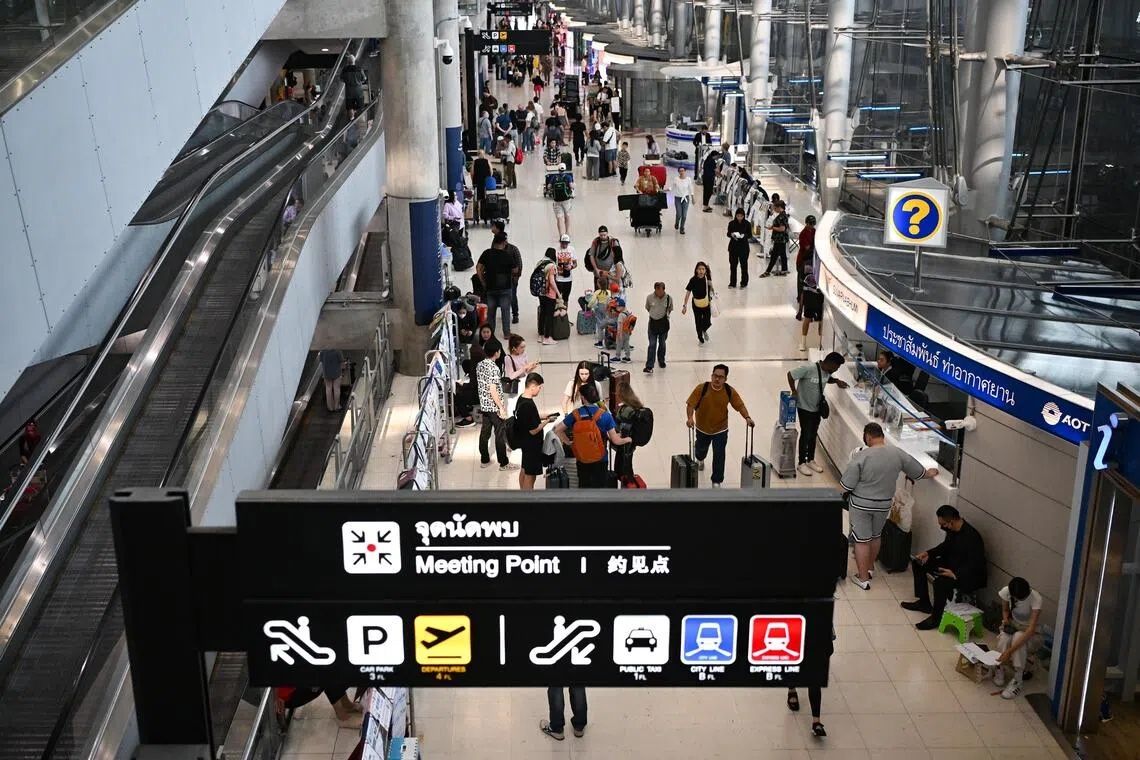
Thailand is moving to streamline border entry procedures at its busiest airport by extending automated passport control to travellers from 31 additional nationalities by the end of August. The expansion of the Auto Gates system at Suvarnabhumi Airport has been approved in principle by the Immigration Bureau, with formal signing expected imminently, according to Deputy Government Spokesperson Lalida Persvivatana. Once implemented, the measure could unlock faster processing for a significant majority of international visitors, addressing chronic congestion that has become increasingly problematic as Thailand's tourism sector rebounds to pre-pandemic levels.
The airport's capacity challenges have become more acute with the resumption of mass tourism. Suvarnabhumi handles approximately 190,000 passengers daily during peak tourism seasons, of which roughly 70,000 are international arrivals. The Immigration Bureau faces extraordinary pressure during afternoon peak hours, between 1pm and 5pm, when passenger flows swell to between 5,000 and 6,000 individuals per hour. This concentration creates extended queue times that frustrate visitors and strain airport infrastructure, potentially damaging Thailand's reputation as a tourism destination that prides itself on hospitality and seamless travel experiences.
The expansion promises to substantially reduce bottlenecks by making approximately 6.5 million additional passengers annually eligible for the automated gates. When combined with around 900,000 holders of specific long-term visas already permitted to use the system, the initiative will eventually enable roughly 53 per cent of arriving international passengers to bypass traditional manual immigration processing entirely. This proportion represents a watershed moment for Thailand's immigration modernisation efforts, transforming the entry experience for the majority rather than a minority of foreign visitors.
The phased rollout will depend on the availability and readiness of biometric equipment, security infrastructure, and the collection of necessary facial recognition data. Travellers arriving for the first time will still require initial biometric registration before they can use the automated gates, a prerequisite that balances efficiency with security protocols. This distinction between repeat and first-time visitors ensures that Thailand maintains rigorous screening standards whilst maximising convenience for returning tourists and business travellers who form a growing segment of Thailand's visitor profile.
Higher-level Thai officials have prioritised this infrastructure modernisation as central to maintaining Thailand's competitive edge in regional tourism. Deputy Prime Minister and Commerce Minister Suphajee Suthumpun, alongside Tourism and Sports Minister Surasak Phancharoenworakul, visited Suvarnabhumi to oversee discussions about comprehensive immigration streamlining strategies. The visit reflected institutional recognition that border processing efficiency has become a differentiating factor in attracting and retaining international visitor flows, particularly as competing Southeast Asian destinations upgrade their own facilities.
The strategic focus extends beyond queue management to encompass the entire arrival experience. Lalida emphasised that the objective encompasses far more than merely reducing waiting times; the underlying ambition is to ensure that foreign visitors encounter a fundamentally convenient, expedited, and secure environment from the moment they disembark. This holistic approach acknowledges that first impressions significantly influence visitor satisfaction, repeat visitation likelihood, and word-of-mouth recommendations that drive tourism demand in an increasingly competitive regional marketplace.
Additional infrastructure investments are simultaneously under consideration to support Thailand's tourism expansion trajectory. The working group discussed augmenting passenger waiting areas and transit zones, alongside longer-term capital projects designed to accommodate anticipated passenger growth. These complementary initiatives recognise that immigration gate automation alone cannot solve all congestion issues without parallel investments in terminal capacity, baggage handling systems, and internal circulation spaces that distribute passenger flows more efficiently throughout the airport.
Thailand's tourism recovery has exceeded expectations following the pandemic's disruption. From January 1 to July 18 this year, Thailand attracted approximately 17.36 million international tourists, demonstrating the scale of visitor demand pressing against existing infrastructure constraints. This figure underscores why immigration modernisation has become an operational necessity rather than merely a convenience enhancement, with current processing systems demonstrably insufficient to handle the volume and pace of arrivals that contemporary tourism expectations demand.
For Malaysian and Southeast Asian visitors specifically, the expansion carries particular significance. Malaysian travellers represent one of Thailand's largest visitor cohorts, with many crossing the border multiple times annually for leisure and business purposes. Once Malaysians are included in the expanded Auto Gates programme—a likely scenario given Malaysia's regional prominence—the efficiency gains would be most directly experienced by Malaysia's travelling public. The streamlined process could encourage increased cross-border tourism, business travel, and regional integration, whilst reducing friction costs associated with Thailand visits that currently deter some potential travellers who perceive border procedures as unnecessarily time-consuming.
The automated immigration initiative also reflects broader regional trends toward digital transformation and contact-minimisation in public services. Thailand is aligning itself with international best practices established at major hubs in Singapore, South Korea, and Australia, where biometric-enabled automated processing has become standard. This modernisation positions Thailand as a technologically progressive destination that respects visitor time and resources, potentially appealing to time-conscious business and upscale leisure travellers who factor convenience into destination selection decisions.
Successful implementation depends on meticulous coordination between multiple agencies, reliable biometric data collection and management, and sustained investment in system maintenance and upgrades. The August deadline provides a concrete target but also represents an ambitious timeframe given the requirement to secure necessary equipment, train personnel, and ensure security clearance for 31 additional nationalities. Any delays would likely attract scrutiny from international tourism operators and traveller forums that increasingly use airport efficiency metrics in assessing destination appeal.

