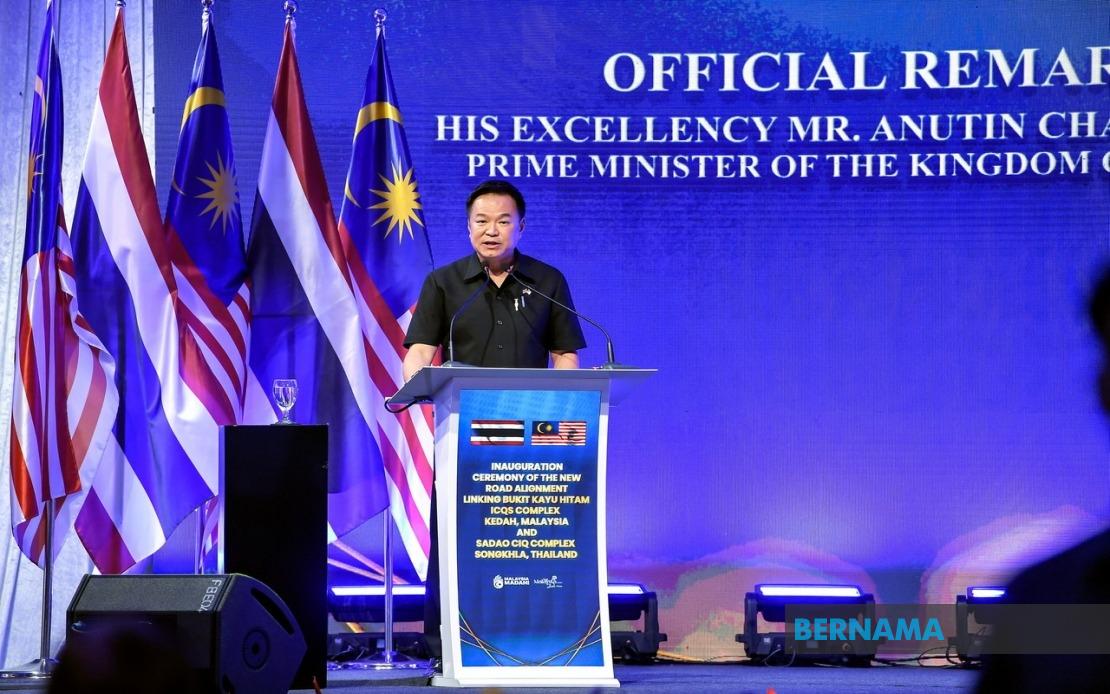
Thailand's Prime Minister Anutin Charnvirakul has pledged his government's commitment to filling critical gaps in the region's transport infrastructure, aiming to create uninterrupted corridors for the movement of goods and people from Malaysia through Thailand and into broader Asian markets including China and Russia. Speaking at Bukit Kayu Hitam in Kedah, where he jointly inaugurated a new road alignment with Malaysian Prime Minister Datuk Seri Anwar Ibrahim, Anutin outlined an ambitious vision for land connectivity that would position both nations as vital nodes in an expanding continental trade network.
The newly opened road link connecting the Bukit Kayu Hitam Immigration, Customs, Quarantine and Security (ICQS) Complex in Malaysia with the Sadao Customs, Immigration and Quarantine (CIQ) Complex in Thailand represents the fruit of sustained bilateral cooperation between the two governments. Rather than a singular infrastructural achievement, this project exemplifies the kind of pragmatic, incremental approach to regional integration that has characterised Malaysia-Thailand relations in recent years. By streamlining border procedures and reducing physical congestion at one of Southeast Asia's busiest crossing points, the alignment directly addresses longstanding complaints from logistics operators, traders, and commuters who have struggled with bottlenecks along the terrestrial corridor linking Peninsula Malaysia to the Thai heartland.
Anutin's remarks reveal a sophisticated understanding of how border infrastructure must function within larger continental supply chains. His reference to ensuring goods reach destinations "with the shortest time" underscores how Thailand conceptualises its geographical position not merely as a domestic asset but as a critical intermediary in north-south trade flows. When goods from Malaysia can transit Thailand efficiently, they gain access to Chinese markets via the growing overland routes through northern Thailand. Similarly, Thai and Chinese products moving southward through Malaysian territory toward Singapore and Indonesia encounter fewer delays, making the entire regional ecosystem more competitive against extra-regional trade corridors.
The bilateral nature of this infrastructure push carries particular weight for Malaysia's northern states, which have historically underperformed economically compared to the developed Klang Valley and Iskandar Malaysia regions. Kedah and Perlis have long positioned themselves as potential gateways to Thailand and beyond, yet persistent infrastructure gaps have frustrated these ambitions. The new road alignment, by reducing transit times and operational friction, potentially transforms the economics of northern Malaysian manufacturing and logistics hubs. Companies considering whether to base regional operations in Penang, Kuala Lumpur, or alternatively in emerging northern corridors may now find the calculation shifting in favour of Kedah and Perlis as viable alternatives.
The conversation between Anutin and Anwar extended beyond this single project to encompass an entire portfolio of interconnectivity initiatives spanning three additional border crossings: the Songkhla-Kedah route, the Satun-Perlis connection, and the Narathiwat-Kelantan link. This comprehensive approach suggests that both governments understand regional development not as isolated point-to-point improvements but as systemic transformation requiring coordinated investment across multiple entry points. Such strategy-level thinking is relatively rare in Southeast Asian bilateral relations, where projects frequently proceed in fits and starts depending on domestic political cycles or budgetary constraints.
For southern Thailand, where per-capita income lags significantly behind Bangkok and the central regions, these connectivity projects represent genuine economic opportunity. The Thai provinces of Songkhla, Satun, and Narathiwat have nursed grievances about peripherality within the Thai economic sphere for decades. Enhanced land links to Malaysia's relatively prosperous northern states and the broader regional ecosystem could catalyse cross-border investment, tourism, and labour mobility that might address chronic underdevelopment. Northern Malaysia faces comparable regional disparities, making these corridors potentially transformative for both sides of the border.
The political symbolism of Anutin's visit and the joint inauguration ceremony deserves close attention. Thailand's government has sometimes been viewed with caution in Malaysia, particularly during periods of political instability in Bangkok. The formal, high-level nature of this engagement and Anutin's explicit appreciation for Anwar's support signal a deliberate effort to normalise and deepen the bilateral relationship at a moment when both countries face economic pressures and seek to maximise regional influence. By framing infrastructure development as a shared endeavour benefiting both populations, both leaders position their administrations as forward-looking and pragmatic.
The logistical challenges that these projects address remain substantial. Customs procedures, quarantine protocols, and security screening still consume hours at major crossings despite technological advances. The new road alignment reduces physical congestion, but harmonising border processes requires ongoing cooperation between Thai and Malaysian agencies, a task complicated by different administrative systems, regulations, and sometimes competing bureaucratic interests. Success will depend on whether both governments maintain momentum beyond the inauguration stage and allocate sufficient resources to operational improvements alongside infrastructure.
For the broader Southeast Asian region, these Malaysia-Thailand initiatives fit within larger patterns of infrastructure ambition. The Asean Connectivity agenda, Chinese Belt and Road initiatives, and regional development banks' funding mechanisms have all created an environment where governments feel pressure to improve cross-border infrastructure. However, few projects match this scale and bilateral commitment. The Malaysia-Thailand effort thus becomes a test case for whether ASEAN member states can sustain serious infrastructure partnerships over multiple years despite political transitions and competing priorities.
The economic implications for Southeast Asia are multifaceted. Improved Malaysia-Thailand connectivity reduces costs for manufacturers with supply chains spanning both countries, potentially attracting new investment to the region as a whole. It also strengthens the region's hand in negotiating with extra-regional powers, particularly China, which has long sought to position itself as an indispensable partner for Asian infrastructure development. When ASEAN countries advance their own connectivity agenda through bilateral cooperation, they retain greater autonomy over the terms and strategic direction of regional integration.
Anutin's emphasis on facilitating not just goods but also people movement carries implications for cross-border labour and tourism. Easier passage for citizens of both countries could expand informal economic activity in border regions, though also raising concerns about regulatory oversight. Malaysian authorities will need to balance the efficiency gains from streamlined procedures against security and immigration control considerations. Similarly, Thai authorities must weigh trade facilitation against concerns about smuggling and illegal movement.
Looking forward, the success of this initiative will likely influence other ASEAN border relationships. If Malaysia and Thailand can demonstrably increase cross-border trade volumes, reduce transit times, and improve local economic conditions, the model becomes attractive to other country pairs facing similar infrastructure challenges. Conversely, if implementation falters or benefits accrue unevenly, neighbouring states will view regional connectivity projects with heightened scepticism. The stakes, therefore, extend well beyond bilateral relations into the foundational question of whether Southeast Asia can successfully upgrade its internal infrastructure to support deeper regional integration and compete more effectively in global markets.

