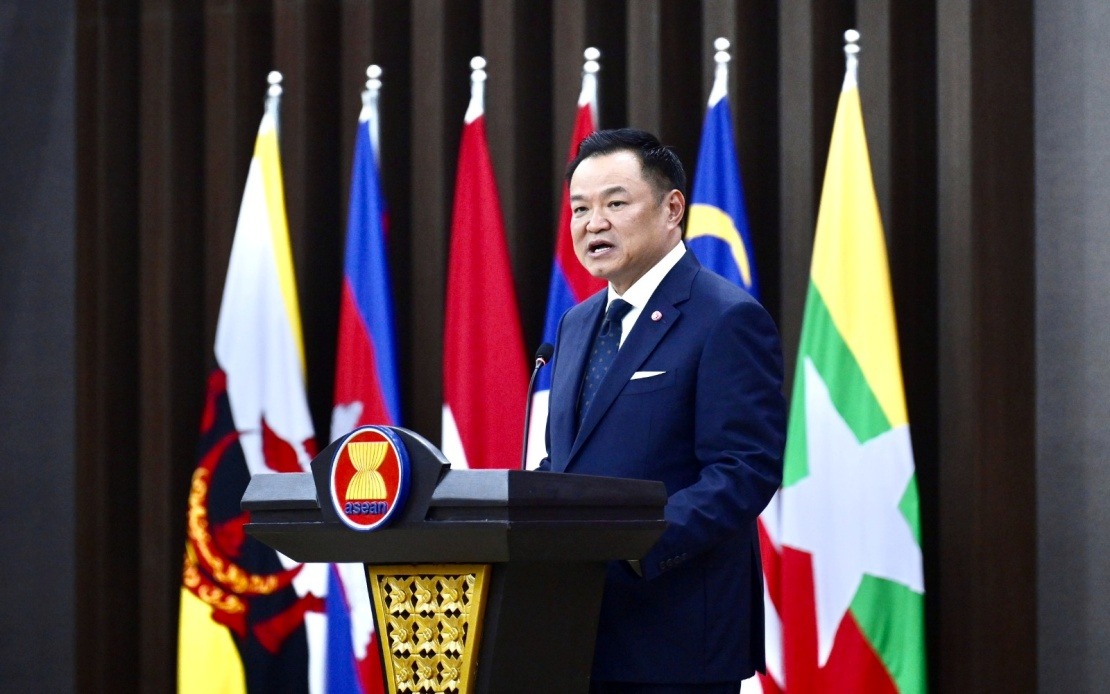
Thai Prime Minister Anutin Charnvirakul has set out an ambitious framework for regional development, calling on ASEAN to evolve into a more robust and people-focused organisation as it approaches its 60th anniversary next year. Speaking at the ASEAN Secretariat in Jakarta during his first official visit to Indonesia since taking office as Thailand's 32nd prime minister in September 2025, Anutin articulated three interconnected pillars for the bloc's future trajectory: strengthening regional integration, building institutional and economic resilience against mounting global uncertainties, and ensuring that ASEAN's initiatives translate into concrete improvements in citizens' lives across the ten-member organisation.
The Thai leader's emphasis on regional self-sufficiency carries particular weight in Southeast Asia's current geopolitical context, where member states are increasingly caught between competing great-power interests and economic pressures. His insistence that "regional challenges require regional solutions" acknowledges the reality that individual Southeast Asian nations, regardless of their size or economic heft, cannot independently navigate the interconnected threats and opportunities posed by shifting global dynamics. The statement reflects growing recognition within ASEAN capitals that the bloc's greatest asset remains its collective voice and unified approach to problems ranging from maritime security to pandemic preparedness and climate adaptation.
Charnvirakul's call for greater operational flexibility within ASEAN's decision-making framework represents a subtle but significant proposal for institutional evolution. While reaffirming commitment to the hallowed principles of consensus and non-interference that have historically defined ASEAN's modus operandi, he suggested these foundational doctrines should be applied with increased pragmatism to enable faster and more decisive responses to emerging crises. This tension between preserving ASEAN's traditional consensus culture and adapting to rapid-fire challenges mirrors broader debates within the bloc about how to remain relevant and effective without compromising the sovereignty concerns that underpin member states' commitment to the organisation.
The prime minister identified several concrete priority areas demanding immediate ASEAN attention. Supply chain resilience has become an increasingly pressing concern for the region, particularly as regional economies seek to reduce dependency on single suppliers and diversify trading relationships following pandemic-related disruptions and ongoing geopolitical tensions. Similarly, energy and food security remain acute vulnerabilities for a region that imports significant quantities of both commodities and faces growing climate-related threats to agricultural productivity. The emphasis on digital connectivity reflects recognition that technological advancement is reshaping economic competition, with nations that lag in infrastructure and skills facing long-term disadvantage in attracting investment and fostering innovation-driven growth.
Charnvirakul's focus on developing human capital for the digital age addresses a demographic imperative that will shape ASEAN's prospects for decades. The region's large youth population represents both enormous potential and significant risk, with economic opportunity and educational investment critical to preventing social instability and brain drain. By advocating for enhanced ASEAN cooperation in equipping young people with relevant digital skills, the Thai PM positioned technical education and knowledge-sharing as foundational to the region's competitiveness. This also implies greater openness to labour mobility and exchange programmes within ASEAN, though such measures remain politically contentious in several member states.
The proposal to expand cooperation with middle powers and the Global South signals Thailand's strategic thinking about ASEAN's place in a multipolar world where binary superpower competition is increasingly insufficient for understanding international dynamics. By cultivating relationships beyond the traditional Western-China axis, ASEAN member states seek to preserve strategic autonomy and expand their range of partnerships. This approach allows individual nations and the collective body to diversify economic relationships, access alternative sources of development financing, and avoid the pressure to choose sides in great-power competition that could undermine ASEAN unity.
On the thorny Myanmar question, Charnvirakul's reiteration of support for ASEAN's Five-Point Consensus while advocating "calibrated re-engagement" reflects the delicate balancing act that member states, particularly Thailand with its lengthy border with Myanmar, must perform. The Five-Point Consensus, agreed by ASEAN leaders in April 2021, outlined steps toward resolving Myanmar's political crisis but has faced criticism for lacking enforcement mechanisms and producing limited practical progress. By characterising the International Committee of the Red Cross visit to Aung San Suu Kyi as a positive development, Charnvirakul framed incremental diplomatic movements as evidence that dialogue and engagement remain viable approaches, even as Myanmar's military junta maintains firm control and the country's humanitarian situation deteriorates.
Thailand's approach to the Myanmar crisis carries particular weight because of geographic proximity and deep cultural and economic ties. The junta's continued isolation and international pressure have created pressures on Myanmar's economy that ripple across the border, affecting Thailand's tourism industry, labour supply, and security dynamics. By championing dialogue and incremental progress rather than confrontation or isolation, Bangkok seeks to prevent state collapse while maintaining space for eventual political resolution. This pragmatic engagement strategy, while sometimes criticised by international human rights advocates, reflects the reality that coercive measures have limited leverage and that ASEAN lacks enforcement capacity regardless of its stated consensus positions.
Charnvirakul's remarks on Cambodia indicate Thailand's broader commitment to managing bilateral tensions through institutional frameworks and renewed engagement. The statement about rebuilding mutual trust and continuing dialogue suggests ongoing friction between the two nations, whether related to border demarcation, historical grievances, or strategic competition for ASEAN influence. By emphasising commitment to international law and peaceful resolution, Thailand positions itself as a responsible regional actor while signalling openness to renewed cooperation. This approach contrasts with more confrontational tactics and reflects the premium Southeast Asian governments place on stability and functional interstate relationships.
The timing of Charnvirakul's Jakarta visit as the first official Thai prime ministerial visit to Indonesia in 15 years underscores the significance of bilateral relations between the region's largest and most strategically important economies. Indonesia, as ASEAN's nominal leader and home to the ASEAN Secretariat, serves as the bloc's institutional anchor and most influential voice. By prioritising an Indonesian visit early in his tenure, Charnvirakul signalled respect for Jakarta's leadership role and commitment to working within the regional framework despite Thailand's own substantial economic and strategic assets.
The emphasis on measuring ASEAN success by tangible benefits to ordinary citizens—stronger economic opportunities, improved security, and effective transnational crime prevention—reflects acknowledgment that the organisation's legitimacy ultimately depends on demonstrating value to member state populations. Abstract commitments to regional solidarity carry limited political weight if citizens experience no concrete improvements in their daily lives or economic prospects. This people-centric framing also suggests recognition within ASEAN's leadership that the bloc faces legitimacy challenges as rising nationalism, populism, and state dysfunction in several member countries strain the cooperative frameworks on which ASEAN depends.
As ASEAN approaches its 60th anniversary, Charnvirakul's vision articulates the contemporary challenge facing the organisation: remaining true to foundational principles while adapting to a world of accelerating change, intensifying great-power competition, transnational challenges that transcend borders, and rising citizen expectations. Thailand's proposed emphasis on proactive preparation rather than reactive crisis management, flexibility within consensus rather than rigid unanimity, and tangible results alongside diplomatic principle suggests a pragmatic evolution of ASEAN's approach. Whether the bloc can successfully implement such adjustments while preserving the unity that remains its greatest asset will significantly shape Southeast Asia's trajectory in coming years.

