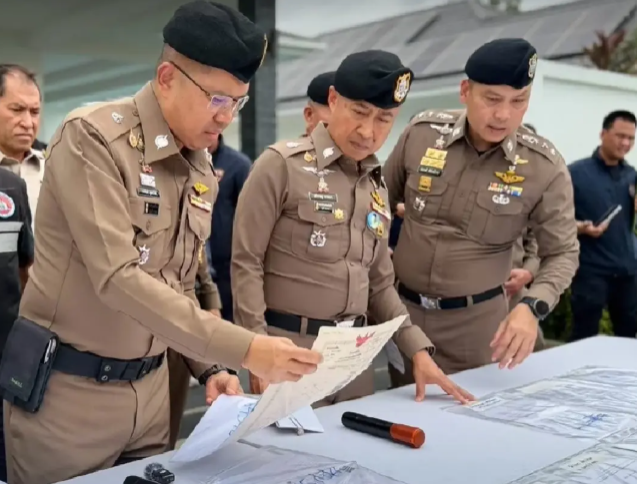
Thai police have intensified enforcement action against foreign nationals suspected of circumventing property ownership laws, arresting 13 people during coordinated raids across 15 locations in Hua Hin on Monday as part of the sixth phase of a nationwide crackdown on nominee structures. The operation, which mobilized over 200 officers and government officials in Prachuap Khiri Khan, represents an escalation in authorities' efforts to uncover and dismantle elaborate schemes that have allowed foreigners to hold high-value real estate through companies ostensibly controlled by Thai shareholders.
The arrested individuals included three British nationals, four Chinese nationals, and one person each from Italy, France, the Netherlands, Austria, the Philippines, and the United States. While courts had issued arrest warrants for 45 foreign nationals in total, police also called in 39 Thai nationals for questioning as investigators seek to map the full scope of the suspected networks. The detainees remain under investigation and have not yet faced charges in court, reflecting authorities' determination to build comprehensive cases against those implicated.
The Hua Hin operations centered on a residential development of detached houses and modern pool villas located in Thap Tai subdistrict, with individual properties valued between 10 and 20 million baht. The broader investigation encompasses 33 companies suspected of holding land on behalf of foreign nationals, with preliminary valuations suggesting the properties involved are worth approximately 300 million baht. Preliminary searches at the targeted development identified six companies allegedly operating with Thai nationals as nominee shareholders, with four companies linked to the scheme's initial phase and two to its second iteration.
According to police accounts of their interrogations, foreign nationals involved claimed they sought to lawfully own property in Thailand and had received advice from law and accounting firms recommending the establishment of corporate entities to facilitate this objective. These individuals reportedly believed the arrangements constituted a legitimate pathway to property ownership within Thai legal frameworks. However, investigators concluded that the companies in question conducted no genuine business operations, suggesting their sole purpose was to serve as vehicles for foreign property acquisition. The specific law and accounting firms implicated in these arrangements remain unnamed in official statements.
Thailand's property laws strictly prohibit foreigners from owning land directly, though exemptions exist for condominiums under specific conditions. This regulatory framework has historically created opportunities for circumvention, with foreign buyers working through elaborate corporate structures and nominee arrangements to acquire residential properties in prime locations. The targeting of properties in tourist-heavy destinations like Hua Hin underscores authorities' concern that such schemes concentrate in areas where foreign demand for real estate remains robust and where local facilitators may be more readily available.
Investigations revealed that Thai nationals identified as shareholders consistently denied meaningful involvement in the companies' operations. These individuals told investigators they had agreed to hold shares nominally on behalf of foreign principals but had never contributed capital toward share purchases and played no role in company management. Additionally, they claimed to have received no financial documentation or other evidence substantiating their supposed investments, a pattern that strongly suggests the nominee arrangements lacked any legitimate commercial foundation. Police characterize these findings as evidence that corporate structures were deliberately designed to obscure foreign beneficial ownership and control.
Police seized extensive documentation and electronic materials during the operations, including company registration records, accounting files, computers, mobile phones, and digital data. Investigators now face the painstaking task of analyzing these materials to reconstruct financial flows and identify additional individuals, beneficiaries, and networks potentially engaged in similar schemes both within Thailand and internationally. The scope of the inquiry extends beyond the immediate detainees to encompass potential government officials suspected of corruption or complicity in facilitating the unlawful arrangements.
The Hua Hin operation represents the latest phase of a campaign that began in July on Koh Phangan in Surat Thani province, where police initiated investigations into nominee companies, law firms, and accounting networks allegedly orchestrating property and tourism business control. Subsequent phases expanded the operation to Phuket, Phang Nga, and Krabi, where authorities examined 89 properties valued at over 1.05 billion baht. Phase 4 extended investigations to Chonburi, while Phase 5 targeted 31 companies and 29 land plots in Chiang Mai collectively worth approximately 633 million baht.
Cumulatively, the first five phases of the campaign examined 233 land parcels and buildings spanning more than 160 rai, or approximately 25.6 hectares, with combined estimated values reaching 2.539 billion baht. The courts approved 133 arrest warrants stemming from these earlier operations, while prosecutors secured convictions in 20 cases. These statistics demonstrate the substantial scale of foreign property ownership through nominee arrangements and suggest that illegal schemes had proliferated across Thailand's prime real estate markets for an extended period before intensive enforcement began.
Thailand's approach reflects broader regional tensions surrounding foreign investment in real estate and land ownership. Several Southeast Asian nations maintain similarly strict restrictions on foreign land ownership, yet face comparable challenges in enforcement as foreign capital continues seeking investment opportunities in popular tourist destinations and emerging urban centers. The Thai authorities' willingness to pursue complex financial investigations and coordinate across multiple provincial jurisdictions signals heightened commitment to closing loopholes that have enabled circumvention of foundational property laws.
Royal Thai Police officials have emphasized that the campaign specifically targets nominee structures and foreign-backed businesses suspected of operating unlawfully, rather than legitimate foreign investors who comply with Thai legal requirements. This distinction carries significance for Malaysia and other Southeast Asian nations with comparable foreign investment communities, as it clarifies that enforcement efforts aim to prevent circumvention of existing laws rather than to discourage legitimate international business activity. The Royal Thai Police has indicated the crackdown will continue systematically across tourist destinations nationwide, with investigations extending to potential corruption involving government personnel.
Public reporting mechanisms have been established to support the investigation, with members of the public able to report suspected illegal foreign business activity to local police stations or through the Royal Thai Police hotline numbered 1599, operational around the clock. For Malaysian readers and investors with interests in Thai real estate or businesses, the escalating enforcement activity serves as a reminder that authorities are actively investigating historical transactions and corporate structures, and that foreign nationals and their Thai counterparts face heightened legal exposure for engaging in nominee schemes regardless of how long such arrangements may have operated undetected.

