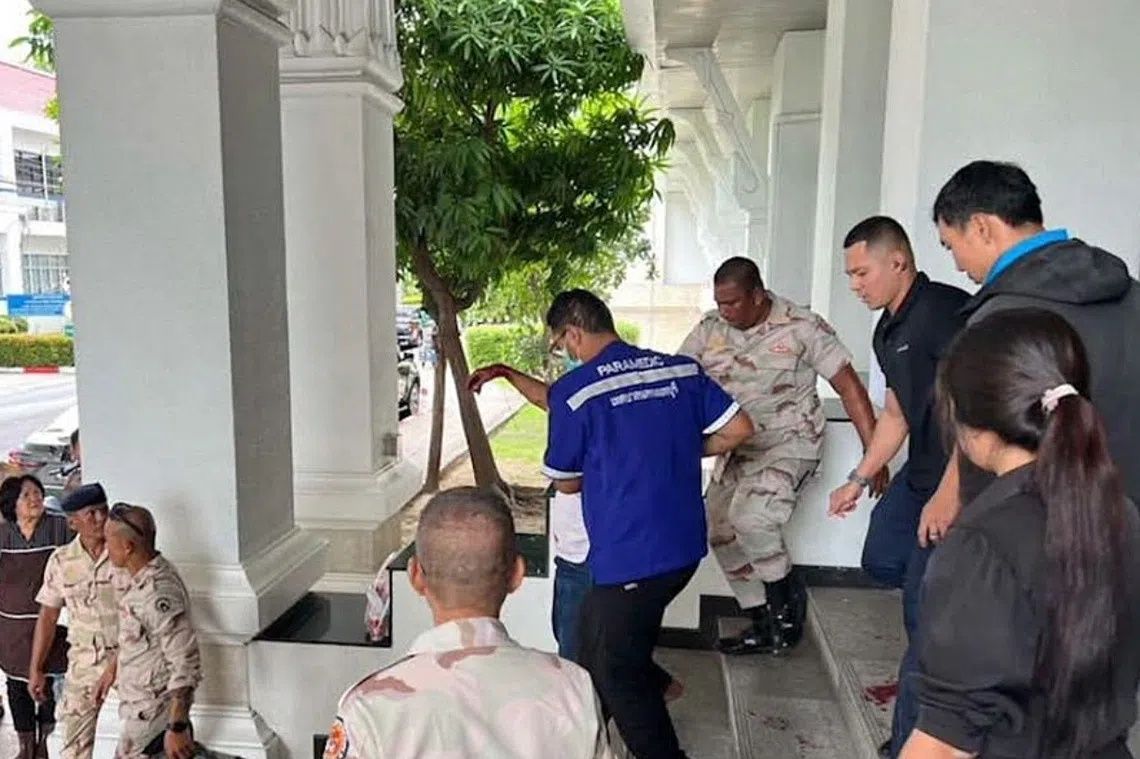
Thailand's volatile relationship with firearms has erupted into fresh crisis as a second shooting incident struck the country within days, this time targeting a government office on Bangkok's outskirts. A former lawmaker opened fire at a local administrative building on Monday, injuring two officials in an incident that has intensified pressure on authorities to address what many regard as a growing public safety concern. Provincial police commander Major General Dejrapee Kongdee confirmed that the suspected gunman was apprehended at the scene, though details surrounding his motives remain unclear.
The Monday shooting wounded a senior provincial official and his driver, both of whom received medical treatment for their injuries. The arrested suspect's background as a former member of parliament suggests this was no random act of street violence, but rather a targeted assault with political undertones. This element adds another layer of complexity to Thailand's broader security conversation, raising uncomfortable questions about access to firearms among individuals with influence or grievance against state institutions.
The timing of this incident could hardly be worse for a nation still reeling from one of its most traumatic events in recent memory. Just three days earlier, on Friday, a fourteen-year-old boy carried out a devastating rampage at Debsirin Nonthaburi School, located in the same province. The juvenile shooter first killed his grandparents before proceeding to the school premises, where he opened fire on students and staff in an attack that left nine people dead and injured more than twenty others. The violence concluded when the teenager turned the weapon on himself, bringing an end to what authorities are describing as Thailand's deadliest mass shooting event in nearly four years.
The scale of Friday's school shooting sent shockwaves across Thai society and globally, forcing difficult conversations about youth violence, mental health, and the circumstances that allow a child to access lethal weapons. That such a tragedy could be followed almost immediately by another armed incident at a government facility suggests systemic vulnerabilities in Thailand's approach to firearm regulation and public safety. The nation's gun laws, historically permissive compared to other Southeast Asian countries, have long drawn scrutiny from regional observers concerned about unchecked proliferation.
In response to the escalating violence, authorities have begun implementing visible security measures at educational institutions. Schools across the country resumed normal operations on Monday, but with notable additions to their protocols. Students and visitors now pass through metal detectors and undergo additional security checks before entering campuses, a practice that would have been unusual in Thailand just weeks ago. These measures reflect an acknowledgment by officials that the threat environment has shifted, and that schools—traditionally regarded as sanctuaries for learning—now require active protective infrastructure.
Prime Minister Anutin Charnvirakul has seized upon the crisis to signal a shift in government policy. In public statements on Monday, he reiterated his intention to tighten gun control measures in response to Friday's school shooting, marking a significant pivot from Thailand's historically lenient firearms regulations. The premier's commitment suggests that the administration recognizes the political and social pressure mounting from families of victims, civil society organisations, and concerned citizens demanding substantive action. Whether such commitments translate into concrete legislative change remains an open question, as Thailand's gun ownership culture runs deep in parts of the population.
The back-to-back incidents illuminate a troubling pattern that resonates across Southeast Asia and beyond. Thailand shares with several regional neighbours a culture of private gun ownership rooted in historical factors, ranging from rural security concerns to legacy attitudes about personal protection. Unlike some developed democracies that have implemented comprehensive buyback programmes or licensing overhauls in response to mass shootings, Southeast Asian nations have generally pursued more incremental reforms, when they pursue them at all. Thailand's upcoming policy discussions may therefore carry implications for how the region addresses public safety and violence prevention.
The involvement of a former lawmaker in the Monday shooting adds a distinctly political dimension to what might otherwise be classified as a personal dispute. This detail raises uncomfortable questions about whether former politicians retain some residual sense of entitlement or grievance following their departure from office, and whether access to firearms creates dangerous opportunities for such grievances to escalate into violence. The incident also underscores that gun violence in Thailand is not confined to marginalised or disadvantaged populations, but extends into educated, connected, and politically aware segments of society.
For Malaysia and other Southeast Asian nations observing Thailand's crisis, the events offer a cautionary lesson about the cumulative effects of permissive gun policies combined with insufficient mental health support and conflict resolution mechanisms. The Malaysian government and civil society will likely monitor how Thai authorities respond, particularly whether legislative reforms materialise and whether such reforms prove effective in preventing future incidents. The comparative study of Thailand's policy responses may inform ongoing regional debates about whether stricter firearms regulations, enhanced psychological screening, or comprehensive community-based interventions offer the most promising path forward.
As Thai society processes the trauma of these recent shootings, authorities face mounting pressure to demonstrate that action, not merely rhetoric, will follow. The government's stated commitment to tighten gun controls will be tested in coming weeks as proposals are drafted, debated, and potentially enacted. The school community and families of victims will be watching closely to see whether Friday's tragedy becomes a genuine inflection point in Thailand's approach to firearms, or whether institutional inertia and political obstacles once again limit meaningful reform.

