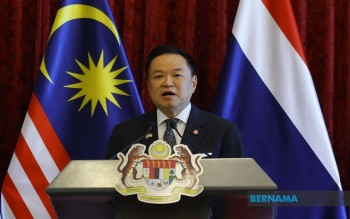
Thailand's Prime Minister Anutin Charnvirakul arrived in Malaysia on Tuesday for a two-day official visit, bringing with him optimistic projections about deepening economic ties between the two neighbouring nations. Speaking at a joint press conference with Malaysian Prime Minister Datuk Seri Anwar Ibrahim at Perdana Putra Complex in Putrajaya, Anutin expressed confidence that the two countries would surpass their ambitious US$30 billion bilateral trade target well before the 2027 deadline. The statement underscores the momentum building between Bangkok and Kuala Lumpur as both governments prioritise regional economic integration and strengthened commercial partnerships.
The current bilateral trade relationship between Malaysia and Thailand stands at approximately US$28 billion, positioning Malaysia as Thailand's largest trading partner within the ASEAN bloc. This substantial foundation reflects the depth of commercial integration that has developed over decades of trade and investment flows between the two economies. For context, the region's trade dynamics have been shaped by geographic proximity, historical ties, and complementary industrial sectors, making Malaysia-Thailand commerce a linchpin of Southeast Asian economic activity. The proximity of the US$28 billion baseline to the proposed US$30 billion target suggests that bridging this gap requires incremental growth rather than transformative expansion, a realistic ambition given current trade momentum.
Anutin emphasised that the two nations' joint trade committee would convene to establish even more ambitious targets beyond 2027, signalling intention to sustain growth beyond the current framework. This forward-looking approach reflects recognition that trade goals require periodic recalibration to reflect evolving economic capabilities and market opportunities. The establishment of structured mechanisms for reviewing and resetting trade objectives indicates institutional commitment to continuous improvement in bilateral commerce. Malaysian and Thai policymakers appear aligned in viewing trade expansion not as a one-time achievement but as part of a sustained trajectory of deepening economic interdependence.
A memorandum of understanding was exchanged during the Putrajaya meeting, though the specific focus areas and provisions of this agreement were not detailed in official statements. Such MOUs typically establish frameworks for reducing tariff barriers, facilitating investment flows, harmonising standards, and creating mechanisms for resolving trade disputes. In the context of Malaysia-Thailand relations, these instruments serve to formalise cooperation in sectors where both nations possess comparative advantages and complementary needs. The symbolic significance of signing such documents during a high-level bilateral visit emphasises the political priority assigned to trade expansion at the executive level.
Anutin highlighted that Thailand intends to support efforts aimed at strengthening regional value chains and supply chains, leveraging the complementary strengths of both economies. This positioning reflects Thailand's strategic intent to position itself as a crucial node in Southeast Asian production networks. The emphasis on value chain integration suggests that future trade growth may not simply involve increased volumes of existing commodities but rather the development of more sophisticated, vertically integrated production systems. For Malaysia, participation in these enhanced supply chains offers opportunities to move higher up the value ladder and capture greater economic returns from manufacturing and services sectors.
The Thai prime minister identified three priority areas for future bilateral cooperation: food security, energy security, and the digital economy including high-tech industries. Food security resonates particularly in Southeast Asia, where demographic growth and climate variability create persistent challenges in agricultural production and food access. Both Thailand and Malaysia possess significant agricultural sectors and can benefit from coordinated approaches to managing supply fluctuations and ensuring stable food supplies across the region. Energy security similarly reflects mutual vulnerabilities, as both nations seek to balance energy independence with affordability and environmental sustainability. Thailand's focus on digital economy and high-tech industries aligns with regional trends toward digitalisation and the emergence of technology-driven manufacturing, sectors where both countries possess growing capabilities and investment potential.
Malaysian Prime Minister Anwar responded by committing his government to pursuing the US$30 billion target with full institutional backing, specifically delegating responsibility to the Ministry of Foreign Affairs and the Ministry of Investment, Trade and Industry (MITI). This ministerial-level focus indicates that Malaysia views the bilateral trade agenda as sufficiently important to warrant sustained bureaucratic attention and resource allocation. Anwar's framing positioned trade and economic fundamentals as the bedrock upon which broader friendship and collaboration could be built, emphasising that commercial ties have multiplier effects across tourism, cultural exchange, and political cooperation.
Anwar specifically mentioned tourism as an additional field ripe for expansion alongside trade, recognising that visitor flows and tourism earnings represent another dimension of economic interdependence beyond merchandise and services trade. Southeast Asian tourism has recovered robustly since the pandemic, and Malaysia-Thailand tourism corridors, particularly those linking Kuala Lumpur with Bangkok and northern Thailand, hold significant untapped potential. Enhanced bilateral cooperation on visa facilitation, infrastructure development, and marketing could substantially increase tourist flows in both directions, creating employment and generating foreign exchange earnings for both economies.
Anutin's visit marks his first journey to Malaysia since his reappointment as Thai prime minister in March 2026, suggesting that this represents a deliberate effort to reaffirm Thailand's commitment to its closest ASEAN neighbour at a leadership transition point. The timing and tenor of the visit indicate that despite Thailand's complex domestic political environment, the government prioritises stable, productive relations with key regional partners. For Malaysia, the reception of the Thai PM at the highest levels of government reinforces the strategic importance assigned to the bilateral relationship and signals continuity in Malaysia's Southeast Asian policy.
The bilateral meeting at Perdana Putra examined progress across the full spectrum of Malaysia-Thailand relations, encompassing not only trade but also security, cultural, and people-to-people cooperation. This comprehensive approach reflects understanding that sustainable regional stability and prosperity depend on multifaceted engagement rather than single-issue focus. As ASEAN navigates geopolitical complexities and economic transitions, the strength of intra-regional partnerships like that between Malaysia and Thailand becomes increasingly valuable. The optimism expressed by both leaders during this visit suggests that despite various external pressures and challenges, the foundational commitment to deepening Malaysia-Thailand ties remains robust and mutually reinforcing.

