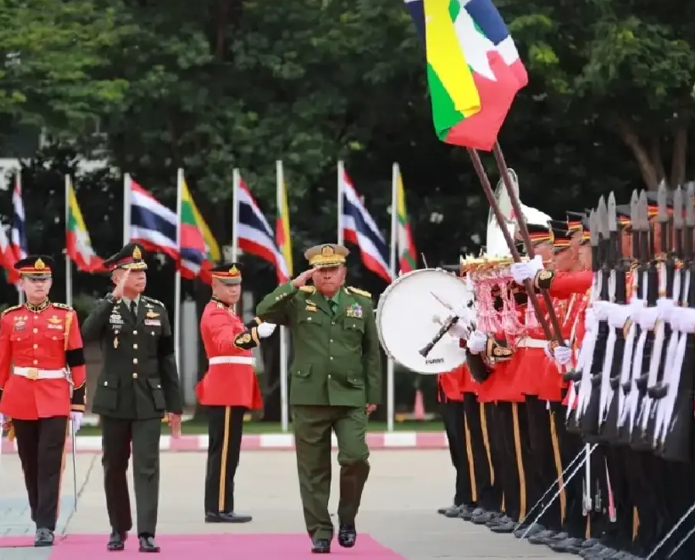
Thailand's military leadership rolled out a formal reception for Myanmar's armed forces chief Ye Win Oo on Thursday, underlining Bangkok's willingness to normalise relations with a government that seized power through armed force in 2021. The visit represents Ye Win Oo's maiden overseas trip since assuming the ceremonial position of military chief following Myanmar's contested elections earlier this year, and signals a broader regional acceptance of the coup leaders despite their pariah status in Western capitals.
Myanmar's military orchestrated a dramatic power consolidation over the past five years. Following the 2021 putsch that deposed elected leader Aung San Suu Kyi and triggered an ongoing civil conflict, the junta constructed a veneer of legitimacy through tightly controlled elections held around early 2026. These polls served a predetermined outcome: coup architect Min Aung Hlaing transitioned from armed forces chief to the presidency, while Ye Win Oo, a former intelligence officer, was installed as military leader. The choreography suggests the military intends to govern under a civilian guise while retaining absolute control through the defence establishment.
The bilateral talks between Ye Win Oo and Thai counterpart Ukris Boontanondha centred on managing the volatile 2,400-kilometre shared frontier, where the ongoing Myanmar civil war has destabilised communities on both sides. This border management angle is critical to understanding Bangkok's diplomatic calculus—Thailand cannot ignore the humanitarian and security spillover from Myanmar's internal conflict, making practical engagement with the military authorities a pressing necessity despite political objections from rights advocates and democracy proponents.
Ye Win Oo carries significant baggage in international circles. He served as a spymaster under Myanmar's previous military junta and faces sanctions from the United States and allied nations for his instrumental role in orchestrating the 2021 coup. His appointment as military chief represents continuity rather than reform, signalling that the armed forces have no intention of relinquishing substantive control. Yet Bangkok's decision to host him reflects a calculation that pragmatic engagement serves regional stability better than isolation—a position increasingly adopted by neighbouring states with geographic vulnerabilities.
The scale of Myanmar's internal catastrophe cannot be overstated. The civil war that erupted following the coup has claimed approximately 100,000 lives according to international estimates, creating one of Asia's most severe humanitarian emergencies. Armed Forces from the junta have been documented systematically attacking civilian infrastructure, enforcing arbitrary detentions, and deploying torture and sexual violence as instruments of state control. These are not marginal accusations but patterns documented by the United Nations' Independent Investigative Mechanism for Myanmar, which released findings this week detailing escalating aerial assaults on non-combatant targets.
Thailand's diplomatic overture contradicts its public stance on democratic governance. Prime Minister Anutin Charnvirakul extended a full ceremonial welcome to Min Aung Hlaing earlier this month, and Foreign Minister Sihasak Phuangketkeow framed the decision with notable candour: the government was engaging with Myanmar not because it recognised the military's political legitimacy, but because Myanmar's regional geography and border realities made dialogue unavoidable. This pragmatism reflects how geography can constrain ideological consistency in foreign policy, particularly for nations sharing land borders with militarised neighbours.
Thailand is not alone in this reorientation. Several neighbouring states have seized upon Myanmar's orchestrated elections as an opportune moment to reset diplomatic relations that had grown frigid during the junta's international isolation. The implicit message from these governments is that Myanmar's elections, however limited and stage-managed, constitute sufficient grounds for renewed engagement. Whether this represents cynicism, realism, or a combination of both remains contentious among observers of regional geopolitics.
The international response to Myanmar's rehabilitation efforts remains fractured. Western democracies and human rights organisations have dismissed the 2026 elections as an elaborate rebranding exercise designed to perpetuate military dominance while excluding popular opposition figures. Suu Kyi and her National League for Democracy remain sidelined, with regime opponents facing imprisonment and persecution. Democracy advocates view the elections as a confidence trick—a cosmetic constitutional modification that preserves the substance of authoritarian rule whilst manufacturing an appearance of civilisational normalcy.
The Special Advisory Council for Myanmar has articulated this scepticism sharply, arguing that Bangkok's embrace of the Myanmar military amounts to endorsing warlordism. The council contends that Thailand's willingness to provide high-level diplomatic access to sanctioned military figures represents a betrayal of democratic principles and undercuts international efforts to maintain pressure on the junta. This criticism reflects the deeper tension between moralist foreign policy frameworks and the pragmatic necessities of managing border security and regional stability.
Yet Thailand faces genuine dilemmas that criticism from international NGOs cannot resolve. A Myanmar in chaos, with uncontrolled spillover effects across Thai territory, poses tangible security and economic challenges. Drug trafficking, refugee flows, and cross-border armed conflict all emanate from Myanmar's dysfunction. From this perspective, Thailand's diplomatic engagement represents an attempt to manage an unstable neighbour through dialogue rather than isolation, even if such engagement implicitly confers a measure of diplomatic legitimacy upon demonstrably authoritarian actors.
The UN's recent documentation of escalating military violence adds another layer of complexity. The junta's armed forces are not consolidating control through restraint but through intensified coercion. This suggests that diplomatic engagement, if it comes at the cost of reducing international pressure and accountability mechanisms, may inadvertently enable further abuses. Myanmar's government has dismissed the UN findings as biased and unverifiable, maintaining that its security operations target legitimate military opponents rather than civilians—a standard rebuttal that carries little credibility given documented patterns.
For Malaysia and other Southeast Asian nations, Myanmar's trajectory presents a cautionary tale about the limits of ASEAN's approach to internal governance in member states. The association's principle of non-interference creates space for member governments to engage practically with Myanmar's military authorities, but it also potentially weakens ASEAN's collective voice on human rights and democratic accountability. Myanmar's case demonstrates how regional pragmatism can conflict with stated institutional commitments to human rights standards, creating diplomatic ambiguity that leaves victims of military violence without meaningful international recourse.
Looking forward, Myanmar's military appears committed to consolidating power through a managed political transition that preserves defence establishment dominance whilst adopting civilian institutional trappings. Thailand's willingness to facilitate high-level military-to-military dialogue suggests that Myanmar's international rehabilitation, however incomplete, is progressing. For Myanmar's persecuted minorities and displaced populations, however, such diplomatic normalisation may simply entrench the military's ability to govern through coercion without facing meaningful international consequences.

