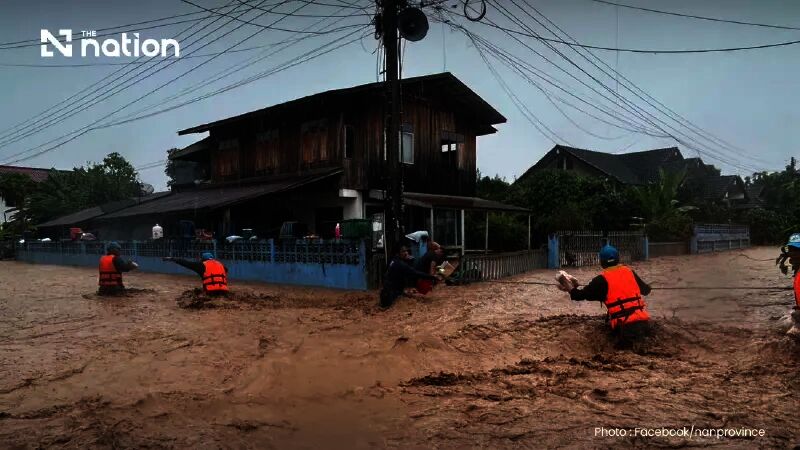
Thailand has formally declared a disaster zone in Nan province and elevated alert status for two adjoining northern regions as a severe weather system unleashes torrential rain across the country's upper reaches. The administration announced the escalation on Wednesday as floodwaters severed transport links and necessitated the relocation of residents from vulnerable communities, underscoring the mounting challenge posed by the monsoon season to Thailand's disaster management infrastructure.
Prime Minister Anutin Charnvirakul, currently on official business in Australia, has taken direct command of the national response despite his geographical distance from the affected regions. His intervention signals the gravity officials attach to the situation and their determination to coordinate a swift, multi-agency operation. Government spokesperson Rachada Dhnadirek confirmed that Anutin has issued comprehensive directives mandating participation from all state bodies, including the military apparatus, to mobilise relief capabilities and support vulnerable populations.
The prime minister's strategy emphasises rapid deployment of response teams and heavy equipment to areas facing the greatest danger, with particular emphasis on water management in zones historically susceptible to inundation. His instructions prioritise the establishment of drainage operations in recurrently flooded localities to mitigate accumulation and prevent prolonged waterlogging that compounds damage to infrastructure and livelihoods. This approach reflects lessons learned from previous disaster cycles, where effective water removal proved critical to limiting economic losses and accelerating recovery.
Rachada underscored that Anutin's directives place human welfare at the forefront of all operations, with explicit concern for the welfare of elderly residents, hospitalised patients requiring continuous care, children, and families inhabiting high-risk zones. The administration has instructed rapid damage and vulnerability surveys across affected territories to identify priority areas requiring intervention. Simultaneous monitoring protocols for rainfall trends and water level fluctuations have been activated to enable early warning systems that can trigger timely evacuation orders and resource pre-positioning before conditions deteriorate further.
The meteorological outlook for August paints a challenging picture, with forecasters predicting sustained thunderstorm activity, pockets of intense rainfall, and powerful gusts across the region. These atmospheric conditions create the preconditions for multiple hazards including sudden flash floods that surge through valleys with minimal warning, excessive runoff overwhelming drainage capacity, and landslides destabilising hillside communities. The forecast extends the danger window through Friday, meaning that risk persists for several additional days as weather systems continue their trajectory across northern Thailand.
Deputy Prime Minister Yodchanan Wongsawat, who holds direct responsibility for flood response operations in the northern region, has issued an urgent mobilisation order to provincial governors in Nan, Phayao and Lamphun, requiring them to accelerate preparation measures immediately. This directive reflects the tiered governance structure through which Thailand coordinates disaster response, with national leadership establishing strategic objectives while provincial administrators implement ground-level operations tailored to local geography and population distribution. The three provinces represent the critical frontline of the current weather emergency.
The scope of authorities' warnings extends beyond the three provinces under formal alert, encompassing northern, north-eastern and central zones where residents have been advised to prepare for potential flash flood emergence, surface water runoff, and terrain instability. This broad geographic coverage indicates meteorologists assess the weather system poses a diffuse rather than localised threat, potentially affecting millions of Thais across multiple regions. The extended warning period through Friday provides administrative bodies and households with a clear window during which enhanced vigilance and contingency activation become essential.
These developments reflect the recurring challenge Thailand faces during its monsoon cycle, when atmospheric moisture and topographic features combine to generate episodic severe weather. Northern provinces, with their mountainous terrain and river systems that concentrate drainage from extensive highland catchments, prove particularly vulnerable to flooding episodes. The concentration of warnings and formal disaster declarations in recent years suggests either intensifying weather patterns or improved official responsiveness—likely reflecting both factors working in tandem.
For Malaysia and other Southeast Asian nations sharing comparable monsoon systems and geographic vulnerabilities, Thailand's response provides both reassurance and caution. The rapid activation of national command structures and military assets demonstrates institutional capacity to mobilise resources at scale when disasters strike. However, the recurring necessity for such mobilisations underscores the structural vulnerability of the region's populations and infrastructure to weather extremes, a challenge unlikely to diminish as climate patterns continue their evolution. Regional cooperation frameworks for disaster preparedness and cross-border information sharing may prove increasingly valuable as such events affect multiple countries simultaneously.

