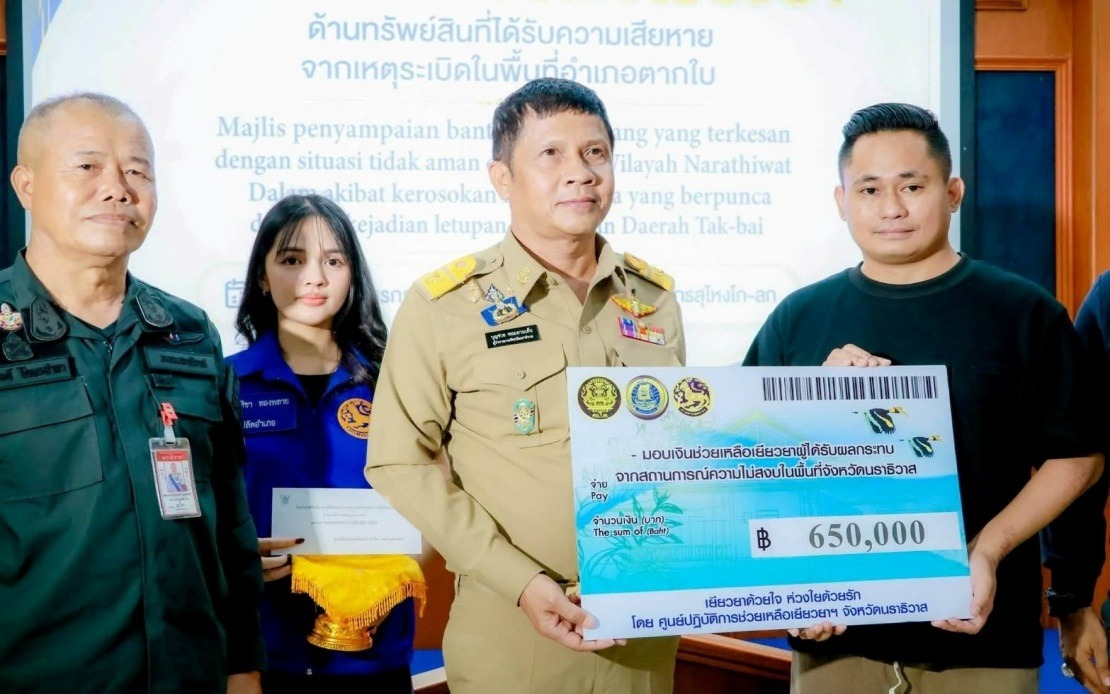
The Thai government has commenced compensation payments to Malaysians wounded in a bombing incident that occurred in the southern border district of Tak Bai on June 29. Officials presented 650,000 baht—roughly equivalent to RM80,000—to Muhammad Yusri Udin during a formal ceremony held on Friday at the Sungai Golok Customs Office in Narathiwat province, marking the first tangible government response to the cross-border incident that sparked immediate diplomatic attention.
Narathiwat Governor Boonchuay Homyamyen characterised the attack as a serious matter warranting immediate intervention, emphasising that Thai authorities view the wounding of Malaysian citizens with considerable gravity. In remarks to journalists, the governor articulated the government's position that no room exists for complacency regarding border security, particularly given the vulnerability of civilians and international visitors traversing this sensitive region. His public statements reflected Bangkok's recognition that such incidents carry broader implications for Thailand's reputation as a secure tourist destination and for bilateral relations with Malaysia.
The compensation mechanism deployed represents part of Thailand's established framework for addressing casualties resulting from security-related violence. Rather than treating the payments as ad-hoc charitable responses, Thai officials positioned the disbursement within a formal government fund specifically designed to support victims of insurgency-related incidents. This structured approach underscores how cyclical security threats have prompted Bangkok to institutionalise victim assistance as a predictable policy instrument.
On the morning of June 29, the explosive device detonated unexpectedly near the Sapom junction in Tak Bai, striking Muhammad Yusri, aged 38, and Abdullah Syarapi Abd Rahman, 45, who were in the vicinity when the homemade IED concealed within a roadside drainage channel exploded around 11:40 am local time. Intelligence assessments concluded that the two Malaysians represented incidental casualties rather than deliberate targets, suggesting the attack was intended for other purposes, possibly linked to broader insurgent activities within the province.
Thai security operations responding to the incident moved with notable speed and comprehensiveness. Authorities detained a 40-year-old individual within hours of the blast and initiated multifaceted investigative efforts encompassing explosive ordnance disposal technicians and forensic specialists who thoroughly examined the crime scene. This systematic approach reflects enhanced protocol development that Thai authorities have cultivated over years of managing periodic violence in the Deep South.
The incident occurs against a backdrop of longstanding security challenges afflicting Thailand's southernmost provinces, where insurgent groups have periodically conducted attacks targeting military installations, civilian infrastructure, and commercial establishments. Tak Bai district has experienced multiple previous incidents, making it a focal point for security concerns shared by both Thai officials and Malaysian counterparts who transit the border region regularly. For Malaysian businesses and citizens engaged in legitimate cross-border commerce and travel, such attacks introduce unpredictable risk factors that complicate planning and decision-making.
Governor Boonchuay's pledge to strengthen security measures addresses broader anxieties within the tourism and business sectors, particularly among Malaysian visitors who represent a significant proportion of Thailand's international tourist arrivals. His public assurance that protective infrastructure would be enhanced signals recognition that confidence restoration requires demonstrable commitment rather than merely rhetorical reassurances. The governor explicitly framed the government response as proactive rather than merely reactive, emphasising sustained engagement with security challenges.
From a Malaysian perspective, the compensation payment, while modest by absolute standards, carries symbolic importance in demonstrating Thai willingness to assume responsibility for incidents affecting its citizens. The prompt processing and ceremonial presentation of compensation cheques signals diplomatic attentiveness to bilateral concerns and recognises Malaysian sovereign interests in the safety of its nationals abroad. Such gestures, though limited in material scope, contribute to broader confidence-building between governments managing shared security challenges across porous borders.
The investigation into the bombing remains ongoing, with Thai authorities focusing on identifying whether the attack represents isolated opportunism or forms part of coordinated campaign activity by organised rebel factions. The involvement of a detained suspect provides investigators with potential intelligence channels for understanding perpetrator motivation and operational networks. Successful prosecution of such cases, however, often proves challenging within Thailand's southern provinces due to witnesses' reluctance to provide testimony and perpetrators' ability to exploit difficult terrain for evasion.
For Malaysian authorities, the incident underscores persistent security risks faced by citizens conducting business or tourism activities within Thailand's border regions. While isolated attacks cannot eliminate cross-border engagement entirely, the incident may prompt Malaysian officials to review advisory frameworks guiding citizens regarding travel to affected areas and heightened vigilance measures. Cooperation between Thai and Malaysian security agencies, already established through existing bilateral mechanisms, may require intensification to address intelligence gaps.
Thailand's security situation in the Deep South reflects decades-long complexities rooted in historical grievances, resource competition, and ideological motivations that defy simple resolution. Compensation payments address immediate harm but cannot resolve underlying conditions generating periodic violence. The Thai government's commitment to sustained security improvements reflects pragmatic acceptance that protecting the region's economic viability—dependent partly on Malaysian engagement—requires credible performance on safety matters.

