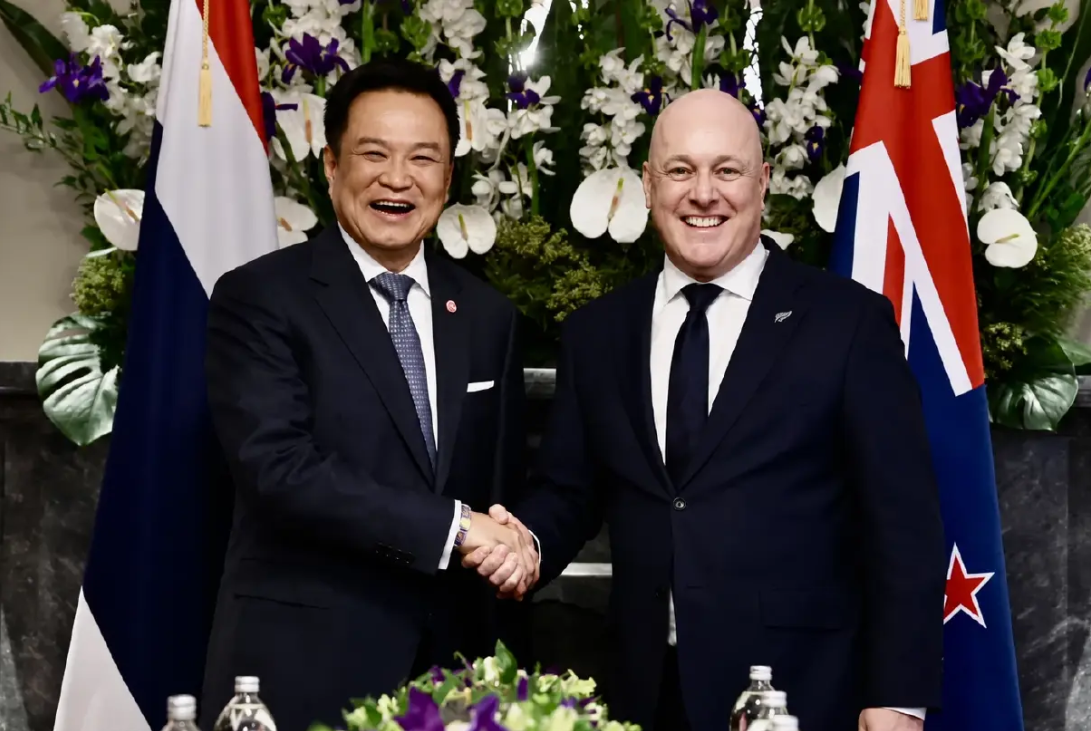
Thailand and New Zealand have taken a significant step forward in their relationship by establishing a formal strategic partnership designed to substantially deepen economic, security and cultural ties between the two nations. The accord, signed during Prime Minister Anutin Charnvirakul's official visit to Wellington on Friday, sets an ambitious target of tripling bilateral trade to US$7.5 billion by 2045 while coinciding with celebrations marking seven decades of diplomatic relations. The partnership represents a watershed moment for both countries in Southeast Asia's broader engagement with the Asia-Pacific region, signalling renewed momentum in an historically cordial but comparatively modest bilateral relationship.
Prime Minister Anutin and his New Zealand counterpart Christopher Luxon inked the Joint Declaration on the Strategic Partnership at Government House following formal bilateral discussions, with Government spokeswoman Rachada Dhanadirek confirming the signing occurred at noon local time. Beyond the headline accord, both nations executed four supplementary cooperation documents spanning cultural exchange, civil service education collaboration, police partnership and information-sharing protocols, and a private-sector memorandum involving industrial instruments and environmental monitoring technology. This layered approach to formalising cooperation demonstrates the comprehensiveness of the partnership framework, extending beyond traditional government-to-government arrangements to encompass civil society, law enforcement and commercial actors.
The strategic partnership rests upon four pillars of cooperation outlined in the Thailand–New Zealand Joint Plan of Action 2026–2030, each addressing distinct yet interconnected dimensions of national interest. The political and security cooperation framework prioritises combating transnational threats that increasingly affect both nations, including organised crime, cybercriminal networks operating online scams and human trafficking networks that exploit vulnerable populations across borders. Enhanced coordination between Thai and New Zealand law enforcement agencies, coupled with systematic information-sharing mechanisms, aims to create a more hostile environment for criminal enterprises operating within or between the two countries' jurisdictions.
The economic pillar represents perhaps the most consequential element of the partnership framework, as it directly addresses the substantial gap between the countries' current trade relationship and their potential. By establishing the ambitious goal of tripling trade to US$7.5 billion by 2045, both governments have committed to dismantling remaining barriers to commerce and investment while actively promoting sectors aligned with contemporary global priorities. Food security, agricultural sustainability, renewable energy development and environmental protection have been designated as particular focus areas, reflecting both nations' concerns about climate resilience and resource security as global supply chains face mounting pressures from geopolitical fragmentation and environmental degradation.
The planned development of the Thailand–New Zealand Closer Economic Partnership agreement signifies intention to move beyond conventional free trade arrangements toward integrated economic frameworks that create tangible opportunities for small and medium-sized enterprises across both nations. For Malaysian businesses and investors, this deepening of Thailand-New Zealand economic integration carries implications for regional competitiveness, potentially redirecting investment flows and trade patterns across Southeast Asia as two significant players formalise closer economic coordination. The emphasis on innovation and technology transfer suggests both nations view collaboration as a pathway to competing more effectively in global markets dominated by larger economic powers.
Education and cultural cooperation constitutes the third strategic pillar, acknowledging that sustainable bilateral relationships ultimately depend upon human connections and shared understanding between populations. Expansion of academic exchanges, skills development programmes and capacity-building initiatives creates conduits through which younger generations from both countries can develop familiarity with one another's institutions, values and perspectives. This generational investment in people-to-people connectivity potentially yields long-term dividends in terms of business networks, diplomatic understanding and mutual cultural appreciation that transcend formal government frameworks.
Regional and multilateral cooperation forms the final pillar, positioning the Thailand-New Zealand partnership within broader Asia-Pacific frameworks including the Mekong cooperation mechanisms, Asean-led institutions, and the Asia-Pacific Economic Cooperation forum. This contextualization reflects recognition that bilateral relationships derive enhanced value when embedded within multilateral structures capable of addressing transnational challenges requiring coordinated responses across multiple nations. For Southeast Asian observers, New Zealand's commitment to closer engagement through Asean mechanisms signals continued interest in the region's stability and prosperity despite geographic distance, potentially offsetting concerns about great power competition and strategic competition for regional influence.
The planned restoration of direct air services between Bangkok and Auckland represents a tangible manifestation of the partnership's commitment to enhancing connectivity. Thai Airways' target date of March 2027 for resuming the route responds to practical demands arising from expanded trade, investment and tourism between the nations. Direct flights eliminate costly and time-consuming connections through intermediate hubs, reducing friction in business transactions, facilitating tourism growth and enabling educational exchanges that depend upon affordable and convenient air transportation. Anutin's indication that he would endeavour to accelerate the service's resumption demonstrates governmental commitment to translating aspirational goals into concrete operational improvements affecting ordinary travellers and business operators.
Anutin has additionally sought New Zealand's support for Thailand's aspiration to join the Organisation for Economic Co-operation and Development, with Luxon expressing full backing for this objective. New Zealand's endorsement carries significance within OECD deliberations, as membership from a major Southeast Asian economy would represent a symbolic recognition of Thailand's developmental achievements and institutional maturity. For the broader region, Thailand's potential OECD accession could establish precedent for other Southeast Asian nations seeking elevated status within international economic governance structures, potentially reshaping regional representation within global rule-setting institutions that have historically concentrated decision-making authority among established developed economies.
The timing of this partnership upgrade, coinciding with the 70th anniversary of diplomatic relations, reflects deliberate strategic calculation by both governments to leverage historical continuity while projecting forward-looking ambition. Anutin's characterisation of the visit as commencing a new chapter in bilateral friendship indicates aspirations for qualitatively different engagement patterns going forward, moving beyond incremental cooperation toward integrated strategic coordination. The comprehensive nature of the partnership framework suggests both nations view their relationship as meriting elevated priority within their respective foreign policy architectures, particularly as major powers increasingly compete for influence and alignment across the Asia-Pacific region.
For Southeast Asia more broadly, the Thailand-New Zealand strategic partnership exemplifies a trend toward middle and developed powers formalising closer ties through structured frameworks designed to generate concrete economic and security benefits. New Zealand's renewed emphasis on regional engagement through Asean mechanisms and bilateral partnerships responds partly to its interests in stable trading relationships and partly to geopolitical imperatives stemming from great power competition in the Indo-Pacific. As countries across the region navigate complex choices about strategic alignment and economic orientation, partnerships such as this between Thailand and New Zealand demonstrate that smaller and mid-sized nations retain agency in shaping their relationships with distant but significant partners, creating networks of cooperation that reflect shared values and complementary interests rather than hierarchical dependence.
The ambition embedded within the target of tripling bilateral trade by 2045 requires sustained commitment from both governments and private sectors across two decades, necessitating removal of specific tariff barriers, regulatory harmonisation and investment in complementary infrastructure. Success depends partly upon macroeconomic developments affecting both nations and partly upon deliberate policy choices prioritising the relationship. The partnership's comprehensiveness—spanning security, commerce, education and multilateral cooperation—creates multiple points of contact and reinforcement that potentially make the relationship more resilient to inevitable strains and disagreements. As Thailand and New Zealand move from formalising strategic partnership to implementing concrete cooperative initiatives, success will ultimately be measured through tangible outcomes affecting business operators, educators, law enforcement professionals and ordinary citizens whose lives benefit from enhanced connectivity and expanded opportunities across borders.

