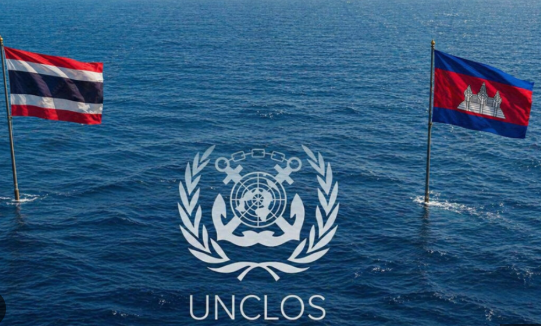
Thailand has formally embraced Cambodia's call for compulsory conciliation under the 1982 United Nations Convention on the Law of the Sea to address their protracted disagreement over maritime boundaries in the Gulf of Thailand, yet Bangkok has carefully emphasised that this mechanism carries no legal weight and should serve merely as a stepping stone toward renewed bilateral negotiations. The Thai Ministry of Foreign Affairs submitted its formal response to Cambodia on June 19, roughly three weeks after Phnom Penh transmitted the initial notification requesting the process, signalling neither enthusiasm nor resistance from Thailand's perspective.
The appointment of senior Thai officials to lead the conciliation team underscores the gravity Bangkok attaches to the dispute, despite its insistence on the non-binding nature of outcomes. Deputy Prime Minister and Foreign Minister Sihasak Phuangketkeow has been designated Thailand's principal representative, known as the Agent, with Songchai Chaipatiyut, formerly a high-ranking official at the Department of Treaties and Legal Affairs and currently ambassador to Kuwait, serving as Deputy Agent. This configuration positions two experienced legal and diplomatic practitioners at the helm, reflecting Thailand's determination to shape proceedings according to its preferred framework.
Both nations have jointly selected Judge Albert J Hoffmann of South Africa and Judge Rudiger Wolfrum of Germany as their respective conciliators, both recognised internationally as specialists in maritime law. The conciliation commission structure, which remains incomplete pending selection of a fifth chair within thirty days, represents a deliberate choice to involve neutral expertise rather than adversarial legal advocates. Thai officials have taken pains to clarify that conciliators function as impartial mediators tasked with comprehending the dispute's complexities and facilitating mutually palatable solutions, rather than as counsel advancing either side's interests.
The anticipated timeline envisions the conciliation commission producing a report with recommendations within approximately twelve months, barring an agreement by both parties to prolong the schedule. Critically, Thailand has been explicit that this report will constitute non-binding guidance rather than enforceable judgment, consistent with the convention's Annex V provisions. Bangkok's legal interpretation emphasises that the conciliation product remains a consultative tool to inform ongoing diplomatic engagement, not a substitute for it or a mechanism that either party must implement.
Thailand's stance reflects a broader strategic preference for bilateral dialogue as the ultimate resolution mechanism. The Foreign Ministry has repeatedly advocated that direct talks between the two governments remain indispensable, with conciliation functioning as a supporting framework to facilitate common ground-seeking. This position differs subtly but significantly from Cambodia's apparent agenda, which Bangkok perceives as extending beyond maritime delimitation to encompass provisional development arrangements and resource-sharing schemes. Thailand has insisted the conciliation scope be confined strictly to boundary demarcation under UNCLOS.
The resource dimension of this dispute cannot be overlooked, as the contested gulf waters are believed to harbour substantial natural gas deposits and other hydrocarbons of considerable economic value to both nations. The disagreement thus intertwines technical maritime law questions with pressing energy security and revenue interests, elevating its salience for each country's developmental priorities. Cambodia's decision to initiate compulsory conciliation may reflect frustration with slow progress on joint development frameworks as much as concern over boundary delineation per se.
Thailand's termination in May of the 2001 memorandum of understanding with Cambodia, internally designated as MoU 44, signalled Bangkok's intention to recalibrate the engagement approach. Prime Minister Anutin Charnvirakul attributed this cancellation to negligible advancement over twenty-five years rather than acrimonious bilateral breakdown, seeking to reframe the move as a constructive reset rather than confrontational escalation. The Thai government has underscored that abandoning the outdated framework does not presage disengagement from Cambodia but instead repositions UNCLOS itself as the common reference point for future maritime cooperation discussions.
Cambodia's subsequent invocation of UNCLOS compulsory conciliation represented a calculated response to Thailand's MoU withdrawal, invoking international legal mechanisms to maintain negotiating momentum and prevent maritime issues from languishing indefinitely. Cambodia has framed the conciliation request as consistent with commitment to peaceful resolution through established international protocols, positioning itself as the rules-respecting actor within the dispute. Thailand's acceptance, while qualified by assertions regarding non-binding outcomes, nonetheless demonstrates both nations' continued adherence to international legal frameworks and willingness to engage third-party expertise.
From a broader Southeast Asian perspective, the Thailand-Cambodia maritime disagreement exemplifies challenges facing the region as coastal states navigate overlapping claims within the UNCLOS framework. The conciliation process may establish useful precedents for managing comparable disputes elsewhere in the region, though the deliberate construction of non-binding outcomes suggests that neither Thailand nor Cambodia views such mechanisms as suitable for achieving final territorial resolution. The emphasis on maintaining bilateral negotiating channels underscores a regional preference for consensus-building and diplomatic flexibility over legalistic adjudication.
Thailand's characterisation of conciliation as distinct from litigation reflects anxieties about ceding sovereignty determinations to international bodies, a concern resonating throughout Southeast Asia where maritime disputes remain politically sensitive and economically consequential. By participating in conciliation while maintaining that outcomes lack legal force, Thailand navigates between demonstrating commitment to peaceful dispute settlement and preserving its freedom to reject recommendations it deems inconsistent with national interests. This carefully balanced stance allows Bangkok to engage the mechanism without surrendering autonomy over ultimate boundary decisions.
The twelve-month timeframe for conciliation proceedings creates an opportunity for both parties to explore compromise arrangements through structured dialogue before returning to bilateral negotiations. Whether this process yields genuine movement toward maritime agreement or merely postpones fundamental disagreements remains uncertain. Thailand's repeated insistence that direct negotiations remain paramount suggests Bangkok views conciliation as procedurally necessary but strategically insufficient, implying that substantive resolution depends upon renewed bilateral engagement reflecting evolved positions by both governments on boundary and resource-sharing arrangements.