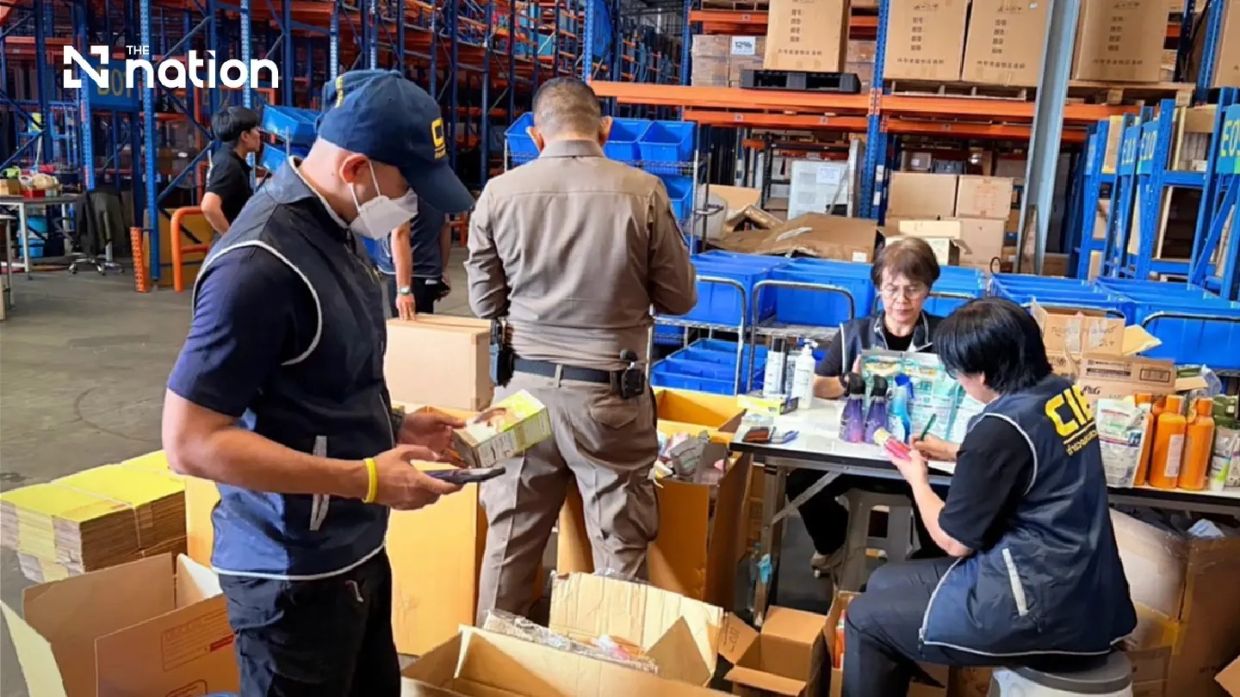
Thai police have dismantled a significant distribution operation supplying unlicensed Japanese health and beauty products to online merchants across the country, seizing 83,483 items worth more than 8.34 million baht during a coordinated raid on a warehouse in Bang Phli district, Samut Prakan, on Thursday. The operation, directed by Pol Maj Gen Kongkrit Lertsittikul, commander of the Consumer Protection Police Division, represents one of the larger recent crackdowns on the importation and sale of products that bypass Thailand's mandatory safety and labelling requirements.
The warehouse, which authorities had been investigating after receiving numerous consumer complaints, functioned as a critical node in a sophisticated online distribution network. Operating for more than four years, the facility processed between 200 and 300 items daily, charging sellers a packing fee of 10 to 12 baht per box. This seemingly modest operation masked the scale of the problem: police identified 116 distinct categories of cosmetics, dietary supplements, and medicinal products, all imported from Japan without the necessary Thai regulatory approvals or safety certifications required by the government.
At the heart of the enforcement action lies a fundamental consumer protection concern that resonates throughout Southeast Asia, where the digital marketplace has created unprecedented distribution channels for unapproved goods. The products in question lacked Thai-language labels and had not undergone mandatory safety checks or received certification from Thailand's relevant health authorities, creating what officials determined posed material risk to consumers who could not verify product authenticity or safety profiles. Many buyers purchasing through online platforms would have been entirely unaware they were acquiring goods that had circumvented regulatory pathways designed to protect public health.
The warehouse's business model illuminated how modern e-commerce infrastructure enables the rapid proliferation of such products. Rather than operating as a direct retailer, the facility served as a centralized hub for multiple online sellers, providing storage, inventory management, and packing services. This arrangement allowed individual merchants to maintain the appearance of legitimacy while outsourcing the logistics to a single location stocked entirely with undeclared imports. The efficiency of this system, paradoxically, made it an attractive target for law enforcement once its operations came under official scrutiny.
Thailand's regulatory framework, which authorities invoked in pursuing this case, provides comprehensive mechanisms for combating the distribution of hazardous consumer goods. Prosecutors are preparing legal actions against those responsible under the Cosmetics Act, Food Act, Drug Act, and Hazardous Substances Act, each statute carrying distinct penalties and enforcement provisions. The multiplicity of applicable laws reflects how the seized products crossed several regulatory categories, from beauty items to dietary supplements to medicinal substances, each governed by separate oversight regimes.
For Malaysia and other regional economies grappling with similar e-commerce challenges, the Thai case offers instructive lessons about enforcement vulnerabilities. The sophistication required to trace products from international suppliers through warehouse intermediaries to multiple online retailers typically exceeds the investigative capacity of typical customs or health inspectorates. Thai authorities demonstrated thoroughness by first establishing patterns through consumer complaints, then systematically tracking imports to their source, before seeking judicial authorization and executing the warehouse raid with sufficient documentation to support criminal prosecution.
The broader context involves the significant expansion of cross-border e-commerce within Southeast Asia, where consumers increasingly purchase health and beauty products from online platforms offering Japanese brands at competitive prices. While many legitimate Japanese products are available through authorized channels, the price differentials between approved imports and black-market equivalents create strong commercial incentives for unauthorized distribution networks. The warehouse operation's longevity suggests that detection and enforcement gaps had persisted despite regulatory frameworks theoretically prohibiting exactly such conduct.
Consumer behaviour in Malaysia and across the region shows substantial appetite for Japanese cosmetics and supplements, particularly skincare products and dietary aids perceived as premium or exotic. This demand, coupled with relatively affordable logistics for importing from Japan, has fueled a parallel market where products circumvent registration requirements. Consumers attracted by lower prices and product variety may underestimate the regulatory gaps in such transactions, assuming that products available through online channels have undergone appropriate vetting.
The investigation's discovery that the warehouse had expanded from simple goods storage into full logistics support services for online businesses underscores how infrastructure evolution can facilitate regulatory circumvention. Initially established for legitimate import warehousing, the facility adapted its business model to meet merchant demand for end-to-end supply chain services, crossing a threshold into culpable participation in unlawful distribution. Thai authorities recognized this transition and held the warehouse operators accountable accordingly.
From a regional trade perspective, this enforcement action highlights tensions between facilitating commerce and protecting consumers. While regulatory compliance imposes genuine costs on importers and retailers, the risks posed by unverified products—particularly medicines and supplements that may contain undeclared ingredients or contaminants—justify stringent requirements. Thai authorities clearly determined that these consumer protection imperatives outweighed any commercial disruption resulting from seizing legitimate inventory.
The case also illuminates how online platforms, which rarely verify that sellers possess proper authorizations for imported products, inadvertently enable such networks. Neither the platforms nor individual merchants necessarily possessed detailed knowledge of regulatory requirements for products sourced from warehouse intermediaries, creating an enforcement environment where culpability was concentrated in the central logistics operation rather than distributed across numerous retail participants.
Looking forward, the seizure may prompt both intensified scrutiny of similar warehouse operations throughout Thailand and increased vigilance among other Southeast Asian regulatory agencies. Malaysia's pharmaceutical and health product regulators, along with consumer protection bodies in other regional economies, will likely heighten surveillance of the supply chains through which Japanese products reach local consumers. The financial impact—more than 8.34 million baht in confiscated inventory—provides material demonstration of the scale of unauthorized imports that can accumulate when such operations persist unchecked for years.
The arrested suspects now face a comprehensive legal reckoning that could establish precedent for how authorities address coordinated unauthorized importation and distribution schemes. Whether these cases result in substantial penalties or merely serve as business interruptions will likely influence the calculus of future operators considering similar ventures. For consumers, the most immediate benefit derives from preventing circulation of products that lacked any assurance of safety, purity, or accurate ingredient disclosure—a foundational principle of consumer protection law across Southeast Asia.

