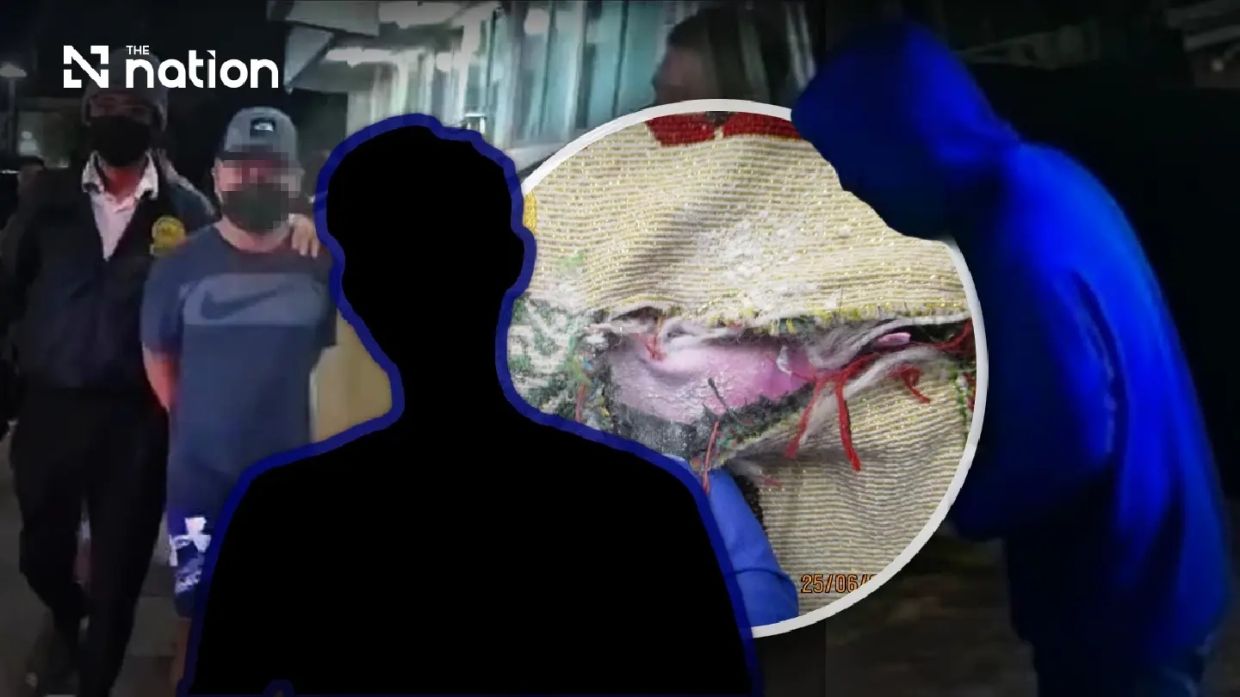
Thai authorities have made significant progress in dismantling what appears to be an organised drug trafficking operation, arresting a man police believe served as a key logistical coordinator in a heroin smuggling ring allegedly attempting to move narcotics to Australia. The Metropolitan Police Bureau confirmed the overnight arrest of Ekkawit in Phayao province as investigators expand their understanding of how the network functioned across multiple provinces and international borders.
According to Pol Maj Gen Theeradej Thamsuthee, deputy commissioner of the Metropolitan Police Bureau, the investigation has evolved considerably since officers initially seized an elephant-print fabric bag containing concealed heroin and subsequently apprehended several individuals believed to be part of the operation. Ekkawit's arrest represents a crucial breakthrough, as police allege he operated as a middleman who physically delivered the drug-laden bag to Uthai, a man captured earlier who was allegedly responsible for passing the contraband to a female flight attendant tasked with transporting it internationally.
The network's communication structure reveals a deliberate compartmentalisation designed to obscure the operation's leadership and scale. Police have identified that Ekkawit used the online chat handle "Rin Rin" to arrange logistics with Uthai, while a separate individual operating under the alias "Rose Rose" appears to have issued instructions to Ekkawit and coordinated with potential drug carriers including the flight attendant identified as Mina. This layered approach to command and control is typical of sophisticated trafficking networks attempting to minimise exposure of senior organisers to direct evidence of criminal activity.
During initial questioning, Ekkawit acknowledged his involvement but minimised the extent of his participation, claiming he had undertaken similar courier work only two or three occasions previously. However, investigators expressed scepticism about these assertions, noting that his detailed knowledge of the supply chain and payment mechanisms suggested deeper and more frequent involvement. He admitted accepting THB100,000 for his role in this particular shipment, demonstrating that the operation allocated substantial compensation for individuals willing to handle physical logistics, a standard practice indicating resource-rich criminal organisations.
The supply mechanism itself reveals considerable operational sophistication. According to police accounts of Ekkawit's statements, the process began with Rose Rose instructing him to purchase an elephant-print bag in Chiang Mai. Once acquired, Ekkawit would notify Rose Rose and deposit the bag at a predetermined kilometre marker location. An associate would then retrieve it, conceal heroin inside, and return it to another marker where Ekkawit would collect both the bag and THB100,000 in payment. This relay-based system ensures that individual participants handle only discrete segments of the operation, reducing each person's awareness of the broader network.
Police remain unconvinced by Ekkawit's assertion that the heroin was concealed within Laos, suspecting instead that the narcotics were processed and packaged domestically. The timing he described—whereby Rose Rose would arrange for him to retrieve the bag one to two days after the drugs were concealed—suggests a tightly coordinated operation capable of responding quickly to operational windows. The payment system, whereby Ekkawit received cash and subsequently transferred THB60,000 to Uthai via automated bank deposits, demonstrates the network's adoption of financial mechanisms that leave traceable records while maintaining plausible deniability through the use of multiple individuals and accounts.
Investigators have obtained substantial intelligence regarding the "Rose Rose" profile despite its anonymous construction, though police acknowledge that this individual likely functions as a coordinator rather than the network's apex leadership. The discovery that Rose Rose and Ekkawit are close relatives from the same Phayao province, confirmed through photographs showing them travelling together, indicates family connections play a significant role in these operations. This relationship would explain how recruitment and trust were established, factors crucial for maintaining operational security in criminal enterprises where exposure carries severe legal consequences.
Uthai, the individual arrested previously, faces mounting scrutiny over the veracity of his preliminary statements. He claimed involvement in only five or six similar operations, but investigators believe this account was carefully prepared before his arrest and substantially understates his actual participation. Police discovered that Uthai had maintained rental accommodation in Phra Nakhon Si Ayutthaya province for at least five or six months, suggesting the network operated with sufficient scale and frequency to justify such long-term logistical infrastructure. The discrepancy between his claimed minimal involvement and the evidence of sustained operational presence suggests investigators are dealing with a well-established trafficking mechanism operating over extended periods.
The targeting of flight attendants as drug couriers represents a calculated exploitation of the relative privileges and reduced security scrutiny afforded to airline staff. By recruiting Mina to carry the heroin-laden bag aboard a commercial flight to Australia, the network leveraged an individual with legitimate reasons to travel internationally, superior access to aircraft, and reduced likelihood of suspicious behaviour detection. This pattern of recruiting workers in transportation sectors has become increasingly common among sophisticated smuggling organisations throughout Southeast Asia, recognising that such individuals possess multiple competitive advantages over amateur couriers.
Police have explicitly stated that their investigation remains ongoing, with Deputy National Police Chief Pol Gen Samran Nuanma scheduled to personally conduct extended questioning of Ekkawit on Friday. The level of senior attention devoted to this case suggests authorities recognise its significance either in terms of the drug quantities involved, the network's apparent scale, or its potential connections to higher-level trafficking organisations. The investigation's expansion to locate and apprehend additional network members indicates police have identified further targets beyond those currently detained.
From a regional perspective, this case exemplifies the evolving sophistication of drug trafficking networks exploiting Thailand's geographical position between major production regions and consumer markets in developed nations. Australia's distance and relative difficulty of access do not discourage trafficking organisations, which have developed systematic methods leveraging commercial aviation, family networks, and compartmentalised operations. For Malaysia and other Southeast Asian nations, the case demonstrates how international trafficking networks operate across borders, utilising domestic recruitment and logistical infrastructure to facilitate long-distance smuggling. The network's discovery and partial dismantling also highlights Thai law enforcement's increasing capacity to penetrate sophisticated criminal operations, though the investigation's ongoing nature suggests the highest-level organisers may have successfully insulated themselves from direct exposure. Success in identifying and prosecuting all network participants will determine whether Thai authorities have genuinely disrupted an active trafficking mechanism or merely arrested lower-level operatives while the organisation's leadership and infrastructure remain intact.

