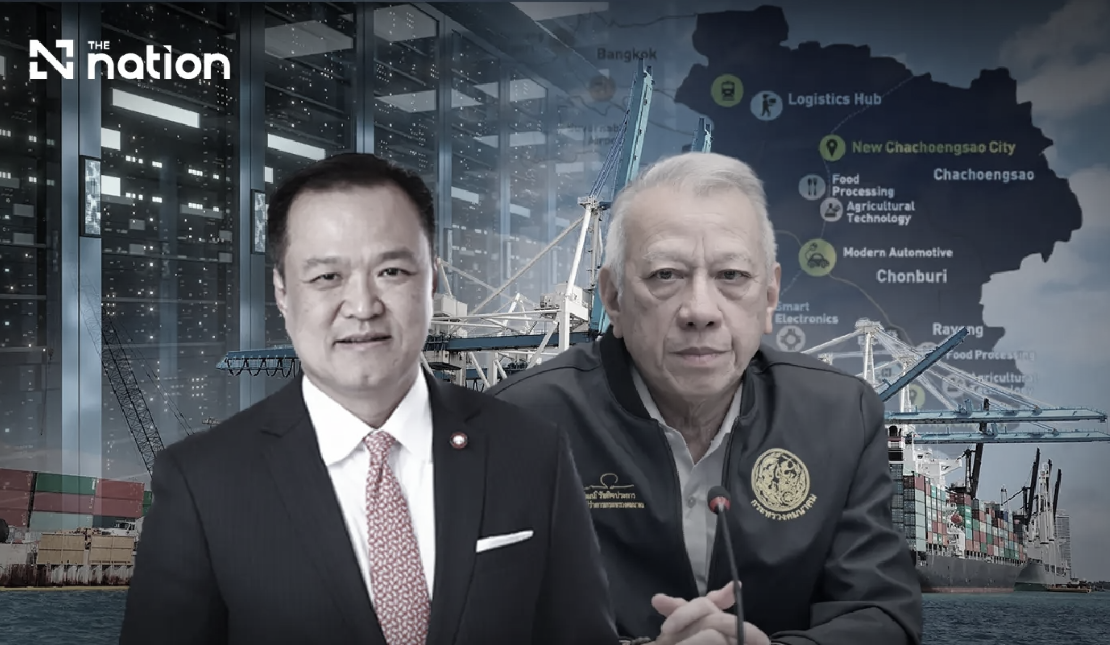
Thailand's Prime Minister Anutin Charnvirakul has reclaimed direct oversight of the Eastern Economic Corridor, signalling a fundamental repositioning of one of Southeast Asia's most ambitious regional development projects. The move, formalised through Prime Minister's Office orders signed on June 15, removes Deputy Prime Minister and Transport Minister Phiphat Ratchakitprakarn from his role as supervisor of the EEC Office and chairman of the Eastern Economic Corridor Policy Committee. Government sources characterised the administrative restructuring as a strategic decision rather than a political confrontation, though the timing and sudden nature of the shift have raised questions about underlying tensions within Thailand's coalition government.
The recentralisation of EEC authority under Anutin's direct purview represents more than a routine bureaucratic reshuffle. It reflects a deliberate effort to rebrand Thailand's eastern development platform as a premier destination for foreign direct investment by moving beyond the corridor's traditional foundation in heavy manufacturing. Rather than continuing to compete primarily on the basis of industrial infrastructure and labour costs, the government now plans to present the EEC to international investors through a fundamentally different lens, one that emphasises emerging sectors aligned with global economic priorities.
Food security has emerged as the flagship element of this recalibrated investment strategy. Thailand's eastern region possesses considerable agricultural and aquaculture assets, including established livestock production networks, fisheries operations, and horticultural capabilities that remain largely underutilised as foreign investment drawcards. Government planners have identified a significant international appetite for secure supply chains in agricultural commodities, particularly among developed economies concerned about supply chain resilience following recent global disruptions. By positioning the EEC as a platform for food security investment, Thailand aims to attract capital from multinational agribusiness corporations, logistics operators, and food processing enterprises seeking to establish regional production and distribution hubs.
The data centre initiative represents an equally significant reorientation. Thailand currently lacks a dedicated regulatory framework and infrastructure provision specifically designed for hyperscale data centre operations, creating both an opportunity and a challenge. The Energy Ministry is developing a new electricity user category, designated Type 9, which would accommodate data centres' exceptionally high power consumption through a tiered tariff structure. This regulatory innovation reflects official recognition that data centre investment could generate substantial economic value whilst addressing chronic infrastructure deficits. However, the sector's demanding requirements for uninterrupted power supply, substantial water resources, and robust telecommunications connectivity pose formidable coordination challenges across multiple government agencies.
Infrastructural constraints provide the underlying rationale for this strategic pivot. Government assessments have concluded that the eastern region can no longer sustain significant expansion of traditional heavy industrial operations due to acute limitations in electricity and water supply. These utilities carry considerable procurement costs, making the eastern corridor less competitive for conventional manufacturing compared to other locations within Thailand and across Southeast Asia. The shift towards food security and data centres reflects pragmatic acknowledgement of these physical constraints whilst positioning the corridor to capture investment opportunities in sectors where Thailand possesses genuine comparative advantages or where infrastructure demands can be more efficiently managed.
The administrative transition places Anutin in the position of principal salesman for Thailand's investment narrative abroad. This personalisation of the EEC portfolio suggests the Prime Minister intends to leverage his international profile and diplomatic connections to attract marquee foreign investors directly. By positioning himself as head of the "team selling Thailand projects" to international capital, Anutin signals high-level government commitment to the EEC's revitalisation whilst potentially expanding his control over a significant economic and political asset. The move also allows him to shape the corridor's development trajectory according to his own priorities and vision.
Official denials notwithstanding, the reshuffle occurred amid notable friction between the EEC Office and the Board of Investment. Government sources attributed the transfer of authority to Phiphat's reported dissatisfaction with persistent jurisdictional conflicts between these two bodies. The explanation suggests that Phiphat, rather than driving the restructuring, may have welcomed its relief from managing a situation characterised by institutional rivalry and unclear delineation of responsibilities. Phiphat's public statement that he received no advance notification of the Cabinet orders indicates potential surprise at the timing and manner of the announcement, even if he tacitly supported the underlying administrative logic.
The reshuffle's relationship to other contentious infrastructure projects remains contested. Government sources explicitly denied any connection between the EEC restructuring and Phiphat's opposition to amending the high-speed rail contract linking Don Mueang, Suvarnabhumi, and U-Tapao airports. Phiphat had resisted proposals to shift from the original payment model, wherein the private operator completes construction before receiving state compensation, towards a "build-and-pay" arrangement indexed to construction progress. Anutin himself reportedly endorsed Phiphat's position, stating he would not assume the risk of renegotiating the Asia Era One concession agreement. Nevertheless, the coincidental timing of the EEC transfer and ongoing high-speed rail negotiations invites speculation about whether Anutin sought to consolidate control over the broader eastern development agenda.
Questions regarding the proposed Disneyland development within the EEC zone further illustrate evolving government priorities. Anutin reportedly questioned Phiphat about the project's feasibility and timeline, noting the absence of detailed return-on-investment analyses. This line of inquiry suggests the Prime Minister intends to apply more rigorous financial scrutiny to EEC initiatives and may deprioritise ventures viewed as speculative or insufficiently grounded in empirical analysis. The implicit criticism of the Disneyland proposal signals a shift towards projects promising more demonstrable economic returns within defined timeframes.
For Malaysian and Southeast Asian observers, the Thai restructuring carries several significant implications. Thailand's repositioning of the EEC towards food security and data centres could intensify regional competition for foreign investment in both sectors. Malaysia's own economic corridor initiatives and data centre capabilities may face enhanced competitive pressure. Conversely, if the Thai government successfully markets the EEC as a food security hub, it could catalyse broader Southeast Asian interest in agricultural investment platforms, creating opportunities for cross-border supply chain integration and regional cooperation. The administrative centralisation of authority under Anutin also reflects a pattern common across Southeast Asia wherein prime ministers increasingly concentrate economic portfolio management, potentially enabling faster decision-making but risking reduced institutional checks and bureaucratic accountability.
The EEC's strategic evolution from heavy industrial base to diversified platform anchored in food security and data centre investment represents a pragmatic response to infrastructure constraints and shifting global economic priorities. Whether this repositioning succeeds in attracting the targeted foreign investment depends heavily upon implementation effectiveness, regulatory clarity surrounding data centres, and sustained political commitment to the initiative's long-term development. Anutin's assumption of direct control positions him as the principal champion of the EEC's revitalisation, making its success or failure increasingly linked to his political fortunes within Thailand's fractious coalition government.