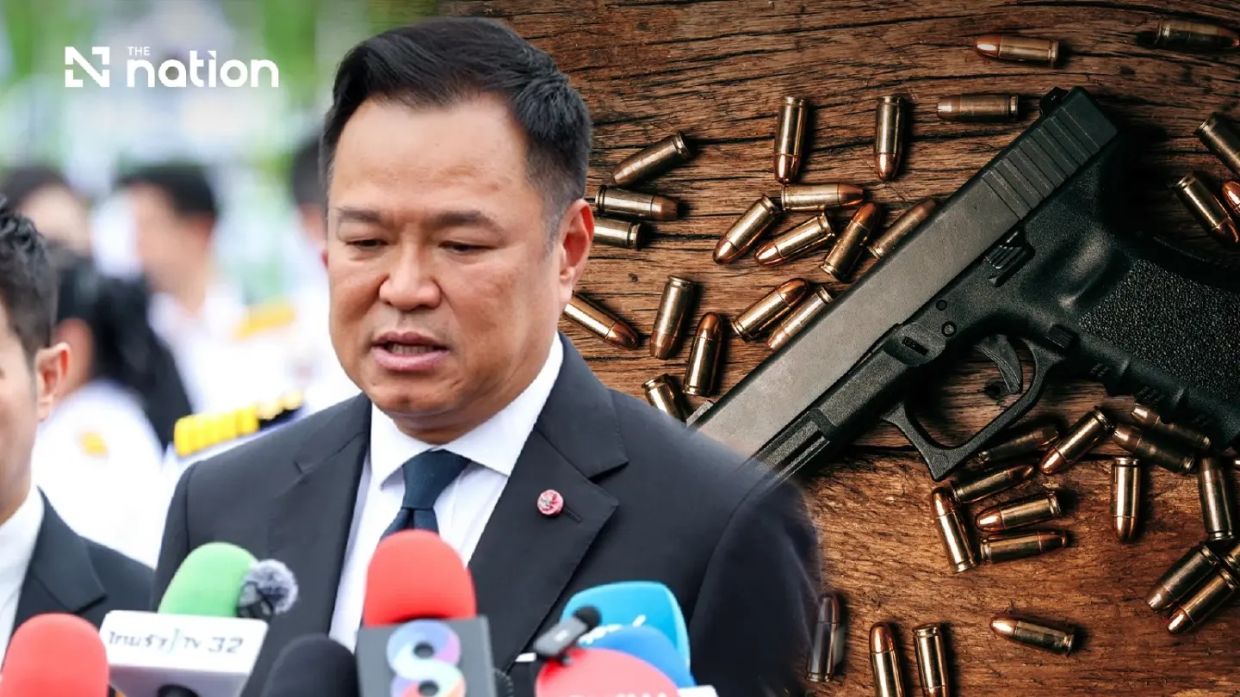
Thailand's Prime Minister Anutin Charnvirakul has committed to tightening the nation's firearms regulations following a mass shooting incident at Debsirin Nonthaburi School, pledging to work with law enforcement and government officials to implement comprehensive legislative changes aimed at preventing similar tragedies. After visiting the school shooting scene and meeting with national police chief Pol Gen Kittharath Punpetch at Government House, Anutin outlined an ambitious crackdown on illegal weapons circulation, signalling that gun control will become a centerpiece of his administration's public safety agenda.
The prime minister's proposed approach centres on establishing more rigorous checkpoint operations and systematic inspections across public spaces, vehicles, and private areas to intercept unauthorised firearms before they can be used in violent crimes. Anutin made clear that individuals carrying weapons outside their homes without legitimate professional duties face severe legal consequences, framing the enforcement strategy as non-negotiable. This enforcement philosophy reflects growing international concern about civilian access to firearms in Southeast Asia, where sporadic but deadly mass shootings have prompted policymakers to reconsider permissive weapons laws that have historically characterised the region.
In a significant policy stance, Anutin rejected calls from some quarters to distribute firearms to teachers as a self-defence mechanism, arguing that educators lack the training and legal authority of sworn law enforcement personnel. This position reflects broader global trends favouring stricter separation between civilian and armed security roles, particularly within school environments where weapons presence may escalate rather than defuse volatile situations. The prime minister's stance places Thailand on a different trajectory than some other nations that have considered arming school staff as a response to mass shooting incidents.
Anutin has revived discussion of an amnesty programme allowing citizens to voluntarily surrender illegal or otherwise unauthorised weapons to state authorities without facing criminal penalties. However, he simultaneously maintained that weapons cannot transition from illegal to legal status through mere registration, underscoring the government's hardline position that unauthorised firearms must be eliminated from circulation entirely. This dual approach—offering amnesty pathways while refusing legitimisation of black-market weapons—attempts to balance incentives for voluntary compliance with absolute standards regarding firearm legality.
The government's enforcement framework requires that surrendered weapons be handed to the Department of Provincial Administration, district offices, or police stations where official documentation is created and the arms are removed from public circulation. This bureaucratic apparatus aims to create comprehensive records of illegal weapons and prevent their reintroduction into networks supplying unlawful actors. By centralising the surrender process, authorities can track patterns of illegal firearms distribution and identify potential trafficking routes that may be supplying weapons to criminals and disturbed individuals.
Anutin characterised the broader security challenge as extending beyond single-agency responsibility, indicating that police departments and multiple authorised bodies have received policy directives to conduct thorough weapons inspections across jurisdictions. This multi-institutional approach acknowledges that firearms control requires coordinated efforts across various government agencies rather than concentrated enforcement by a single department. The strategy reflects international best practices where successful gun control initiatives involve systematic coordination between local police, customs authorities, and administrative bodies.
Regarding secure storage requirements, the prime minister mandated that firearms kept in residences must be properly registered with authorities, physically secured in ways preventing children's access, and stored according to government-specified safety standards. These provisions address a documented vulnerability in many Southeast Asian countries where household firearms are frequently accessible to minors and other unauthorised users. By establishing clear storage liability, the government aims to hold both registered owners and anyone using a weapon in criminal activity equally accountable, creating powerful disincentives against casual storage practices.
Anutin notably deflected public speculation about the shooter's possible experience with bullying, urging citizens to refrain from prematurely concluding that harassment motivated the attack before police investigations conclude. This approach seeks to prevent copycat incidents that might be inspired by media narratives linking bullying to mass violence, while allowing investigators to establish verified facts without public interference. The prime minister's caution reflects awareness that media coverage and social discussion of school shooting incidents can inadvertently encourage similar attacks by individuals seeking notoriety or motivated by perceived grievances.
For Malaysia and the wider Southeast Asian region, Thailand's move toward stricter gun control carries significant implications as neighbouring countries grapple with similar security concerns. The region's porous borders and cross-national trafficking networks mean that weapons control measures in one nation affect neighbours' security landscapes. Thailand's emphasis on checkpoints, registration requirements, and enforcement mechanisms provides a potential model for other ASEAN countries considering legislative responses to firearms violence, while the rejection of armed teacher programmes may influence regional policy discussions about school security strategies.
The shooting incident has exposed vulnerabilities in Thailand's existing firearms oversight mechanisms and prompted systematic reconsideration of regulations that may have enabled the attack. Anutin's commitment to legislative amendment signals that Thailand recognises incremental adjustments to existing frameworks as insufficient, necessitating structural reforms to registration systems, enforcement capacity, and storage requirements. As the government moves forward with these changes, success will depend on sustained political will to maintain enforcement rigour and adequate resource allocation to police and administrative agencies responsible for implementation across Thailand's diverse provinces and districts.

