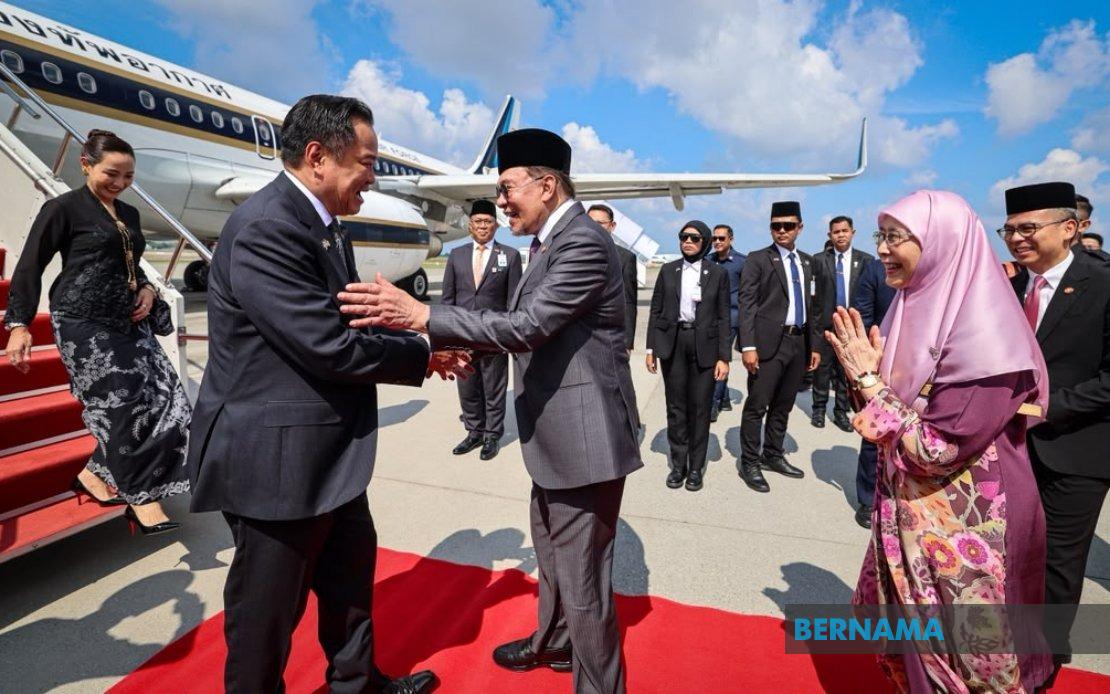
Thailand's Prime Minister Anutin Charnvirakul touched down at Kuala Lumpur International Airport this morning to begin a two-day official visit that underscores the enduring importance of Malaysia-Thailand relations within Southeast Asia. Arriving at the Bunga Raya Complex at 11.11 am alongside his spouse Thananon Charnvirakul, the Thai leader was received by Prime Minister Datuk Seri Anwar Ibrahim in a formal welcome that reflected the significance of the bilateral engagement. The visit marks Anutin's first trip to Malaysia since his reappointment as Prime Minister in March 2026, arriving at a moment when both nations are navigating shifting regional dynamics and deepening economic integration.
The ceremonial reception extended beyond the airport greeting. Anutin was accorded a full official welcome featuring a 34-member guard of honour from the First Battalion of the Royal Ranger Regiment, with national anthems played for both countries. Also in attendance were Prime Minister Anwar's wife Datuk Seri Dr Wan Azizah Wan Ismail and Communications Minister Datuk Fahmi Fadzil, who served as the receiving minister. The formal nature of these proceedings reflects how Malaysian and Thai governments continue to prioritise high-level diplomatic engagement despite the complexities of regional geopolitics.
The substantive work of the visit centres on a bilateral meeting scheduled at Perdana Putra, where Anwar and Anutin will review the trajectory of Malaysia-Thailand relations and chart directions for enhanced cooperation. A notable highlight involves the signing of a memorandum of understanding focused on agricultural collaboration, an area where both countries see significant mutual benefit. Thailand's agricultural prowess and Malaysia's developed agribusiness sector create natural complementarities, and formalising this framework could accelerate joint ventures in crop production, technology transfer, and market access—particularly relevant as both nations seek food security and rural development.
Beyond the capital, the two leaders will venture to Bukit Kayu Hitam in Kedah on July 10 to officiate the opening of a crucial cross-border infrastructure project. A new road link will connect the Immigration, Customs, Quarantine and Security Complex in Bukit Kayu Hitam with Thailand's corresponding Customs, Immigration and Quarantine Complex in Sadao. This infrastructure development carries substantial practical significance for bilateral trade and people-to-people movement, reducing transit times and improving customs efficiency along one of Southeast Asia's busiest land borders. For Malaysian businesses and citizens, especially those in the northern states, improved border crossing facilities represent tangible benefits that facilitate commerce and travel.
The economic dimension of this visit cannot be overstated. Thailand ranked as Malaysia's sixth-largest global trading partner in 2025, and more significantly, the second-largest among ASEAN member states. The bilateral trade volume reached RM118.57 billion that year, demonstrating the depth of commercial integration between the two economies. The first quarter of 2026 shows robust momentum, with trade climbing to RM31.33 billion compared to RM27.35 billion during the same period in 2025—a notable increase that suggests strengthening demand and expanding cross-border investment.
This upward trade trajectory reflects several underlying factors worth examining. Manufacturing networks increasingly span both countries, with Thai producers sourcing inputs from Malaysia and Malaysian companies utilising Thai production capabilities. The automotive sector, petrochemicals, and electronics represent significant areas of bilateral trade. Additionally, tourism flows reciprocally support service sectors in both nations, while financial services and professional expertise move across the border regularly. The infrastructure improvements being formalised during this visit should further facilitate these existing flows.
For Malaysian readers, the implications extend across multiple sectors. Northern border states like Kedah, Perlis, and Kelantan stand to benefit substantially from improved cross-border infrastructure and closer bilateral cooperation. Malaysian companies operating in Thailand or importing Thai goods will experience smoother logistics. Conversely, Thai investors in Malaysia will find enhanced regulatory frameworks and clearer cooperation pathways. Agricultural producers in both countries may unlock new market opportunities through the agricultural MoU.
Within the broader ASEAN context, Malaysia-Thailand cooperation carries weight. The two countries, alongside Singapore and Brunei, form the more developed economies of the bloc. Their partnership on infrastructure, trade facilitation, and regulatory harmonisation sets examples for other ASEAN members. Enhanced Malaysia-Thailand collaboration also supports regional stability and provides counterbalance to shifting great power dynamics in Asia, offering a model of voluntary, mutually beneficial cooperation among neighbours.
Anwar's approach to this visit reflects his administration's strategic pivot toward regional engagement and economic cooperation. Since assuming office, Anwar has emphasised pragmatic diplomacy that prioritises economic benefits and practical outcomes. This visit, with its focus on tangible deliverables—infrastructure projects, trade growth, and sectoral cooperation—aligns with that philosophy. The hosting of formal lunches and bilateral meetings demonstrates Malaysia's commitment to treating Thailand as a priority partner rather than taking the relationship for granted.
The timing also warrants consideration. Regional attention has increasingly focused on great power competition and intra-ASEAN tensions. A high-profile visit centred on straightforward bilateral cooperation and mutual benefit provides a refreshing emphasis on functional, results-oriented engagement. For Malaysian observers concerned about whether regional cooperation remains viable amid broader geopolitical turbulence, this visit offers reassurance that traditional bilateral partnerships continue to deliver value and remain central to Southeast Asian statecraft.
Looking forward, observers should watch for substantive outcomes beyond ceremonial gestures. The agricultural MoU will be judged by how effectively it translates into joint projects and market access. The border infrastructure opening must demonstrate real improvements in crossing efficiency. Trade numbers in coming quarters will indicate whether the first-quarter 2026 growth represents a sustained trend or a temporary spike. These concrete measures ultimately matter more than the diplomatic symbolism, though that symbolism matters too.

