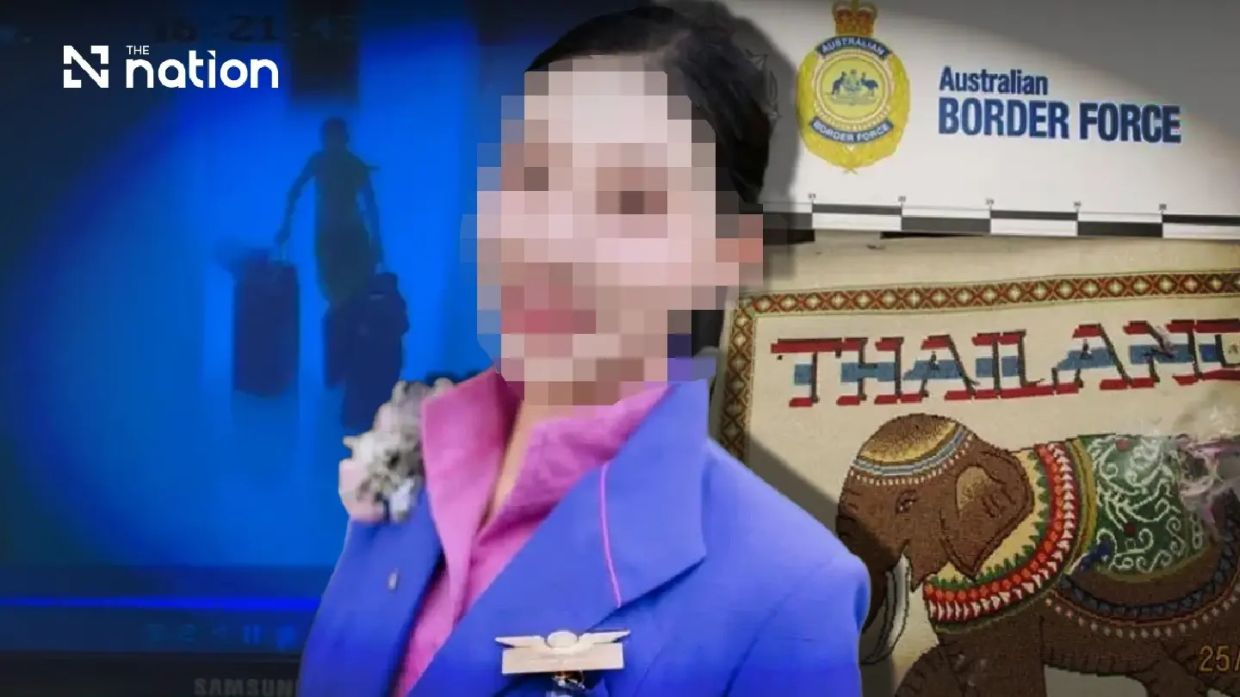
Thai and Australian authorities are intensifying their investigation into a sprawling international narcotics operation following the detention of a Thai flight attendant at Melbourne Airport, who was found carrying 900 grammes of heroin. The case has unveiled a sophisticated smuggling network that extends across Southeast Asia and beyond, employing social engineering tactics to recruit unwitting couriers among workers who travel frequently. The Office of the Narcotics Control Board (ONCB) has characterised the woman as a detainee rather than an accused person, suggesting investigators are examining whether she may have been manipulated into participating in the scheme without full knowledge of its criminal nature.
The inquiry has expanded dramatically across multiple jurisdictions, with Thai authorities collaborating with Australian police and sharing evidence to support the flight attendant's legal defence. The Department of Special Investigation (DSI) has assumed primary responsibility for the Bangkok component of the case, which encompasses three to four related arrests that culminated in the seizure of more than 26 kilogrammes of heroin. This division of labour reflects the scale and transnational character of the operation, which officials believe represents a large criminal enterprise rather than an isolated smuggling attempt. The coordinated response demonstrates how modern drug trafficking transcends national boundaries, requiring sophisticated inter-agency cooperation to unravel the networks involved.
According to Areepak Ngernbamroong, the ONCB's deputy secretary-general, the smuggling network operates through a deliberate recruitment strategy that targets flight attendants and frequent international travellers. Perpetrators create fake social media profiles and send mass messages offering lucrative payments in exchange for transporting parcels across borders. The scheme's appeal lies in its simplicity and apparent legitimacy—targets are typically presented with straightforward logistics and promised compensation, creating psychological distance from any perception of illegality. This represents a calculated exploitation of economic vulnerability and occupational convenience, transforming ordinary workers into unwitting participants in major drug operations. The tactic has proven remarkably effective, suggesting that many individuals worldwide may have fallen victim to similar recruitment approaches.
Investigators have uncovered evidence that the network extends into Australia, where a Thai national known as Dear has operated as the receiver of smuggled narcotics for an extended period. Dear has reportedly lived in Australia for approximately ten years, though authorities remain uncertain about their immigration status or citizenship. The AFP has confirmed that Dear received parcels through similar schemes multiple times previously, indicating a pattern of organised activity rather than spontaneous criminal behaviour. This recurring role suggests Dear functions as a critical node in the distribution network, handling product reception and presumably coordinating onward delivery to ultimate customers. The investigation has revealed that the Australian segment of the operation is likely substantial and includes non-Thai nationals, pointing to a genuinely multinational criminal enterprise.
The flight attendant's account of events provides insight into how the smuggling operation functions at the point of transfer. She reportedly received a delivery of parcels containing elephant-pattern bags from a rider who claimed this was their first delivery to her, contradicting the rider's later admission of conducting similar deliveries three to four times previously for other recipients. The bags were examined and found empty before being packed into her luggage, and her suitcase passed through X-ray screening on the Thai side without detection. This suggests the heroin was secreted into the bags after the initial inspection, occurring during a critical window between the rider's departure and the flight attendant's baggage screening. The sophisticated timing and coordination required to execute this sleight-of-hand manoeuvre indicates operational planning rather than ad-hoc improvisation.
The payment structure associated with the scheme remains partially unclear, complicating assessments of the flight attendant's culpability and knowledge. Australian police identified a payment of approximately 8,800 baht (US$264) on a mobile phone, though Thai investigators have discovered conflicting information suggesting two separate transfers of 1,700 baht each. The first transfer allegedly occurred upon receipt of the goods, while the second came after the flight ticket was obtained, totalling 3,400 baht. Bank records for the flight attendant have not revealed these transactions, and the account balance remained modest, preventing authorities from confirming whether the payment information is accurate. This ambiguity surrounding financial incentives complicates the prosecution's narrative and could support arguments that she was deceived regarding the scheme's true nature.
The Golden Triangle, the mountainous region where Thailand, Laos, and Myanmar converge, remains a significant source of illicit narcotics despite decades of international interdiction efforts. Historically, traffickers moved drugs southward through northern Thailand, but intensified enforcement operations have gradually redirected smuggling routes toward the north-eastern frontier, which borders Laos. The region encompassing Nakhon Phanom, Bueng Kan, Loei, and Nong Khai has become increasingly problematic for drug enforcement, as the Mekong River that forms the international boundary is narrow in these areas while the overall border remains lengthy and difficult to monitor comprehensively. The geography itself poses enforcement challenges, enabling traffickers to exploit gaps in surveillance and move narcotics into Thai territory with relative ease. This geographical vulnerability reflects broader regional security challenges that persist despite Thailand and Laos's stated commitment to coordinated drug-control efforts.
The transit pattern through Laos into Thailand represents a strategic adaptation by trafficking networks responding to enforcement pressure. Rather than abandoning the supply chain, smugglers have simply reconfigured their routes to circumvent areas of heightened interdiction. The narcotics seized in Thai operations are typically already packaged before entering the country, having been consolidated and prepared by upstream organisations before crossing international boundaries. This pre-packaging indicates a highly structured supply chain where different criminal groups control distinct operational segments—production and packaging upstream in the Golden Triangle, transit through Laos and northern Thailand, and distribution through metropolitan areas and international courier systems. Each compartmentalisation provides operational security, ensuring that the compromise of one element does not expose the entire network.
Authorities believe the heroin recovered from the flight attendant may represent merely one operational line within a considerably larger trafficking organisation. The connection between the Bangkok arrests, the Australian receiver, and the Golden Triangle syndicates suggests an integrated criminal enterprise rather than a collection of independent actors. The involvement of Lao nationals in the Bangkok segments of the network further underscores the regional dimension of the operation, with trafficking routes and criminal collaborations spanning the Mekong River and extending into Southeast Asian capitals. The flight attendant's case, therefore, functions as a window into much more extensive criminal architecture, offering investigators opportunities to disrupt wider networks through careful evidence analysis and international cooperation.
The prosecution's case against the flight attendant remains complicated by uncertainties regarding her knowledge and intentions. The evidence that the delivery rider's statement contradicts their own subsequent account could support arguments that she was deceived about the parcels' contents, particularly given the empty bags she observed before packing. The absence of corresponding bank transactions and the modest account balance further suggest she may not have been the primary beneficiary of any payment scheme. Thai authorities have committed to forwarding comprehensive evidence to the AFP, Thai embassy, and consulate to support her legal defence, reflecting official acknowledgement that her role may have been peripheral or involuntary. This approach balances criminal investigation with humanitarian consideration, recognising that victims of human trafficking and manipulation deserve legal protection alongside accountability mechanisms. The international cooperation evident in this case demonstrates how sophisticated modern drug trafficking requires equally sophisticated law enforcement responses that transcend traditional sovereignty concerns.

