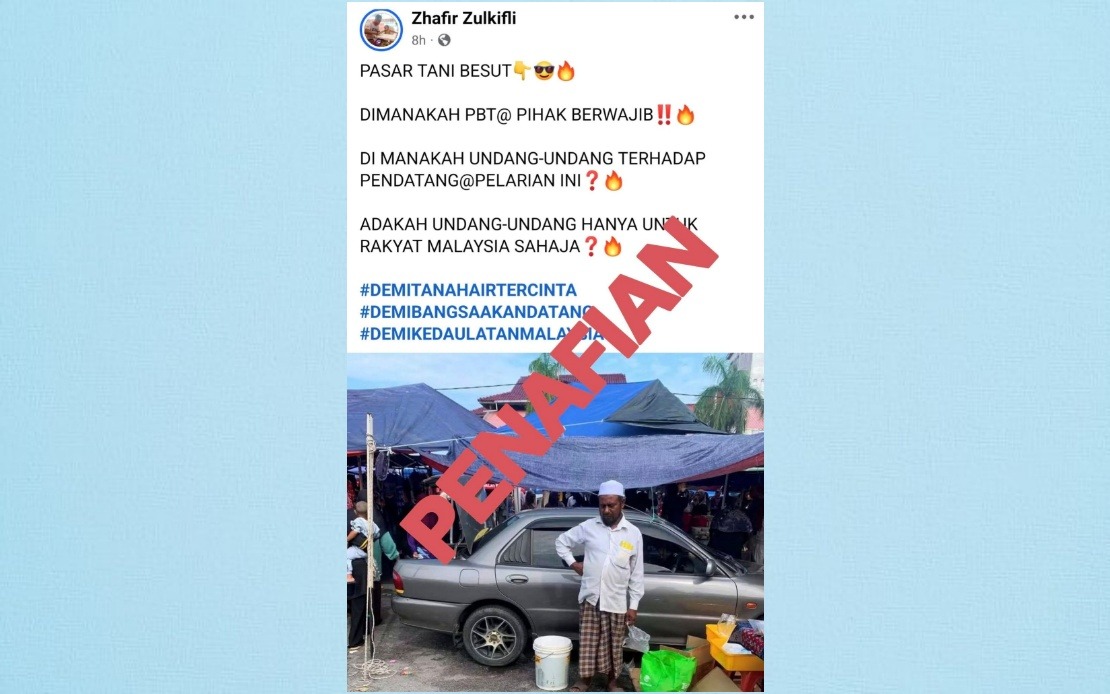
The Terengganu branch of the Federal Agricultural Marketing Authority (FAMA) has moved swiftly to address mounting public concern surrounding allegations that non-Malaysian citizens were permitted to operate as traders at farmers' markets under its jurisdiction. The clarification comes after a Facebook post circulated widely yesterday, featuring imagery of what appeared to be a foreign national vending vegetables at a morning market in Besut, prompting immediate speculation about regulatory oversight and labour standards at such venues.
In an official statement released today, FAMA made clear that the disputed transaction did not occur at any of the agency's officially managed facilities. The authority specified that within the Besut locality, only two farmers' markets operate under its direct supervision: Jerteh Farmers' Market, which convenes each Thursday between 7 am and 1 pm, and Alor Lintang Farmers' Market, operating on Saturdays during the same hours. This distinction proved critical in FAMA's rebuttal, as the incident in question involved Kuala Besut Morning Market, a separate entity operating outside the agency's management structure.
The timing of FAMA's response reflects growing sensitivity across Malaysia regarding informal market operations and the enforcement of trading regulations. Public anxiety about foreign participation in local market activities has intensified in recent years, driven partly by concerns about fair competition for Malaysian traders and partly by broader immigration control considerations. Such incidents, when amplified through social media platforms, can quickly erode public confidence in government institutions tasked with market supervision, making swift and clear communication essential for maintaining credibility.
The distinction between FAMA-managed facilities and independent morning markets underscores a persistent gap in regulatory clarity across Malaysia's distributed market infrastructure. While FAMA maintains oversight of designated farmers' markets through formal licensing and operational protocols, conventional morning markets often operate under different administrative frameworks, sometimes managed by local councils or private operators with varying degrees of regulatory scrutiny. This fragmented landscape creates opportunities for confusion among the public and challenges for enforcement of consistent standards across similar venues.
For consumers and traders alike, understanding which markets fall under which regulatory authority carries practical implications. FAMA-supervised facilities typically implement standardized hygiene protocols, product quality checks, and trader registration requirements designed to protect both purchasers and legitimate vendors. Markets operating outside this framework may lack equivalent oversight mechanisms, though they often serve important community functions and provide livelihood opportunities. The current incident highlights the importance of clearer public communication about these distinctions, particularly in an era when misinformation spreads rapidly online.
The emergence of such claims also reflects deeper anxieties within Malaysia's informal economy about job security and fair competition. Local farmers and market traders have consistently advocated for stronger protections against unfair competition, whether from larger commercial operators or informal traders operating without full compliance with regulatory requirements. These concerns carry legitimate weight, as informal market trading represents a significant income source for thousands of Malaysian households, particularly in rural and semi-rural areas like Besut.
FAMA's clarification serves as a reminder of the importance of source verification in an age of viral content. The rapid spread of the Facebook post demonstrates how quickly allegations can gain traction without proper context or fact-checking, potentially damaging the reputations of both the authority and the market operators involved. This presents an ongoing challenge for government agencies seeking to maintain public trust while addressing legitimate concerns about market operations and foreign participation in local economic activities.
Moving forward, FAMA and other regulatory bodies might consider more proactive communication strategies to prevent similar misunderstandings. Regular public briefings about trader registration processes, market management protocols, and enforcement actions could help establish clearer expectations and reduce vulnerability to misleading claims. Additionally, strengthening communication channels with market operators and community leaders could facilitate faster fact-checking and response when allegations emerge.
The Besut incident also raises broader questions about labour standards and regulatory capacity across Malaysia's extensive network of informal market venues. While FAMA's disclaimer effectively addresses the immediate claim, the underlying issue of how such markets are monitored and managed warrants ongoing attention from policymakers. Ensuring that traders—regardless of nationality—comply with basic health, safety, and licensing requirements protects consumers and supports legitimate Malaysian vendors seeking to maintain their livelihoods in competitive market environments.

